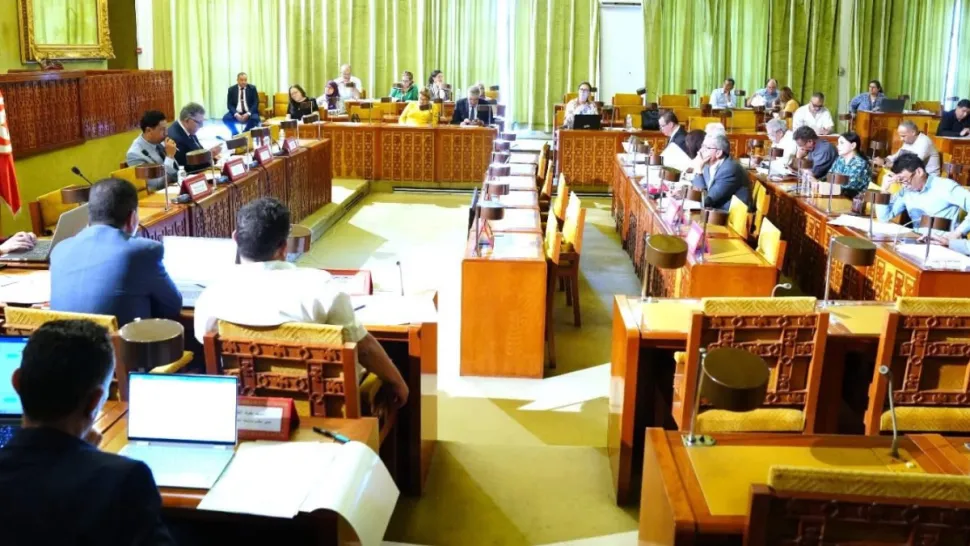

The Parliamentary Academy of the People's Assembly organized a study day on Wednesday, June 24, 2026, focusing on a proposed law aimed at amending and completing Law No. 36 of 1994 concerning literary and artistic property. The event was presided over by Ibrahim Bouderbala, President of the People's Assembly, and attended by Fawzi Dhiab, Head of the General Legislation Committee, along with Mohamed Amari, the manager of the Tunisian Rights of Authors and Neighboring Rights Organization, and various officials from the Ministry of Cultural Affairs.
In his opening remarks, President Bouderbala emphasized that the proposed amendment aims to establish a legislative framework that meets both national and international requirements. This framework is crucial for aligning with the commitments outlined in the Marrakech Treaty, which facilitates access to published works for visually impaired individuals and those with other reading disabilities. He indicated that the People's Assembly, within the constitutional powers granted to it, is committed to keeping pace with developments in the literary and intellectual domains by enhancing the legislative system to protect authors' rights and promote access to knowledge.
He expressed hope that the study day would enrich discussions and enable lawmakers to understand the various provisions of the proposed law, thereby facilitating informed decision-making during the upcoming general session dedicated to voting on the law.
For his part, the Head of the General Legislation Committee stressed that intellectual and literary property has received increasing legislative attention, as evidenced by the constitutional provisions established on July 25, 2022, and Tunisia's ratification of the Marrakech Treaty in 2016. This necessitates ongoing development of the legislative framework pertaining to intellectual property to ensure its consistency with constitutional principles and international obligations, particularly by incorporating the exceptions mandated by the treaty for the benefit of individuals with visual impairments.
He also noted that the General Legislation Committee has held several listening and discussion sessions with experts to delve into the various provisions of the proposed law and to comprehensively address its legal and technical dimensions, ensuring the preparation of a balanced legislative text that meets the demands of the current phase.
During the session, Mohamed Amari reviewed the global landscape of visual impairment, citing data from the World Health Organization, which reports that approximately 2.2 billion individuals suffer from various visual impairments, including over 330 million who are completely blind or have severe uncorrectable visual impairment. These individuals are the direct beneficiaries of the provisions of the Marrakech Treaty.
He provided an overview of the Marrakech Treaty, noting that it is the first intellectual property treaty focused primarily on the rights of beneficiaries and human rights principles. The treaty was adopted in Marrakech on June 27, 2013, and entered into international force on September 30, 2016, with its implementation in Tunisia commencing on December 5, 2016.
The treaty aims to support blind individuals and those with visual impairments and reading difficulties by allowing them access to works in accessible formats, such as Braille, digital audiobooks, enlarged print, and digital formats compatible with screen readers. Amari highlighted the positive impacts of implementing this treaty, which facilitates cross-border exchanges of works prepared in accessible formats, expands access to school textbooks and educational resources, particularly for developing countries, and contributes to promoting equal opportunities in education and employment, as well as supporting the social inclusion and economic independence of individuals with visual impairments and reading difficulties.
Regarding the proposed law, he pointed out several technical and legal observations, notably that the new Article 49 bis does not address the protection of neighboring rights, particularly the rights of performing artists and producers of sound recordings, despite their close connection to the production of audiobooks. He also noted that the definition of accessible format does not explicitly respect these rights. Moreover, he raised concerns that the proposed wording for new Article 49 ter presents legal and technical issues due to insufficient legislative safeguards, while suggesting that new Article 49 quater may lack legal and procedural effectiveness, potentially prolonging the time taken to process requests and depriving beneficiaries of timely access to educational references.
Additionally, he made other observations regarding several articles, including new Article 49 decies, indicating that stipulating an annual percentage of revenues for the encouragement and investment fund in literary and intellectual creativity raises legal issues, given that the law on literary and artistic property cannot impose binding provisions on annual financial laws, as well as the absence of specification regarding the proposed percentage or how those resources would be utilized.
During the general discussion, members of parliament raised several points, emphasizing their desire to refer to various international agreements and references while considering the proposed law amendment, rather than solely relying on the Marrakech Treaty. This approach aims to ensure a comprehensive perspective that considers all types of disabilities, not limited to those who are blind or have visual impairments.
Participants reiterated that the proposed law has undergone two essential phases: the first involved drafting a text proposed by the legislators, while the second was dedicated to listening to various stakeholders in the field, including representatives from the Ministry of Cultural Affairs and several experts, to gather their opinions and enrich the provisions of the text, thereby enhancing its quality and applicability.
Several members of parliament provided clarifications regarding the amendments included in the proposed law, affirming that their objective is to formulate a balanced and coherent legal text that protects both creators and beneficiaries alike, characterized by the flexibility necessary to ensure its effective implementation in practice.
The participants also discussed the amendment concerning Article 49 septies, which mandates authorized bodies to maintain a register subject to the oversight of the Tunisian Rights of Authors and Neighboring Rights Organization. They stressed that maintaining, documenting, cataloging, and making works available within unified national catalogs does not represent interference or overlap with the functions of the National Library but falls within the framework of organizing copyright management and protecting works to ensure their proper handling.
It was agreed to continue receiving proposals and opinions during the upcoming stages of the work, which would contribute to enriching the text, improving its provisions, and enhancing its quality to achieve the required efficiency and respond to various observations and aspirations.
In conclusion, the President of the People's Assembly underscored the significant importance of the Parliamentary Academy as a space for dialogue, training, and exchanging experiences among lawmakers and various stakeholders, including representatives of the executive branch, thereby contributing to elevating the quality of legal texts and enhancing constructive interaction among all parties involved in the legislative process.
He added that the academy represents an appropriate framework for listening to diverse opinions, proposals, and observations, cementing a participatory approach in drafting legislation and ensuring the broadest possible consensus around it.
In this context, Bouderbala clarified that the legislator is open to all observations and proposals presented during the committee's work before the final approval of the text, believing that the quality of legislation is rooted in dialogue, listening, and interaction with different viewpoints, as once the law is published in the Official Gazette of the Republic, it becomes binding for the state in all its functions and institutions, legislative, executive, and judicial, which necessitates thorough verification, precision, and providing ample opportunity for responsible discussion before its adoption in its final form, according to a statement issued by the parliament.
As reported by diwanfm.net.