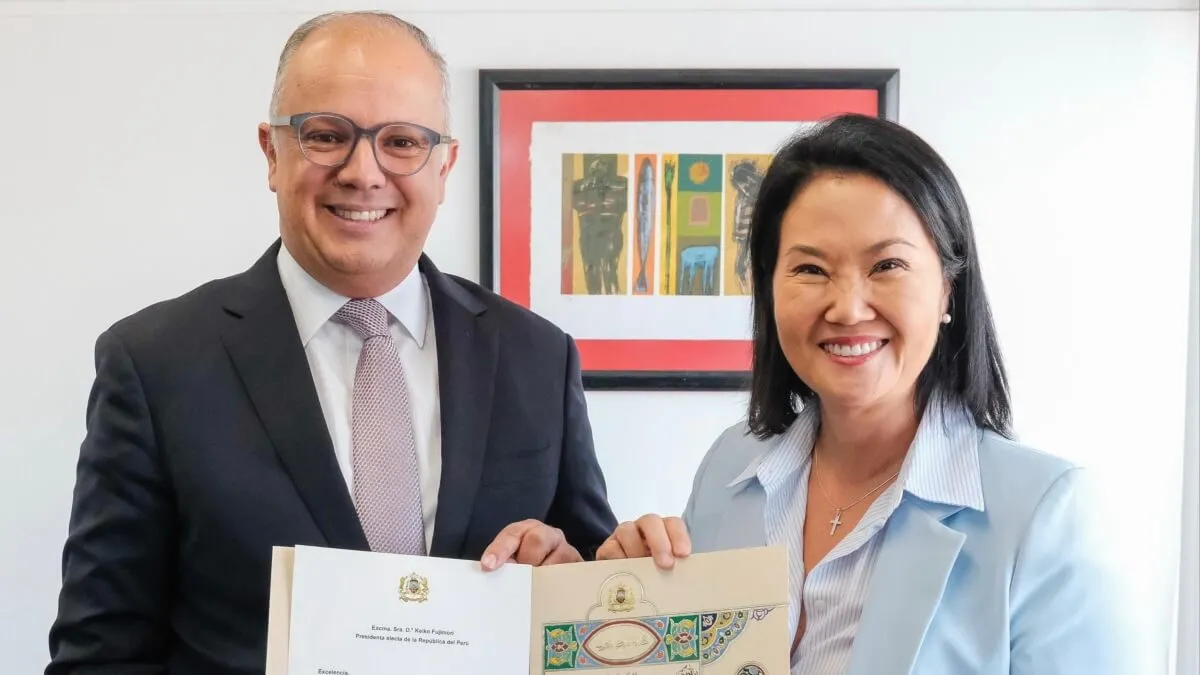
In her initial weeks as the newly elected president of Peru, Keiko Fujimori has begun to establish significant outlines for her foreign policy, particularly regarding Morocco's territorial integrity. This position gained prominence following a visit from the Moroccan ambassador to Peru, Amine Chaoudri, who delivered a letter of congratulation from King Mohamed VI to Fujimori.
Support for the Autonomy Plan for Western Sahara
According to information provided by the Office of the President-Elect, during her meeting with the Moroccan ambassador in Lima, Fujimori informed him of her government's decision to support Morocco's territorial integrity and its autonomy plan for Western Sahara. Fujimori further expressed her administration's backing of UN Security Council Resolution 2797, which recognizes Morocco's autonomy initiative as a basis for moving toward a definitive resolution of the regional dispute. In this meeting, the Moroccan ambassador presented Fujimori with a letter signed by King Mohamed VI, who congratulated her on her election, emphasizing the strong ties between Morocco and Peru, and the shared values that bolster their friendship.
Shifting Away from Previous Ambiguities
Fujimori's position represents a significant departure from the ambiguity that characterized the foreign policy of her predecessors regarding Western Sahara, many of whom exhibited support for the Polisario Front. The historical context dates back to the second term of President Fernando Beláunde Terry, whose government recognized the self-proclaimed Sahrawi Arab Democratic Republic (SADR) in 1984. His successor, Alan García, established diplomatic relations with this entity in 1987, which continued until 1996 when Alberto Fujimori, the current president's father, suspended them. For over two decades, the status quo remained unchanged through several administrations, including those of Valentín Paniagua, Alejandro Toledo, and Ollanta Humala.
During the brief presidency of Pedro Castillo from July 2021 to December 2022, diplomatic relations with the Polisario were reestablished, only to be revoked by Foreign Minister Miguel Ángel Rodríguez Mackat in August 2022, who reaffirmed respect for Morocco's territorial integrity. However, Castillo countered this decision, leading to a turbulent political climate that ultimately resulted in his ousting. His successor, Dina Boluarte, initially maintained the status quo before suspending diplomatic ties with the Polisario in September 2023, yet did not rescind the recognition granted in 1984, keeping a position of ambiguity.
Fujimori's administration marks a return to the approach taken by her father, but with greater assertiveness, as she supports both Morocco's territorial integrity and its sovereignty over Western Sahara, alongside Resolution 2797 from the UN Security Council.
The shift in Peru's foreign policy is also influenced by Morocco's proactive diplomatic efforts in Latin America, where the Polisario Front had previously maintained considerable support. Morocco's outreach has included economic, cultural, and academic cooperation, strengthening its relationships with various countries while asserting its strategic role as a gateway to Africa, Europe, and the Arab world. Consequently, several nations that had recognized the SADR have since suspended such recognition or their diplomatic relations, including Colombia, Guatemala, Paraguay, the Dominican Republic, Haiti, Jamaica, El Salvador, Guyana, Ecuador, and Panama.
As reported by atalayar.com.