
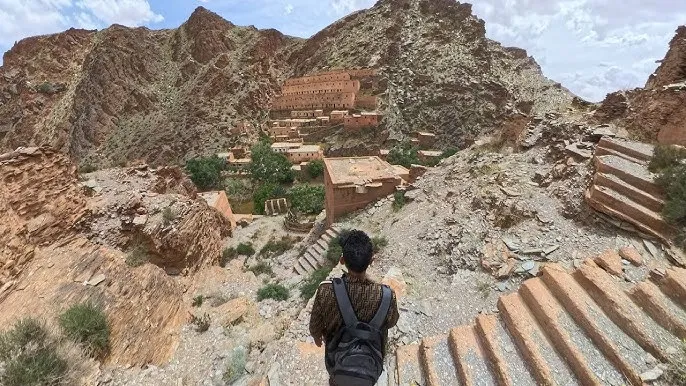

Recent reports from Moroccan scientific sources have unveiled a shocking incident involving the theft of a rare fossil site located in Mechbalad, near Midelt. This operation targeted a unique rock slab that bore footprints of pterosaurs, ancient flying reptiles that roamed the Earth during the age of dinosaurs. This event is being described as a substantial blow to both the geological heritage of the region and international scientific research.
According to scientific data published by the Spanish news agency EFE and referenced by various international research platforms, the thieves successfully seized a massive rock block measuring approximately 3.15 meters in length and 1.5 meters in width. This block contained a rare series of six pairs of footprints from these extinct creatures, marking it as one of the few findings across the African continent that simultaneously document the movement patterns of flying reptiles.
Details surrounding the theft indicate that it occurred in May of the previous year, shortly after the publication of an international scientific study involving Moroccan and Spanish researchers, including Spanish geologist Félix Pérez Lorente. The study included precise coordinates of the site, which is believed to have inadvertently aided illegal fossil hunting networks in identifying the location.
In a related context, Moroccan researchers reported that a portion of the slab had previously gone missing, and it later became apparent that the remaining part was cut using a rock saw and completely removed from the site. This suggests a highly organized operation rather than a random act of theft.
Despite the complete loss of the original fossil, researchers assert that a scientific team had previously created an accurate mold of the rock slab in 2009, along with a three-dimensional model using photogrammetry techniques. However, experts emphasize that these replicas cannot replace the original's scientific and historical value.
Mechbalad is recognized as one of the rare geological sites in Africa that preserves direct traces of prehistoric creatures, making the loss of this slab an irreparable scientific setback, as highlighted by the researchers involved in the study.
As reported by assahifa.com.

