
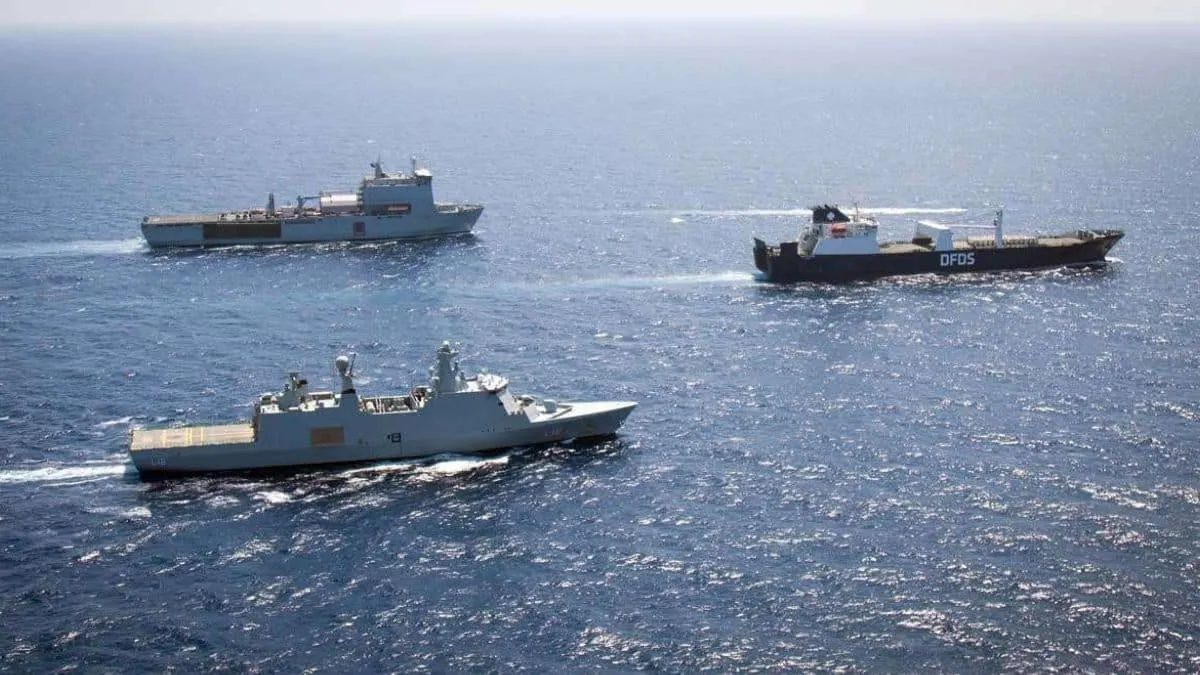
Following a prolonged period of naval decline, Morocco has embarked on a gradual modernization of its Royal Navy under the reign of King Mohammed VI. Rather than engaging in a race for heavy vessels, Rabat has prioritized a more agile fleet that is well-suited for monitoring a vast maritime domain and addressing asymmetric threats. This sovereignty doctrine relies less on displays of power and more on operational effectiveness.
The maritime history of Morocco is characterized by a temporal paradox. Despite possessing **3,500 km** of coastline, the neglect of its naval component in the late 18th and throughout the 19th centuries directly facilitated colonial expansion into national territory. "Had we invested in our seas during that time, we would be one of the world's greatest powers today," laments military consultant **Abdelhamid Harifi**.
Upon King Mohammed VI's ascension to the throne in July 1999, the Royal Navy was still suffering from glaring structural deficiencies. It was merely a modest sovereignty force centered around a single real combat unit: **the corvette Lieutenant-colonel Errahmani (501)**. The rest of the fleet consisted of four missile-launching patrol boats of the **Lazaga** type, whose real combat capabilities were already under scrutiny within the high command, along with a motley assortment of naval units: **Osprey 55** patrol boats, **PR 72s**, and **B200s** (versions of the Lazaga without heavy combat capabilities).
This stagnation was not due to negligence but rather an economic inevitability. Throughout the 1980s, several major projects fell through. **Abdelhamid Harifi** recalls the episode involving Italian missile-launching patrol boats initially built for Iraq but blocked by an embargo. Intense negotiations ensued, with the prestigious publication **Jane's Defence Weekly** prematurely announcing their transfer to Moroccan ownership, yet the contract was never signed due to a lack of funding.
Moreover, Morocco attempted to replicate the success of its corvette 501 by negotiating with the Spanish shipyard _Navantia_ for the acquisition of two **"extended" Descubierta** units. This project hinted at the Kingdom's naval ambitions, as these vessels were intended to carry helicopters. However, these ambitions were consistently sacrificed on the altar of the **structural adjustment plan (SAP)** and the colossal budgetary effort required by the war in the Sahara, which siphoned off the majority of defense resources.
It wasn't until the very end of the reign of the late Hassan II that a renewal began to take shape, with an order in 1998 from France for two Floréal-class surveillance frigates. The high command exhibited pragmatism, as these were **"civilian"** constructed units, less costly than pure warships, and primarily dedicated to state action at sea (AEM).
Delivered in 2002 under the names of **Mohammed V (611)** and **Hassan II (612)**, these frigates allowed the Royal Navy to undertake its most symbolic transformation, marking its entry into the aeronaval era with the integration of Panther helicopters. It was on this still-fragile foundation in 1999 that King Mohammed VI would build the modern navy we recognize today.
The Rise of Naval Power: The Era of FREMM and Sigma
Under the leadership of the young King, the Royal Navy has made unprecedented advancements, transitioning from a coastal surveillance force to a blue-water navy. This enhancement crystallized in the 2010s with the arrival of technological flagship units that now form the backbone of Moroccan naval defense.
Morocco made a significant move with the acquisition of the multi-mission frigate **(FREMM) Mohammed VI (701)** from France, a top-tier unit equipped with advanced anti-submarine and anti-air capabilities. This was complemented by three Dutch-designed multi-mission frigates (Sigma class), consisting of two versions: the **Tarik Ben Ziyad** (613), the flagship of the class, followed by units **Moulay Ismaïl (614)** and **Sultan Moulay Abdallah (615)**.
The effort also focused on renewing patrol capabilities with the purchase of the **OPV 72 Bir Anzarane (341)** from France, along with approximately twenty coastal patrol units acquired from France and Spain to strengthen the coast guard.
Despite this quantitative leap (rising from a single combat unit in 1999 to four top-tier units today), the assessment remains dubious. Given the vastness of Morocco's maritime domain, the country remains structurally **"under-equipped"**. With 3,500 kilometers of coastline and an exclusive economic zone (EEZ) approaching one million square kilometers, the needs are immense.
This shortfall is not due to a lack of political will but rather a rigorous budgetary arbitration. "The will is there, but the budget imposes its limits," explains Mr. Harifi. On a daily basis, the Royal Navy is not engaged in warfare scenarios but rather in an exhausting mission of "maritime policing": **protecting the EEZ against infiltrations, combating organized crime, illegal trafficking, clandestine immigration, and conducting search and rescue operations (SAR).**
Analyzing the naval forces present in the Maghreb reveals a fundamental divergence in military philosophy. While Algeria has opted for an accumulation of heavy resources, Abdelhamid Harifi believes this is more about **capability display** than a fully adjusted response to a real strategic need.
Algeria indeed possesses an impressive inventory, including the helicopter carrier **Kalaat Béni Abbès**, but the Algerian army has no tradition of projecting force outside its national waters and has never engaged in distant conflicts, while these prestigious units paradoxically remain the most vulnerable.
"Recent history, from Libya to Ukraine and Syria, shows that the naval component is always the weak link: it is the first to be annihilated, often by airstrikes at port, before it can even engage in combat," analyzes Mr. Harifi.
In summary, a heavily armed navy without comprehensive protection capabilities can prove to be a **"financial sinkhole"** with no real defensive utility against a technological power like NATO or even in a high-intensity regional conflict.
The Royal Navy: A Choice for Realism and Efficiency
In contrast to Algeria, Morocco appears to have established a strictly defensive doctrine. The aim is not military projection but the protection of vital interests and deterrence. From this perspective, acquiring overly sophisticated combat ships is not being considered.
This is where the pivot towards new-generation OPVs (Offshore Patrol Vessels) comes into play, as exemplified by the contract for the [Avante 1800 from Navantia](https://medias24.com/2026/04/27/modernisation-navale-ce-ce-que-revele-limminente-arrivee-du-patrouilleur-moulay-hassan-i-1666661/), currently in trial phase in Cadiz. This technical choice is dictated by a logic of operational efficiency:
- Tonnage leap: a modern OPV like the Avante 1800 represents nearly three times the tonnage of the older OPV 64 (which the Royal Navy colloquially referred to as "corvettes").
- Endurance: these vessels enable much longer maritime presence missions, a crucial factor for monitoring an EEZ of one million square kilometers.
- Cost rationalization: a single unit of this type can fulfill the missions of three to four classic patrol boats.
This current strategy allows Morocco to save on personnel and operational maintenance costs while ensuring continual coverage of its waters. For a country with limited budgetary resources, the priority is not to possess a naval fleet "on paper," but an agile sovereignty tool capable of daily maritime policing while constituting a credible deterrent platform through its presence and technology.
"Having a heavily armed navy would merely attract more attention without guaranteeing our defense," clarifies Mr. Harifi, who advocates for the strengthening of this fleet of heavy patrol vessels, the true backbone of Moroccan maritime realism.
The debate surrounding the acquisition of submarines by Morocco frequently resurfaces in specialized media, fueled by rumors about French (Scorpène) or South Korean (KSS-III) models. For the Royal Armed Forces (FAR), the issue is neither financial nor political but purely technical and temporal: "If Morocco were to embark on this project today, the first submarine would not be operational until 2040."
The creation of a flotilla of submarines necessitates the training of a core of experts and the construction of specific infrastructures, a process that requires two decades. Furthermore, the often-cited models are deemed "too heavy" for Morocco's needs. The challenge is not to purchase a unit in a **"one-shot"** manner for show, but to build a real capacity, which seems out of reach in the short term.
However, this lack of submarines is mitigated by the reality of the Strait of Gibraltar. Contrary to popular belief, submerged passage in international straits is heavily regulated by maritime law, which requires submarines to navigate on the surface and display their flag when exercising the right of innocent passage in territorial waters.
This constraint makes any invisible incursion by an enemy submarine fleet into the Atlantic rigorously "impossible." Given that these submarines are conventionally powered, with limited underwater endurance and a need for regular logistical support, Morocco would detect any threat long before it reaches its Atlantic shores.
The real threat shifts towards more asymmetric forms, particularly in the Mediterranean. Abdelhamid Harifi identifies two priority dangers:
- Cruise missiles: Algerian submarines, while identifiable, possess a formidable strike capability with Kalibr missiles. With a range of 300 km, they place vital infrastructures like the port of Nador West Med, and to a lesser extent Tanger Med, under potential permanent fire.
- Maritime mining: Nador West Med, due to its relative distance from the Strait of Gibraltar, is a prime target for mining operations. Thus, it is imperative for Morocco to invest in effective anti-mine units to ensure the smooth flow of maritime traffic and contribute to regional stability.
To ensure its sovereignty without getting caught in a futile arms race, Morocco must prioritize a strategy of intelligent deterrence that can revolve around three key axes:
- Coastal sanctuary: rather than new costly frigates, the development of ground-based shore-to-sea missile batteries is recommended. These coastal defense units are the only ones capable of making an adversary think twice before any attempt at an amphibious operation.
- Anti-missile shield: in light of the cruise missile threat, bolstering air defense coverage is necessary to protect northern port complexes.
- Logistics and humanitarian efforts: Harifi also suggests rethinking maritime logistics and amphibious capabilities. Citing the Algerian helicopter carrier as an example, he notes that such units, beyond their military role, are essential for managing natural disasters (earthquakes, floods) in coastal areas that are difficult to access by land.
Ultimately, the Royal Navy is emerging as a force of realism. The issue at hand is not to project military power but to secure the vital interests of the Kingdom. "Heavily investing in combat units without ground-based deterrent capabilities would be a waste of money," concludes Abdelhamid Harifi. The goal now is to avoid the strategic mistakes of past centuries by investing intelligently, far removed from technological fantasies and closely aligned with operational realities.
As reported by medias24.com.


