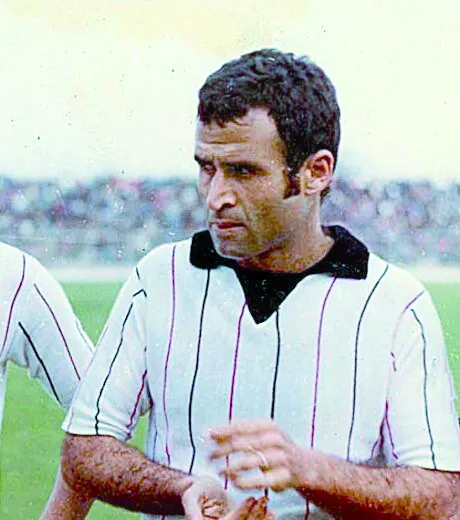

In the same season last year, the world of Moroccan football mourned the loss of Ahmed Faras, a true icon of the sport. As we commemorate the anniversary of his passing, it is essential to reflect on a figure who etched his name in the annals of Moroccan football history and to delve into the remarkable journey of the first Moroccan player to win the African Golden Ball in 1975. Ahmed Faras was not merely a player; he was a manager, coach, mentor, and educator, embodying all the qualities that make a sports figure truly great.
In the book titled "Ahmed Faras: A Life Story," penned by journalist Abdel Aziz Belboudali, the narrative goes beyond mere recollections of the past. It is a firsthand account from someone who witnessed Ahmed's life and was present during the final moments of this national sports symbol's illustrious career. The publication serves as a tribute to Faras, allowing us to reconnect with his legacy during this summer season.
Born Amidst Tragedy
Ahmed Faras was born on December 7, 1946, in a family that had chosen to migrate to the area of Fadala in the early 20th century. This migration was not an isolated event; it involved a collective movement of several families from the region of Oualidia, near Safi. At that time, Fadala, which is now known as Mohammedia, was just beginning to develop as a residential area, with its population centered around the lower city, particularly in the Kasbah neighborhood, which had fewer than 300 residents. Conversely, the Marsa area resembled an industrial zone with numerous factories owned by French or Spanish families.
Adjacent to Fadala was the highland area, characterized by farmland that stretched from Sidi Moussa Majdoub to the outskirts of the Kasbah, divided by a wall running along the railway line. Before the emergence of scattered residential neighborhoods like Derb Marrakech and Derb Rabat, areas such as the slums and "Nawail" encircled the highland, where a young boy breathed his passion for football.
In the streets of the highland neighborhood, Ahmed Faras's relationship with football blossomed. He played and chased after the ball, participating in his first matches on a dusty plot known as Qadiyya Addaban, where a mosque and a fish market now stand. Most residential areas were named after their original inhabitants or the trades they practiced, such as the neighborhoods of Chanty Allal and Chanty Si Meloudi. In the latter, Ahmed's family settled, specifically on the outskirts of the Abdah tribes in a locality called Douar Sidi Faras, known for housing families of noble lineage believed to possess blessings.
Among these families was that of Mohamed Ben Ahmed Boufaras, who moved to Fadala with his wife Aisha bint Mohamed. The head of the family worked in a pig meat factory, affectionately referred to as "the pig factory," and he was content with his work and life in the city. However, his greatest concern was the lack of children to fill their home with warmth and joy. Despite Aisha having given birth to five children previously, all of whom tragically did not survive, the family remained hopeful. Their lives changed for the better in December 1946, specifically on the seventh, when they welcomed a son, Ahmed. The family hoped for a long life for him to dispel the darkness that surrounded their previous losses.
The newborn was named after his grandfather, Ahmed, and his parents' prayers surrounded him in his travels, fearing he might share the fate of his siblings. His grandmother took him under her wing, giving him an additional name, Al-Sharif, which was believed to offer protection. This care extended beyond mere nurturing; she breastfed him herself as an elderly woman.
From that moment on, births in the family continued without the shadow of death haunting them, and Ahmed gained five siblings who all survived, living a life marked by simplicity and contentment. In the slum neighborhood of Chanty Kabaniya, located near the neighborhoods of Deur al-Qaraei and Kasbah in the lower city, Ahmed cried his first cry before his mother gave birth to five more siblings: Al-Tahir, Abdel Karim, Mohamed—who played for Ittihad Mohammedia—along with Fatna and Khadija.
Ahmed Faras recalls, "Immediately after my birth, my family moved to the highland neighborhood, specifically in Deur Labita, where I grew up, playing all the childhood games associated with running, jumping, and shooting. We were unaware that these childhood games had structured forms in the realm of sports. I was naturally gifted at shooting; rarely did I miss my target, becoming adept at breaking whatever my eyes set as a target, regardless of the distance, using stones or any other means. I was told that I excelled in shooting and focus, a talent that often got me into trouble with my father."
He reminisces about a particularly severe punishment: “One day, I remember my grandmother filled a clay water jug and left it out overnight to cool. In the morning, she forced me to put my hand inside it to freeze, punishing me for my destructive passion. I recall that punishment directed at my hand, forgetting to penalize my left foot, which seldom missed its mark as it was the one I relied on most and where my concentration lay.”
By the age of five, young Ahmed ventured into the alleyways, where he engaged in games with his peers, many of which were folk games closely resembling officially practiced sports. He adds, “I remember a game I excelled at called 'Qilini biha,' similar to the sport of petanque, where we would set a glass bottle in the dirt and then step back to throw stones at it. The winner was the one who successfully hit the target. I was particularly distinguished in focused throwing and excelled in another game called 'Dinefri,' which relied heavily on physical fitness, especially speed and agility.”
As reported by alakhbar.press.ma.