
Mohamed Hamidi, the esteemed Moroccan modernist painter, has passed away at the age of 84, as confirmed by the Barjeel Art Foundation through their Instagram page. While details regarding the cause of his death and any surviving family members remain undisclosed, the legacy he leaves behind is monumental.
Born in Casablanca in 1941, Hamidi is celebrated as one of the founding figures of Moroccan modern art. His artistic journey began at the School of Fine Arts in Casablanca, which laid the groundwork for his future endeavors. In 1959, he moved to Paris, where he expanded his artistic education and earned a teaching degree in Monumental Art from the prestigious Ecole Nationale Supérieure des Beaux-Arts de Paris in 1964.
Hamidi's return to Morocco in 1967 marked a significant period following the country's independence from French colonial rule in 1956. This era was characterized by a cultural renaissance that encompassed various forms of artistic expression, including fine art and graphic design, blending modernist concepts with the unique aspects of Moroccan heritage. Notably, in 1969, he participated in the revolutionary exhibition "Manifesto" held at the Jamaa El Fna Square in Marrakech, alongside fellow artists and educators such as Farid Belkahia, Mohamed Chabaa, and Mohamed Melehi. This exhibition was pivotal in reshaping and democratizing the educational curriculum of the Casablanca School, which had been undergoing transformative changes since 1964.
As a prominent figure in the burgeoning national avant-garde, Hamidi contributed to the Casablanca School, where he taught from 1967 to 1975. His influence helped cultivate a new generation of Moroccan artists who were engaged with social issues and forward-thinking methodologies, drawing inspiration from traditional arts to inform their contemporary practices. In 1967, he articulated a vision for art in the Third World, challenging the prevailing prejudices that viewed it merely as primitive expression. This philosophy led him to establish the Moroccan Association of Plastic Arts in 1972, which fostered connections between Moroccan artists and their Arab counterparts through collaborative meetings in cities like Baghdad, Tunis, and Algiers.
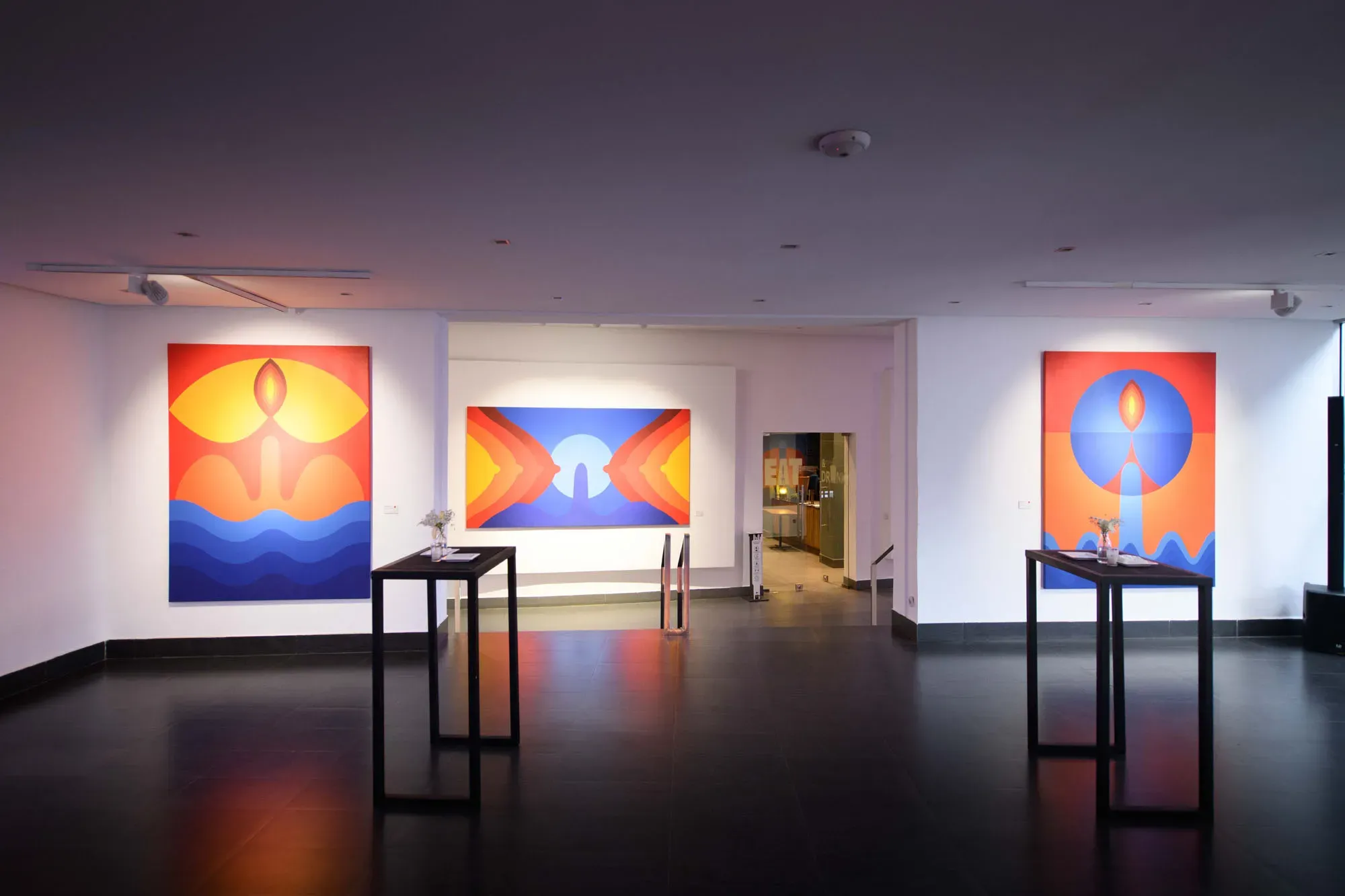
Hamidi's artistic oeuvre often centered on the human body, yet his paintings were predominantly abstract, characterized by the flowing lines reminiscent of the Casablanca School's style. His work incorporated motifs drawn from traditional Maghreb crafts and featured intersecting geometric shapes rendered in warm, solid colors, evoking a sense of eroticism without being overtly representational. In recent years, there has been a growing interest in postcolonial African and Middle Eastern art, with Hamidi's contributions gaining recognition, as evidenced by the acquisition of two of his paintings by the Centre Pompidou in 2019.
As reported by artnews.com.