Exploring the Thrills of the Sahara Gravel Stage Race
The Sahara Gravel Stage Race in Morocco is an exhilarating challenge that combines pure gravel terrain, arid desert landscapes, and the towering Atlas Mountains. Over the course of four days, participants navigate through dust and grit, making it a true test of endurance and spirit. As the event sold out within minutes, I reflect on this extreme desert adventure and what it means for riders like me. The thought of tackling 445 kilometers with more than 4,500 meters of elevation gain, predominantly on gravel, alongside an international field of elite professionals and passionate amateurs, sparked a mix of excitement, respect, and a tinge of doubt within me.
“This is going to be a once-in-a-lifetime experience,” I tell my teammate Anja after paying the steep registration fee for my first multi-day race in the autumn of 2025. While I envision dusty trails, boundless horizons, and camels lazily traversing the terrain, I also wonder if I can keep pace with the challenges ahead. Our journey began with a flight to Marrakech in February, but soon enough, an unexpected twist occurred when Anja chose to leave our original team, Female Cycling Force, to ride with another group called Radfritzen. Faced with the decision to ride solo or adapt, we quickly rebranded our team as Radfritzen × Female Cycling Force, ensuring we could tackle this challenge together.
The Journey Begins in Marrakech
Upon arriving in Marrakech, the sensory overload is immediate. From the airport, the taxi driver nonchalantly hoists my bike box onto the roof and speeds off as if it were the most normal occurrence. I sit in the back, watching my bike sway precariously above me. The hotel experience is a whirlwind of vibrant spices, warm dust in the air, honking cars, and the bustling chaos of cats, dogs, and even donkeys coexisting in the traffic. This cacophony is alive with energy, and it makes me feel right at home.
The Sahara Gravel Stage Race spans four days in southern Morocco's Ouarzazate province, featuring a remarkable 445 kilometers and 4,500 meters of climbing, with 90% of the course comprising gravel and off-road terrain. In 2026, 137 riders from 31 nations participated, ranging from seasoned professionals to enthusiastic amateurs. The allure of this event lies not just in the competition but also in the breathtaking desert and Atlas Mountain landscapes. With the organization providing accommodation, meals, and luggage transport for an entry fee of 1,600 euros, it’s no surprise that the event sold out in mere minutes. The next race is scheduled for March 2-5, 2027, with further details available at www.epicos.cc.
Choosing to forgo the shuttle like most participants, Anja and I decide to bike the 250 kilometers to Ouarzazate, climbing 3,500 meters along the way. Coming from Munich's winter, with snow and frigid temperatures, we are immediately enveloped by the warm, dry air of Morocco that settles in our throats. The roads are dusty beneath our tires, and my body feels unprepared for the adventure ahead. The first kilometers take us out of the city, past honking mopeds and local shops, into villages where children watch us with wide eyes. The landscape shifts from dusty plains to lush fields with palm trees and water streams, only to revert to stark, rocky expanses as we journey deeper into the heart of Morocco.
The first day of the race presents a grueling challenge with 100 kilometers and 2,000 meters of elevation gain, all while hauling our gear on gravel roads. My legs feel heavy, the air becomes thin, and sweat evaporates almost instantly from my skin. Adding to the absurdity of the situation, my bike is brand new, and I have barely ridden it before this race. Trust in my bike fit is all I have as I adapt to the terrain amidst this breathtaking scenery.
We spend the night in a small village where simple earthen houses blend seamlessly with the landscape. Despite it being the off-season and Ramadan, a local guesthouse opens its doors for us, offering warm food, sweet tea, and a place to rest. The hospitality we receive, coupled with the tranquility of the surroundings, leaves a lasting impression. The next day, we climb higher into the Atlas Mountains, reaching altitudes of nearly 3,000 meters. The air becomes cooler and crisper, the scenery more rugged and expansive, each curve revealing a new breathtaking view. Finally, we arrive in Ouarzazate, the gateway to the Sahara, where the atmosphere transitions dramatically to that of a well-organized race event, complete with hotel accommodations and a final shakeout ride.
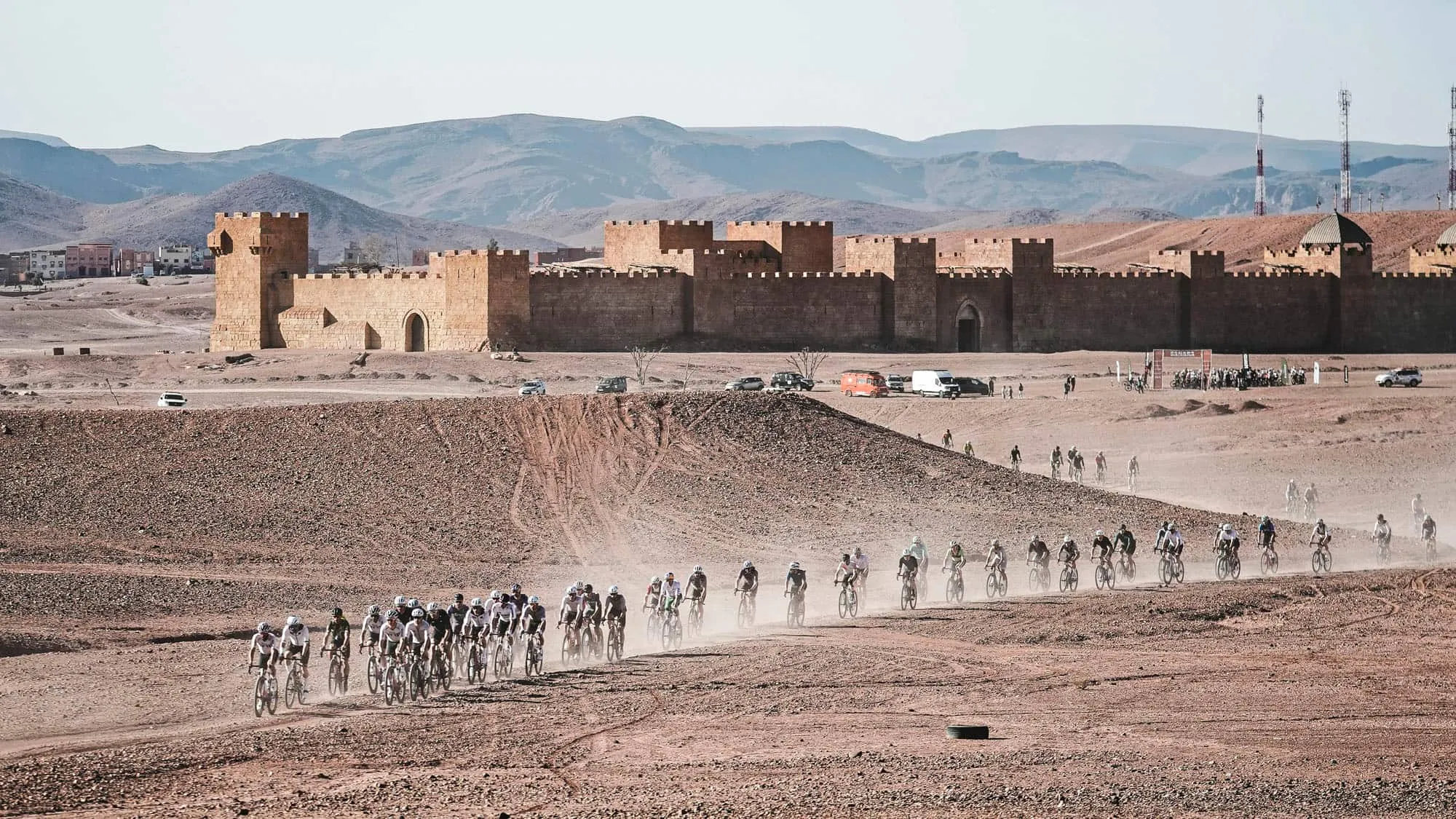
The race is conducted without luggage, with our bags waiting for us at each night’s accommodation. I need only focus on being at the start line each day, yet the nerves build as the safety briefing reveals that help can take hours to arrive in case of emergency—an unsettling reminder of our remote environment. The first stage begins outside the city at an old film set where scenes from "Gladiator" were filmed, with the snow-capped Atlas Mountains in the background and dusty trails ahead. Although Anja and I intend to take it easy during the 95-kilometer stretch with nearly 900 meters of elevation, the race quickly pulls us in, and I find myself exhilarated by the stunning landscape and even taking a moment to photograph the camels that cross our path.
Reaching the finish line in the front half of the pack, we find the elite riders already there, yet what stands out is that everyone rides their own race without time cuts or pressure. As evening falls, we share tales of the day over delicious meals, creating a camaraderie reminiscent of a school trip. The second stage takes us deeper into the Atlas Mountains, where I spend over six hours on the bike, battling uphill climbs and carefully navigating descents. Each curve unveils a new panorama, and Anja and I motivate each other effortlessly as we push past our limits.
The third stage is relatively flat at 94 kilometers and 460 meters of climbing, yet a section through a dry riverbed reminds me of the race's challenges with loose stones and deep sand. Our destination for the day is a desert camp, surrounded by nothing but sand. We sleep in traditional nomadic tents, and the experience of dining together under a starlit sky is unforgettable. By now, I have settled into the rhythm of the race: ride, rest, eat, and sleep, only to repeat the cycle.
The final stage brings wind, sand, and weary legs, culminating in the most profound experience of the race: a segment through open desert without a clear path, relying solely on GPS points and my teammate Anja for navigation. Emotions overwhelm me as I realize how deep into the desert I truly am—an exhilarating blend of anxiety, fascination, and gratitude washes over me. The final stretch is soft and deep sand, yet the spirit of the race drives us forward. As the day ends with an awards ceremony atop a sand dune overlooking the vast desert, I reflect on our achievement as the first female pair to cross the finish line, highlighting the need for more female representation in such events.
Looking back, this experience has been everything I hoped for and so much more. It truly was a once-in-a-lifetime adventure that was worth every effort, blending the thrill of competition with the relaxation of a vacation—albeit a uniquely challenging one. I discovered my capacity to ride for four consecutive days, that I can push beyond my perceived limits, and that sharing these experiences only intensifies their impact. As I reminisce, feeling the sand beneath my feet and envisioning the endless desert landscape, I ponder the possibility that this unique experience may not have to be a one-time event after all.
As reported by bike-x.de.