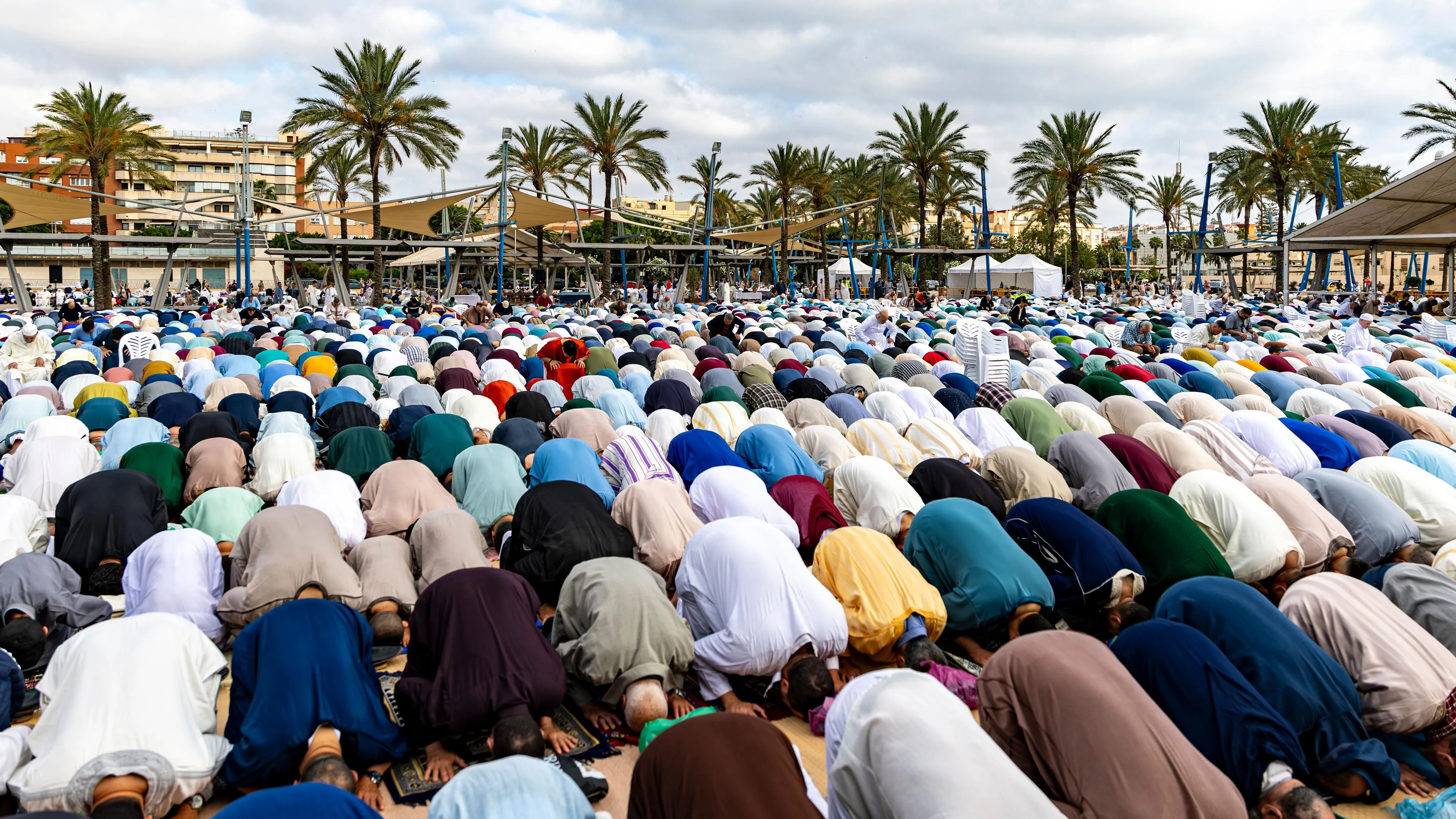

The attendance at the collective prayers for Eid al-Adha, also known as the Festival of Sacrifice, has seen a substantial decline of 57% this year in Melilla compared to the previous celebration. According to the Islamic Commission of Melilla (CIM), approximately 3,000 faithful participated in the prayers held at the multifunctional square of San Lorenzo, a stark contrast to the nearly 7,000 attendees recorded in 2025. This notable drop has raised questions about the factors influencing such a decline.
Abdeselam Hassan, the vice president of the CIM, attributes this decrease primarily to the increased number of residents from Melilla traveling to Morocco to celebrate the festival there. “This year, the practice of sacrificing animals is allowed, and this serves as a significant incentive,” he noted. The previous limitations imposed by Moroccan authorities in 2025—due to a severe drought affecting the country—had curbed the ability to perform sacrifices. With the reinstatement of this practice in Morocco, many have chosen to cross the border to partake in the traditional festivities.
In the days leading up to the celebration, the Beni Enzar border crossing again witnessed long lines of vehicles. Government delegate in Melilla, Sabrina Moh, estimated that around a thousand people crossed into Morocco on Tuesday alone. At times, the wait reached up to five hours. Moh confirmed that all available lanes remained open but acknowledged that the crossing times have been significantly extended. She also emphasized ongoing coordination with Moroccan authorities to expedite border transit, stating, "It is important to communicate so they can also facilitate the process.”
Furthermore, the Autonomous City has highlighted the spirit of coexistence that traditionally characterizes this festival in Melilla. Following the imam's sermon, the president of the Autonomous City, Juan José Imbroda, emphasized the respect that exists among the various religious communities in the city. He remarked, “The respect is mutual among all, and this is a festival for everyone, as all our religious expressions ultimately contribute to the unity of this blessed city of Melilla.”
After the collective prayers, many families engaged in the sacrificial ritual of sheep, adhering to Islamic traditions. To facilitate this significant practice, the Department of Social Policies established various temporary sacrifice points across different neighborhoods, in addition to the municipal slaughterhouse.
As reported by amp.rtve.es.