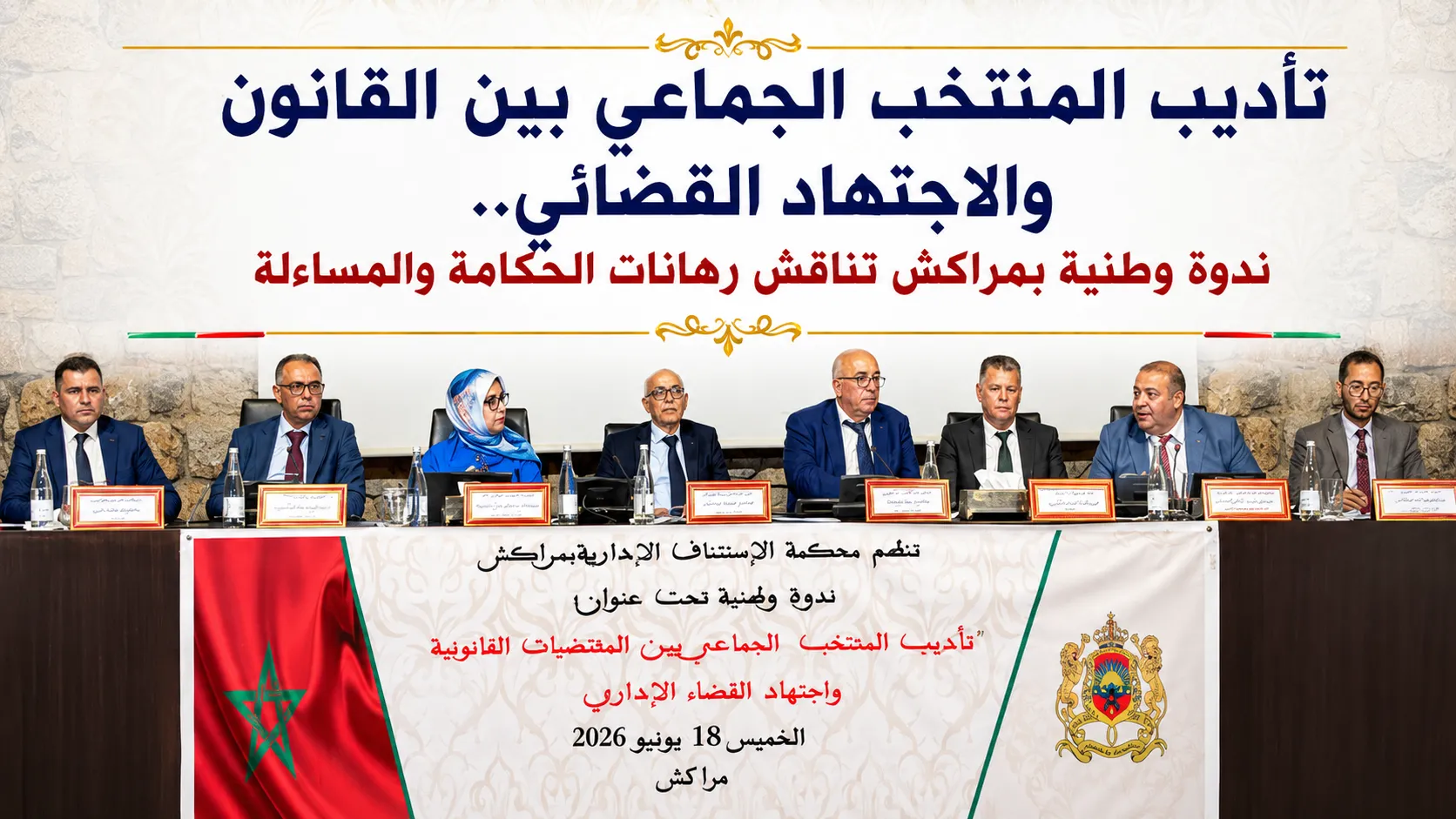

Exploring Legal Discipline in Local Governance
On June 18, 2026, the Administrative Court of Appeal in Marrakech hosted a national academic seminar titled “Disciplinary Measures for Local Elected Officials: Legal Provisions and Judicial Practices.” The event brought together judges, university professors, researchers, and experts in administrative law and local governance to engage in critical discussions regarding the enhancement of territorial governance, principles of transparency, and the accountability of elected representatives.
This seminar provided a platform for addressing various legal and practical issues surrounding the accountability of local elected officials, alongside the mechanisms of judicial and disciplinary oversight that govern local affairs. As the responsibilities of local entities continue to expand, there are significant challenges linked to the protection of public funds and ensuring effective management practices.
The Imperative of Accountability in Local Governance
During the opening remarks, Mr. Abdel Salam Naâni, the President of the Administrative Court of Appeal in Marrakech, emphasized that the Moroccan Constitution has laid a solid foundation for the autonomous management of local entities, which is a crucial aspect of advanced regionalization. He noted the establishment of a comprehensive system for legal and judicial oversight that ensures adherence to legality and enforces the principle of accountability. He articulated that the independence of elected councils should not exempt them from being held accountable when they fail to meet their legal obligations or engage in misconduct that undermines sound management principles. Moreover, he pointed out that administrative courts play a pivotal role in balancing local decision-making autonomy with the requirements of legal oversight and public interest protection.
The first scientific session delved into the financial oversight exercised by financial courts over local elected officials, as well as the distinctions between administrative management errors and actions that could be deemed criminal, such as embezzlement or misappropriation of public funds. Discussions also focused on how local officials can be held accountable for financial violations and the impact of disciplinary penalties on the quality of public administration, alongside a review of the evolution of judicial practices in disciplinary matters and the legal safeguards available to elected officials during oversight and follow-up processes.
The second session, led by Dr. Mustafa Zaher, President of the Administrative First Instance Court in Marrakech, concentrated on the themes of dismissal, deprivation of membership, and the dissolution of local councils. This was explored through an analytical reading of judicial rulings from administrative courts and the Court of Cassation. The discussions highlighted instances of dismissal arising from conflicts of interest, the conditions for deprivation of membership, the legal consequences of dismissal decisions on the electoral eligibility of officials, as well as the legal frameworks governing the dissolution of councils and the removal of their members.
Participants concluded that disciplining local elected officials is no longer merely a legal mechanism for addressing irregularities; it has evolved into a fundamental approach for embedding good governance practices and fostering citizens' trust in elected institutions. The discourse underscored that the advancement of judicial practices and the updating of the legal framework surrounding the disciplinary responsibilities of elected officials are essential for safeguarding public funds, promoting integrity in public life, and enhancing principles of transparency and accountability within local entities.
This seminar reflects the growing importance of administrative judiciary in supporting institutional reform initiatives in the Kingdom, solidifying the rule of law, and ensuring prudent management of local public affairs, in alignment with the demands for good governance and sustainable territorial development.
As reported by satv.ma.