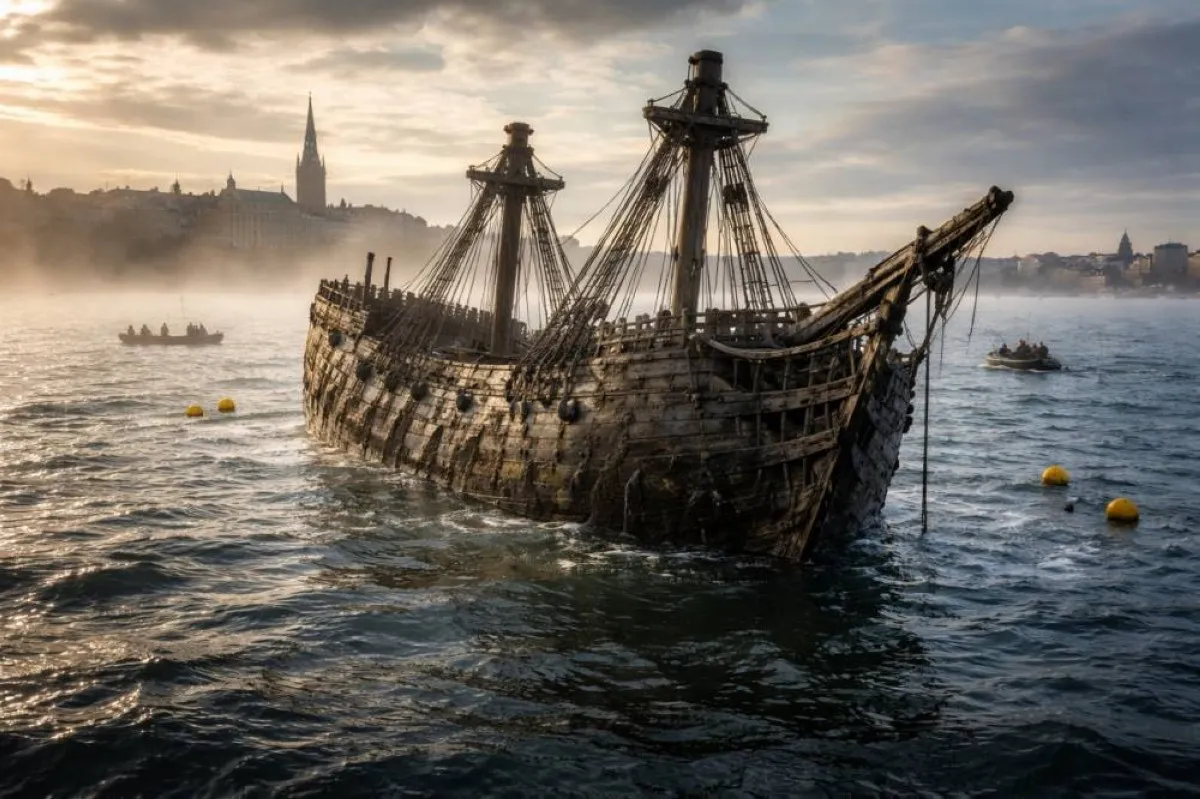

A Remarkable Discovery in the Baltic Sea
After more than four centuries submerged in the depths of the Baltic Sea near Stockholm, a Swedish naval ship has resurfaced, sparking significant interest among scientists and marine archaeology researchers. Jim Hanson, a marine archaeologist at the Vrak Museum in Stockholm, explained that the ship's emergence is attributed to the lowest water levels seen in the past century, coupled with an extended period of high atmospheric pressure in Northern Europe. These conditions have resulted in the Baltic Sea water being pushed towards the North Sea and the Atlantic Ocean.
Historical Significance and Purpose of the Ship
The identity of the ship, believed to date back to around 1640, remains unknown; however, it was intentionally sunk to serve as a foundation for the construction of a bridge to the island of Kastellholmen. Notably, there are five other sunken vessels in the same vicinity, and the Swedish Navy is currently pursuing a project named "The Lost Navy." This initiative aims to study these sunken ships and uncover their identities while repurposing the oak wood structures instead of sourcing new timber.
While it may seem implausible for a wooden ship to endure nearly four centuries in the sea, the conditions in the Baltic have played a significant role in its preservation. Hanson noted that the region is free from shipworms, marine creatures that can grow up to two meters long and utilize bacteria to digest wood, leading to the deterioration and sinking of vessels. Instead of decaying, the deep waters have assisted in maintaining the structural integrity of the ship, transforming it into a sort of "time capsule." However, raising the ship to the surface poses a risk to the wood, which has retained its cohesion due to the water within its cells, and exposure to air could lead to its decay.
The challenges of preserving the exposed wreck are reminiscent of those faced by Sweden during the recovery of the Vasa, a ship that sank in 1628. When the Vasa was raised, the wood began to suffer from the iron and metals that turned acidic upon removal from the water, resulting in damage to the wood. Researchers discovered that using alkaline earth hydroxides could neutralize the acid and halt the chemical reactions that destroy wood. Yet, maintaining the exposed sunken ships continues to pose a significant challenge, and the recently lowered water levels in the Baltic Sea may endanger the newly discovered warship.
As reported by albayan.ae.