
Sydney University Hosts Key Forum on Western Sahara
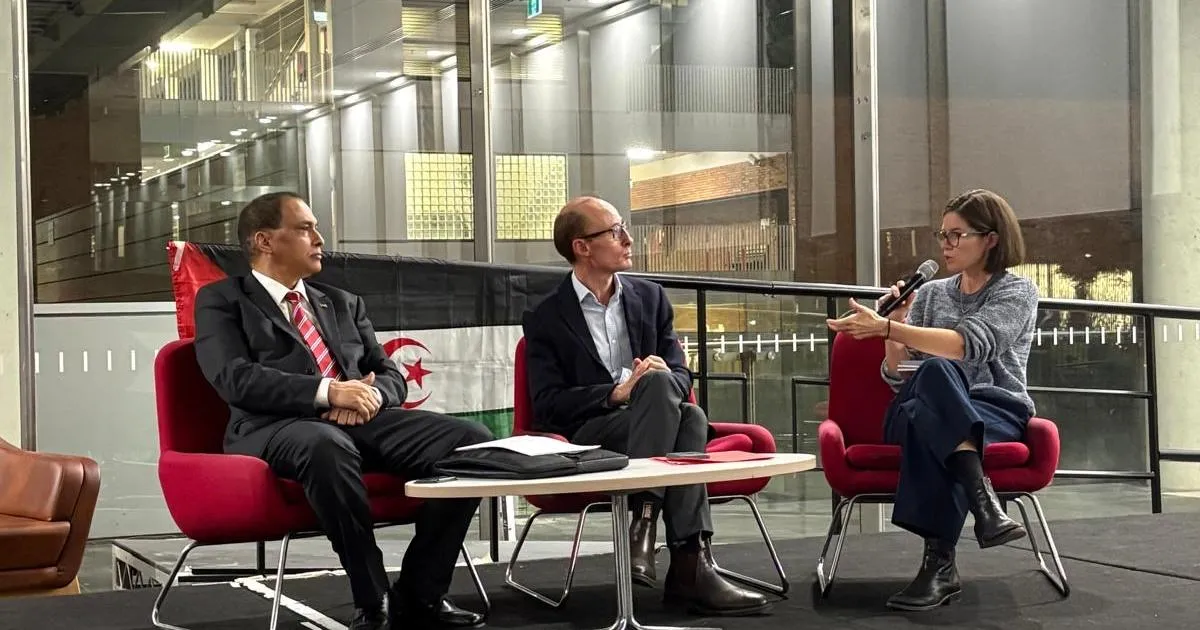
On April 25, 2026, the Sydney Law School building was the venue for a significant public forum titled "Western Sahara: Self-Determination, Conflict, and the Way Forward." This event brought together a select group of international law experts and representatives from Western Sahara to assess the current status of the last decolonization issue in Africa. Organized under the auspices of the Indigenous Studies Program at Sydney University and in collaboration with the Australia Western Sahara Association, the forum attracted a large audience eager to hear from distinguished speakers, including Professor Ben Saul and the representative of the Polisario Front, Mohamed Fadel Kamal, with the session chaired by Dr. Randy Irwin from the University of Newcastle.
Professor Ben Saul, an expert in international law at Sydney University and UN Special Rapporteur on Human Rights and Terrorism, delivered a comprehensive legal analysis of the conflict, focusing on UN Security Council Resolution 2797, which was issued in October of the previous year. While he acknowledged that the resolution reaffirms previous Security Council decisions, including the commitment to organize a referendum under UN supervision, he strongly criticized its overall approach, suggesting it strays from the neutrality that characterized the Council in the past.
During the forum, Saul stated, "Morocco's claim of sovereignty over Western Sahara is clearly illegal under international law." He emphasized that international law prohibits the use of force and the annexation of territory through force, asserting that the Moroccan occupation violates the Sahrawi people's right to self-determination, a right affirmed by the International Court of Justice and colonial decolonization principles. He pointed out that Morocco's transfer of its civilian population into occupied territories constitutes a violation of Article 49(6) of the Fourth Geneva Convention, qualifying it as a war crime under international law.
Saul also criticized recent moves in the U.S. Congress to designate the Polisario Front as a terrorist organization, viewing it as an attempt to coerce the Sahrawi people into accepting Moroccan sovereignty. He stated, "There is no credible evidence that the Polisario meets the criteria for being classified as a terrorist organization under international standards or U.S. law." He noted that the Polisario has never been listed on UN Security Council sanctions lists concerning terrorism and has not faced sanctions from the United States, the European Union, or any other country.
Meanwhile, Mohamed Fadel Kamal, the Polisario representative in Australia and New Zealand, addressed the humanitarian aspect of the conflict, stating, "What we are discussing today concerns a people suffering under occupation and asylum in difficult conditions for fifty years." He described the dire humanitarian situation facing Sahrawi refugees in camps, where food insecurity is exacerbated and the impacts of climate change intensify, while simultaneously highlighting the high morale and continued determination of the Sahrawi people.
On the diplomatic front, he referenced informal preliminary talks recently held in Madrid and Washington, the first of their kind since Geneva 2019, which involved officials from both conflicting parties, Morocco and the Polisario, as well as Mauritania and Algeria. He considered these talks a test of intentions and a means to reinvigorate a consultation framework, warning of the deep-seated disagreements, particularly Morocco's insistence on what it terms an autonomy proposal.
The Polisario representative affirmed that the peace proposal submitted to the UN Secretary-General in October 2025 includes three legitimate options — independence, integration, or autonomy — in line with General Assembly Resolution 1541, adding that what is termed autonomy under occupation is not self-determination, but rather the legalization of colonialism.
He also raised serious concerns regarding human rights, indicating that the occupied territories of Western Sahara are among the most monitored and opaque areas in the world, where access for independent media and human rights observers is prohibited. He cited documented cases of harassment, arbitrary detention, and the forced expulsion of Sahrawi activists, calling for intervention from the UN and international human rights organizations to protect Sahrawi civilians.
Both speakers concluded by urging the international community to apply international law consistently and without exception. The Polisario representative emphasized that the Sahrawi people do not seek special treatment but demand strict adherence to international law, the same right that was granted to the peoples of Timor and Namibia.
Professor Saul reiterated that recognition by any country of Moroccan sovereignty, including the United States, constitutes a violation of international law, as does the exploitation of natural resources in Western Sahara without the free, prior consent of the Sahrawi people.
The discussion concluded with a strong call for a fair and genuine referendum that includes the option of independence, respect for international law, and avoidance of pre-determined outcomes in negotiations. The speakers also called for renewed international commitment to ensuring the Sahrawi people's right to self-determination and reaching a just, comprehensive solution that aligns with international legal principles.
As reported by spsrasd.info.