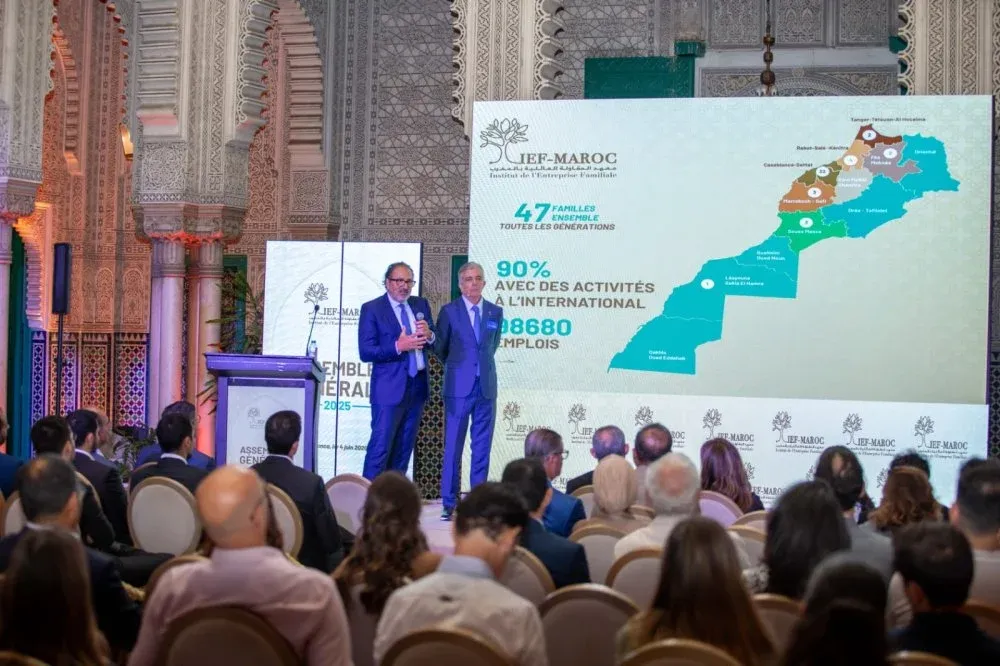

According to a groundbreaking study conducted by the Family Business Institute of Morocco (IEF-Maroc) in collaboration with the International Finance Corporation (IFC), a staggering 92.9% of active enterprises in Morocco are family businesses. These businesses employ approximately 6.3 million individuals, accounting for 65% of the private sector workforce, and contribute a remarkable 60.5% to the nation’s added value. This comprehensive quantitative analysis, based on rigorous scientific methods, was unveiled at a solemn conference held at the Palace of Méchouar in Casablanca, under the theme "The Real Weight of Family Businesses, the Invisible Part." The event brought together leaders from Moroccan family enterprises, international experts, public authorities, financial institutions, and academic researchers. Notably, an agreement was signed between IEF-Maroc and Maroc PME to develop a specialized support system for the transfer of family businesses.
The transition to the third generation poses a significant challenge for many family-owned enterprises, as they must navigate the delicate process of succession without fracturing their unity. Beneath their surface resilience, issues related to governance, a lack of formalization, and a sometimes hesitant succession reveal deep vulnerabilities. As a new generation emerges—better educated, more internationally oriented, and eager to redefine industry norms—these companies find themselves at a crossroads. A meeting organized by SFM Conseil delved into these challenges, providing insights and practical strategies to assist the transformation of Moroccan family businesses, as articulated by strategic vision expert Guillaume Lavigne.
Innovative Methodology to Quantify the Invisible
The study, led by José Carlos Casillas Bueno, president of the Spanish Academy of Family Enterprises Researchers (SAFER), outlined a novel methodology during the conference. Using the international Orbis database, his team compiled a sample of over 2,000 Moroccan enterprises, selected based on strict criteria: active companies with available financial data, identifiable shareholders, and Moroccan nationality of the last owner. Each enterprise was classified primarily on whether the family holds at least 50% of the administrative positions. The findings were then extrapolated to the entire national entrepreneurial population by cross-referencing Orbis data with official statistics from the High Commission for Planning (HCP), the World Bank, the Moroccan Observatory for SMEs, and the Moroccan Industry Barometer. Casillas Bueno acknowledged the significance of these findings, stating, "We knew it was substantial; now we can quantify the exact number of family businesses in Morocco." This study fills a significant documentation gap that has long been lamented by industry stakeholders, revealing that while there is extensive data on micro and small enterprises, there has been a lack of aggregated data specifically identifying and quantifying the family component of the national economic fabric.
In terms of productivity, the results were surprising. Although family businesses incur significantly lower wage costs compared to their non-family counterparts—233 versus 459 on average per employee—they exhibit a higher revenue-to-labor cost ratio of 10.78 against 8.51. This indicates that family-owned enterprises generate more value per unit of labor cost, reflecting a structural operational efficiency attributed to internal cohesion, long-term vision, and the specific commitment of family teams.
The Transmission Challenge: An Existential Dilemma for Moroccan Family Capitalism
Despite these overall performances, the study highlights a concerning reality: 64% of Moroccan family businesses are less than 25 years old, indicating they belong to the first generation. Only 31% are between 25 and 50 years old, representing the second generation, while a mere 5% have surpassed the 50-year mark and reached the third generation. This implies that only one in twenty family businesses survives beyond two generational transitions. This fragility is also evident in governance structures; approximately three-quarters of family businesses are managed exclusively by family members, with one-third having a board composed solely of relatives. In businesses still "developing" (under 25 years), 51% rely on a single administrator who is also the sole shareholder, reflecting a concentration of power that, while ensuring agility and responsiveness, threatens sustainability in the event of failure or unprepared succession. Conversely, among "lasting" businesses (over 50 years), 49% have external administrators, confirming that governance openness is a key determinant of longevity.
Kacem Bennani-Smires, president of IEF-Maroc, emphasized this challenge in his opening remarks, stating, "Family businesses are not measured solely by the pursuit of profit; they are also evaluated by their ability to transmit and disseminate values over the long term." He highlighted the tangible risks of poorly prepared successions, which can jeopardize families, jobs, and expertise passed down through generations. He advocated for a collective awareness, noting, "We need to support all family businesses in recognizing the stakes and best practices. Awareness is not easy, but it becomes even more challenging when the inevitable occurs without preparation." Cheick-Oumar Sylla, regional director of IFC for North Africa and the Horn of Africa, echoed this sentiment, stressing the historical and identity significance of transmission. "When a transmission fails, a part of the family history, intimately linked to Morocco’s history, disappears," he stated. As a partner in the study from its inception, the IFC aims to extend this initiative across the African continent, making the support of family businesses a structural pillar of its regional strategy in the coming years.
Ryad Mezzour, the Minister of Industry and Trade, encouraged family business leaders to take a strategic leap towards technological advancement and international projection. "If you have succeeded in this country, you can succeed anywhere else," he asserted. He emphasized the ongoing technological disruption, the removal of barriers to innovation, and easier access to global markets, urging family entrepreneurs to "seek value" beyond their traditional models. "The real battle lies in value creation. Pursue new models to create value," he urged, acknowledging that challenges related to financing and support remain real. The conference also featured leaders from multigenerational family enterprises, such as Mohamed Laghrari, president of the third-generation ALH Holding Group, and Jose Manuel Sirvent, president of the twelfth-generation Confectionary Holding Group, alongside Jesús Casado, secretary general of European Family Businesses, and Anouar Alaoui Ismaïli, director general of Maroc PME. Their contributions provided concrete insights beyond statistics, aligning with the study’s objective to document and encourage the trajectories of family businesses.
At the conclusion of the event, the signing of the IEF-Maroc/Maroc PME agreement marked the first institutional response to the study's findings: a structured support system for transmission, aimed at family businesses undergoing succession processes. According to Bennani-Smires, this is a first step in what he describes as a long-term endeavor. "We are here to better understand, support, and prepare the future of businesses, preserving key elements of our national heritage and passing them on to the next generation."
As reported by lematin.ma.