The Discovery of a Unique Mineral
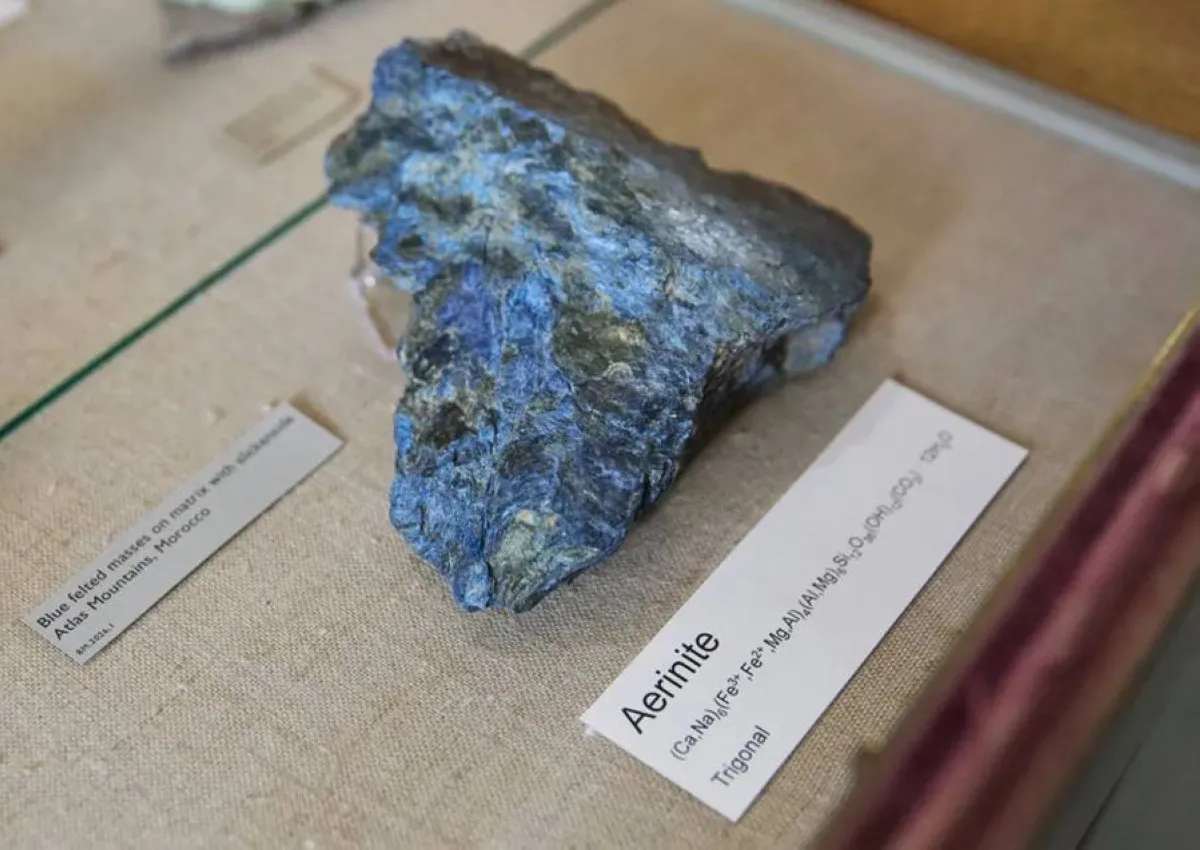
The story of a mysterious blue mineral that changes color depending on the angle of observation has captivated scientists and enthusiasts alike for over three decades. This intriguing tale began in 1980 when geologist Anna Grayson purchased a blue stone from a vendor near the city of Fes in Morocco. The seller claimed that the stone was lapis lazuli, a well-known mineral famous for its vibrant blue hue. However, Grayson was not entirely convinced; she noticed that the stone exhibited a remarkable characteristic—it changed color as the viewing angle shifted, prompting her to suspect that it was an entirely different mineral. This initial observation set the stage for a scientific investigation that would span years.
A Journey into Scientific Analysis
Years later, Grayson decided to present her specimen at an open day event at the Natural History Museum in London, where visitors are encouraged to bring samples for identification. The stone quickly attracted the attention of a team of mineralogists, particularly because it did not resemble any known minerals in their collection. Under the leadership of the late scientist Gordon Kressy, the team embarked on a detailed analysis that utilized advanced techniques, including synchrotron X-ray diffraction. This method allowed the researchers to examine the atomic structure of the mineral with exceptional precision.
As the analysis progressed, the scientists uncovered a surprising revelation: the stone was not a new mineral but an extremely rare one known as irenite. First identified in 1876, the name 'irenite' is derived from the Greek word for 'blue sky,' which reflects its unique color. Despite being a recognized mineral, irenite possesses distinctive properties that made it appear unfamiliar. The specimen Grayson acquired is composed of millions of incredibly fine crystalline fibers, each smaller than one ten-thousandth of a millimeter. Within these fibers are chains of iron ions (Fe²⁺ and Fe³⁺), which facilitate electron movement between atoms. This phenomenon explains why the stone absorbs light differently, sometimes appearing colorless and at other times a brilliant blue, depending on the angle from which it is viewed.
Over thirty years after its initial analysis, the irenite sample has once again become significant. A new scientific team utilized it in recent studies to better understand the unique atomic structure of irenite, aiding in the identification of other mysterious mineral samples housed in the museum's collection and contributing to the development of new analytical techniques used by scientists today.
This narrative illustrates how a small specimen, purchased from a modest kiosk, can evolve into a significant scientific discovery. The story of the irenite serves as a reminder that scientific inquiry often begins with a simple observation, such as a stone that changes color in unexpected ways. Today, visitors to the Natural History Museum in London can witness this rare sample, which has become a symbol of one of the most fascinating scientific tales to emerge from the Moroccan desert, culminating in one of the world's most prestigious scientific institutions.
As reported by albayan.ae.