The Changing Landscape of Journalism
There was a time when social media was non-existent and digital press was just emerging, a period marked by outlandish falsehoods rather than caricatures accompanying attacks on my journalistic work. In the lead-up to the 2002 takeover of Perejil Island, the Casablanca weekly, La Vie Économique, published claims that I worked under the orders of President José María Aznar in the mornings and penned articles for El País, dictated to me mere hours earlier from La Moncloa. This narrative was a clear indication of how the Moroccan state media perceived me, as almost all of them have always suggested that I had a hidden benefactor outside of the media outlet I was associated with.
One notable exception occurred in the mid-2000s during a period of amicable relations between Spain and Morocco, when I received access to the royal residence in Ouarzazate. There, I had the unique opportunity to interview King Mohammed VI for El País, alongside my editor, Jesús Ceberio, making it the only interview he has ever granted to a Spanish media outlet. Since that moment, he has refrained from engaging with the press.
Shifting Allegiances and Accusations
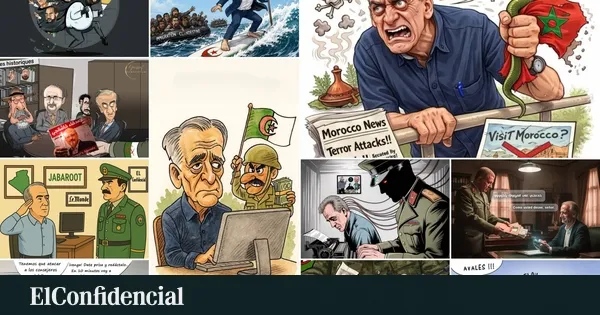
As I began reporting at the start of the last decade about the Moroccan monarch's extended vacations abroad—sometimes lasting up to six months per year—the hostility towards my work resurfaced. Moroccan authorities, the Spanish government under Mariano Rajoy, and even the management of El País forced my departure from the newspaper where I had dedicated over thirty years of my career in 2014. Since that time, my supposed benefactors have changed. During the diplomatic crisis between Spain and Morocco from December 2020 to March 2022, I found myself once again under the payroll of La Moncloa. A Moroccan digital platform, Le 360, associated with Mounir Majidi, the king’s private secretary, even published cartoons depicting me as someone who visits La Moncloa for instructions. I was often accompanied by Ali Lmrabet, a Moroccan journalist exiled in Barcelona, during these moments.
These caricatures, while unsigned, bore the distinct style of a once critical cartoonist of the Moroccan regime, who had to adapt due to economic hardships. I am grateful that he portrayed me as younger and more hirsute than I actually am. Occasionally, I also received financial support from Moulay Hicham, the so-called 'red prince' and a dissenting member of the Alaouite royal family. Depicting members of the Moroccan royalty in cartoons is strictly prohibited, which led to a situation in 2015 when, during Hicham's visit to Madrid for the launch of his book, Diario de un príncipe desterrado, we had to replace the cartoon with a photograph due to a mix-up by those assigned to capture our meeting.
In late 2024, I had the opportunity to work with Mehdi Hijaouy, the former 'number two' of Morocco's foreign intelligence service (DGED), who fled to Madrid from his former colleagues. I recounted his story in El Confidencial, which resulted in social media responses accusing me of being enticed by the dollars he supposedly carried in a sack. However, my most consistent benefactor has been the Algerian military, with memes circulating online portraying me as someone receiving instructions and payments in dollars. Recently, my status has even elevated; the person slipping cash into my coat pocket is no longer a low-ranking officer, but General Saïd Chengriha, the Chief of Staff of the Armed Forces, who is whispered instructions by President Abdelmadjid Tebboune.
Over time, I have amassed a collection of these often sordid but occasionally amusing caricatures and memes. A friend, upon viewing them on my computer, suggested that I should hold an exhibition featuring the best works, providing context about the historical moments of Spanish-Moroccan relations they represent. While I tend to write less about Algeria compared to Morocco, the geographical proximity of only 180 kilometers from the coast of Almería seems to stir less interest among Spanish readers. For instance, in September, I reported on General Abdelkader Haddad's escape to Spain, who had been under house arrest in Algiers. Following my report, Algerian newspapers such as El Khabar and Le Soir d’Algérie pointed fingers at me, labeling me as a writer in service to the Moroccan regime.
Among these caricatures and memes, a slew of lengthy defamatory articles has emerged. In June 2021, Hassan Alaoui, director of Maroc Diplomatique, claimed that I "never works for free and operates behind the scenes in every crisis between Morocco and Spain, being compensated with secret funds from a Spanish ministry." It was Alaoui who first made me suspect that my phone had been infected with Pegasus malware, as he referenced snippets of WhatsApp exchanges I had with a member of the Spanish government during a crisis with Morocco. A subsequent investigation by the Forbidden Stories journalistic consortium confirmed my worst fears about the hacking.
Five years later, earlier this month, Karim Serraj, the leading columnist for Le 360, asserted that my connections with Algeria "reveal something deeper than a mere professional relationship." He added that I "articulates the official Algerian narratives in an appealing format for the Spanish local audience." These accusations, manufactured with AI and invective, are mere annoyances compared to the headaches caused by two criminal complaints from the Moroccan government in 2014 and two civil lawsuits, the most recent in 2022 from the Kingdom of Morocco itself, not just the government. I found myself once again elevated in status.
The initial complaints were dismissed without trial, although I was once indicted. Regarding the defamation lawsuit, a remnant of medieval law still present in the Civil Code, I won in the first instance and at the Provincial Court. However, preparing defenses, gathering documentation, and translating texts into Spanish is a labor-intensive endeavor. While I was always confident in my eventual victory, atypical situations tend to arise when the government or the Kingdom of Morocco appears in Spanish courts, creating unsettling experiences for the defendant. A counter-terrorism prosecutor, who should have been responsible for the complaint, gets sidelined, or a lawyer dispatched from Rabat barges into the courtroom demanding to interrogate me.
How I wish I could frame a judgment akin to that issued by the Federal Court of Karlsruhe, the German Supreme Court, which dismissed Morocco’s lawsuit against two publications, Die Zeit and Süddeutsche Zeitung, in February with a strong defense of freedom of expression. Both had reported on the extensive use of Pegasus by Moroccan intelligence services. However, these trials are trifles compared to the plight of Moroccan journalists who have spent years in prison, like Omar Radi, Souleiman Raissuni, Taoufik Bouachrine, or the blogger Saida el Alami, who remains behind bars. She was sentenced in September to three years in prison.
One of these former prisoners, Souleiman Raissouni, wrote last week from his Tunisian exile, highlighting my independence after reading yet another wave of columns depicting me as a “mercenary” for Algeria. There is nothing more comforting than receiving support from a Moroccan colleague amidst the ink of his compatriots who write under the dictates of the Moroccan regime, namely the Royal House. I would like to express my gratitude to Souleiman for publicly defending me and to the other Moroccans who privately show me their support.
As reported by elconfidencial.com.