
Understanding the Changes in Moroccan Family Dynamics
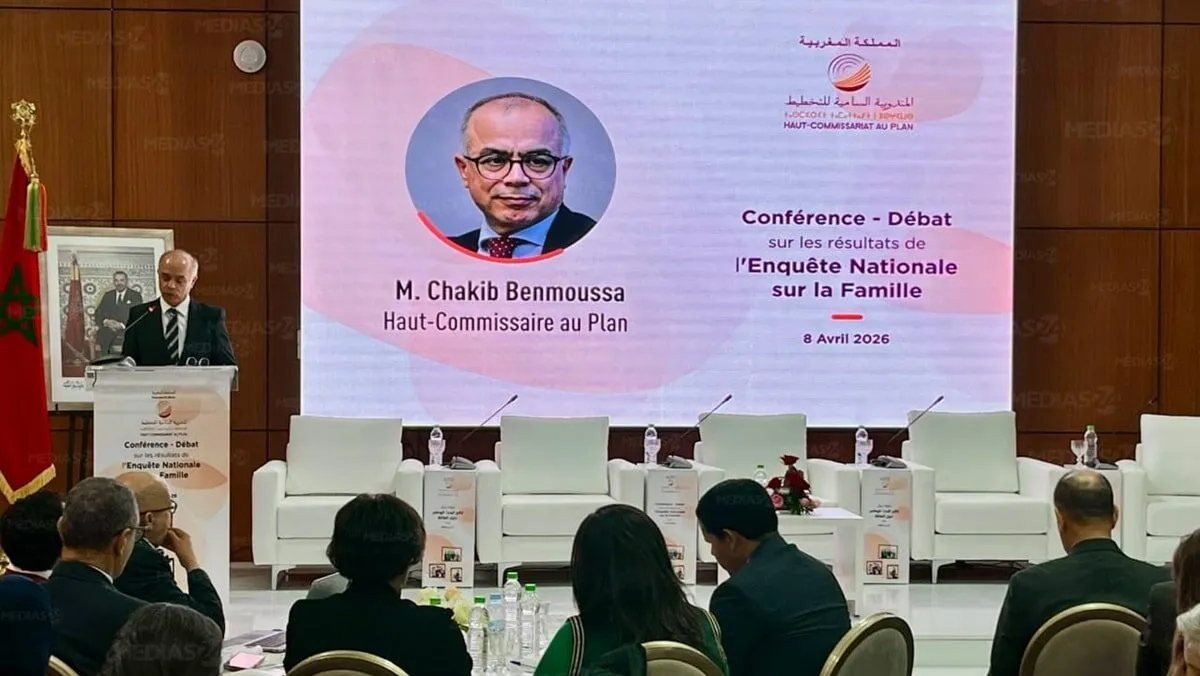
On April 8, 2026, the High Commission for Planning (HCP) unveiled the preliminary findings of the 2025 National Family Survey, conducted between May and September 2025 with a sample of 14,000 families. This survey is significant as it marks the first comprehensive study of Moroccan families in thirty years, following the last assessment in 1995. Chakib Benmoussa, the HCP commissioner, emphasized the importance of the survey, which aims to provide a substantial statistical framework to inform various public policy domains, including housing, social protection, parental support, aging care, economic inclusion, gender equality, and social cohesion. The findings reveal that Moroccan families have not remained immune to the cultural, social, and economic transformations that have occurred over the past three decades.
Key Findings: A Shift Towards Nuclear Families
The results indicate a notable shift in family structure, with nuclear families emerging as the predominant household type, now accounting for 73% of all households, up from 60.8% in 1995. Meanwhile, extended families have significantly declined, dropping from 35.2% to 19.8%. However, this trend towards nuclearization does not equate to a loss of familial solidarity; in fact, 59.3% of elderly individuals still live with at least one of their children. Residential proximity to parents remains strong, albeit in varying forms across urban and rural settings. In urban areas, it often manifests as cohabitation within the same building or nearby, while in rural areas, it tends to occur within the same community.
The survey also highlights changing attitudes towards marriage, with the average age at first marriage now at 33.3 years for men and 26.3 years for women, reflecting a delay in entering unions. Notably, 51.7% of single adults express no desire to marry, indicating the increasing burden of material constraints. While family involvement in marriages persists, with unions among relatives still representing 20.9% of cases, the forms of family have diversified, with single-parent households becoming more visible. In 90.7% of these cases, the heads of these families are women. Furthermore, the rise in childless couples points to broader demographic changes linked to aging and evolving life trajectories.
Despite these transformations, the family continues to play a crucial role in transmitting values, with 75% of households affirming its central importance in educating children. Moreover, technology has become an integral part of family life, with over half of respondents believing it strengthens familial bonds. This evolution does not signify a rupture from traditional values; rather, it reflects a natural adaptation of family roles, tools, and lifestyles while maintaining its status as a central hub for connection, guidance, and unity.
The initial findings illustrate that the Moroccan family is undergoing significant transformations in structure, timing of unions, and life paths, becoming more nuclear while retaining its essential role in social organization, intergenerational solidarity, and value transmission. The pressing question now is how public policies will adapt to these ongoing changes, particularly concerning the aging population, the situation of women as heads of families, and the welfare of the elderly.
As reported by medias24.com.