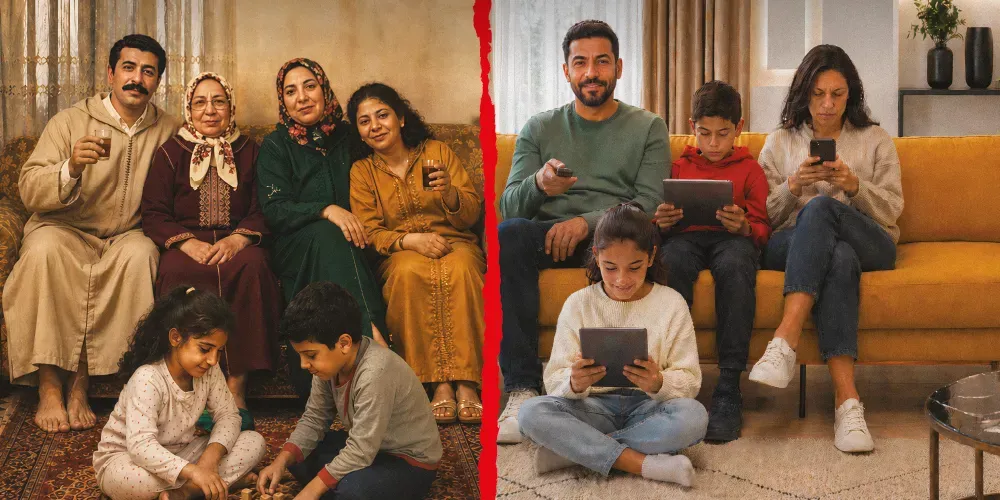

The concept of family remains sacred in Morocco, yet its structure is undergoing significant changes. Thirty years after the first national family survey was published in 1995, the High Commission for Planning (HCP) has released its second survey, conducted between May and September 2025. This extensive study involved over 14,000 households across all twelve regions of the kingdom and confirms the trends suggested by recent population censuses: the Moroccan family of 2026 has evolved dramatically from that of three decades ago. There is a noticeable shift from the traditional extended family model towards a more nuclear and individualized family structure, which reflects the changing dynamics of life in Morocco.
One of the central findings of the survey emphasizes that despite these structural shifts, the family remains a cornerstone of Moroccan society. The HCP notes that the family serves as the fundamental building block of social structure and the primary environment for socialization, fulfilling vital socioeconomic support functions and facilitating the intergenerational transmission of values, norms, and cultural practices. This enduring importance of the family was particularly evident during the COVID-19 pandemic, where families acted as buffers against crises. However, the evolving family model suggests that this central role does not guarantee stability, as families are becoming increasingly compact.
Shifts Towards Nuclear Family Structures
The statistical evidence is striking: 73% of Moroccan households now adhere to the nuclear family model, which consists of a couple and their children, a significant rise from 60.8% in 1995. This trend indicates a definitive move towards households focused on this nucleus. Concurrently, the average household size has decreased from 4.6 individuals in 2014 to 3.9 in 2024, dipping below the symbolic threshold of two parents and two children. This demographic transformation is indicative of a broader change in lifestyle, with the HCP highlighting a shift towards family configurations characterized by fewer individuals living together and a tightening of family relationships. In practical terms, this means that fewer people are residing under one roof, and the nature of familial relationships is evolving.
As a result, the representation of extended families has sharply declined from 35.2% to 19.8% in the past thirty years. Similarly, multigenerational households, which once made up 29% of the total, have now fallen to 16.8%. The traditional three-generation household is becoming an exception rather than a standard. Sociologist Bouchaib Majdoul points out that the extended family, historically rooted in agricultural economies and local solidarity, is becoming less functional in an urban context defined by wage labor, mobility, and housing constraints. The rise of the nuclear family is also accompanied by an increasing trend of residential independence; more than half of married women now reside in independent housing, rising from 39.9% in 1995 to 55.7% today, although living with extended family remains prevalent, especially in rural areas.
Changing Family Dynamics and Individual Aspirations
Despite the decline in cohabitation, familial ties are not diminishing; rather, they are evolving. The HCP observes that this decline signifies a gradual transition from a solidarity model based on cohabitation to more distant forms of solidarity. Anthropologist Khalid Mouna notes that it is often the same parents, who were raised with traditional values, that now encourage their children to pursue long-term education, delay marriage, and seek independence. The family network remains extensive, with an average of 54 declared relatives, including aunts, uncles, cousins, and in-laws; however, the circle of active relationships has narrowed, averaging just 17 close relatives. This reflects a selective focus on immediate family members such as parents, siblings, and children, indicative of the nuclear family structure.
Geographical proximity among family members has also diminished, with only 45.4% of household heads living near their fathers, a decline from 53% in 1995, and 46.3% living near their mothers, down from 63%. As children relocate to different cities or even abroad for education and employment, emotional support has become the dominant form of interaction in long-distance relationships, comprising 87.3% of interactions. Financial transfers and digital communication are increasingly vital for maintaining familial bonds, with virtual communication establishing itself as a crucial means of connection.
Moreover, the survey reveals a significant shift towards individualization in life choices. The traditional institution of marriage is becoming less central to personal aspirations, with 51.7% of single individuals expressing a lack of desire to marry, a disparity that highlights a gender divide: 59.8% of men do not wish to marry compared to 40.1% of women. This divide underscores the pressures that marriage continues to impose on those expected to act as primary breadwinners. Economic constraints largely influence single men’s decisions to forego marriage, while women cite educational pursuits and youth as their primary reasons for delaying marriage. Furthermore, the average age of marriage has risen to 26.3 for women and 33.3 for men. This trend highlights a growing number of adults, particularly men, who remain in a state of limbo—neither married nor independent—reflecting the complexities of transitioning into adulthood amid economic uncertainties.
In conclusion, the HCP report reflects a Moroccan family that is not only smaller and more autonomous but also more vulnerable. While solidarity and mutual support remain essential components of familial relationships, they increasingly depend on indirect and sometimes fragile mechanisms. As the family continues to serve as a social space that cushions vulnerabilities, it is crucial for public policy to provide the necessary support to ensure that families can adapt to these changing dynamics.
As reported by telquel.ma.