
The Ongoing Legal Conflict Over Western Sahara
The Polisario Front emphasizes that the nature of the conflict with Morocco is fundamentally legal. International law is unequivocal regarding the legal status of Western Sahara, previously referred to as the 53rd province. According to the United Nations, this territory remains a non-self-governing region awaiting decolonization. However, for the past fifty years, legal principles have been largely ignored in this area. Abdulah Arabi, the Polisario representative in Spain, succinctly articulates this situation by stating that it represents an unfinished decolonization process. Spain, the power responsible for overseeing this transition, left the Sahrawi people in limbo before effectively completing the decolonization process. Rather than rectify this oversight, Spanish authorities have continued to disregard international law concerning Western Sahara, as evidenced by their letter to the UN renouncing sovereignty over the territory and the recent shift in favor of Morocco's autonomy plan under Prime Minister Pedro Sánchez.
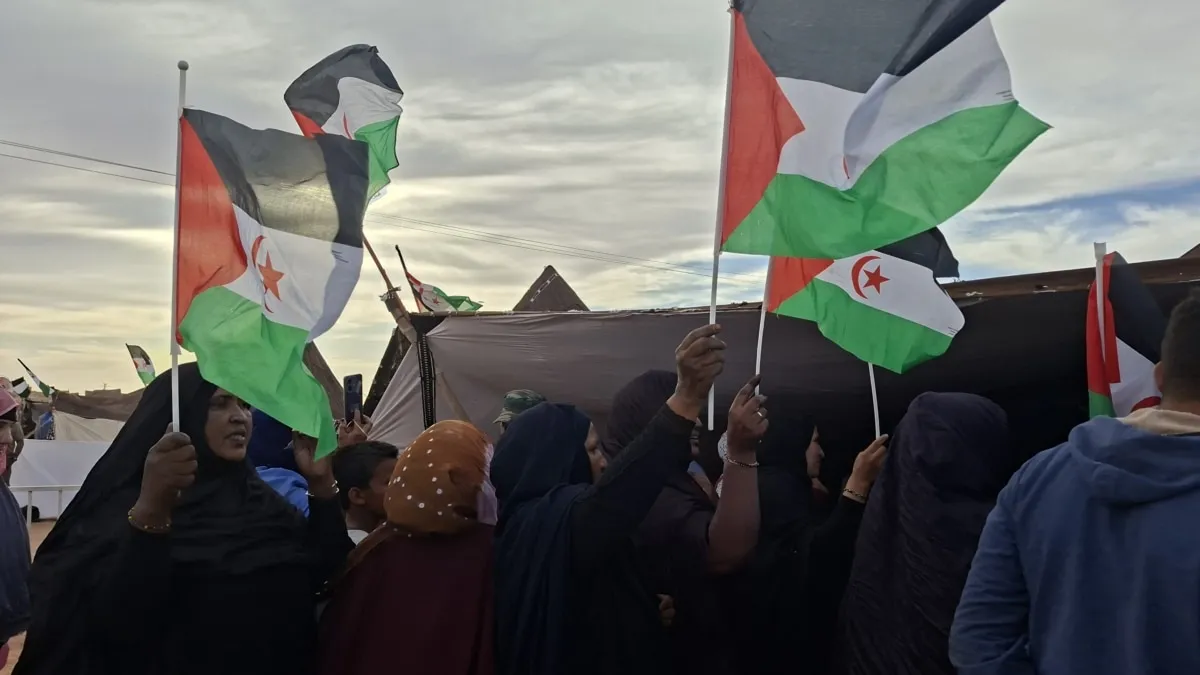
Moreover, Spain is not the only party shirking its responsibilities; the international community has also largely overlooked the legal rights of the Sahrawi people. Many have been forced to live in refugee camps in the Algerian desert, endure Moroccan occupation, or seek exile elsewhere. A recent event titled "International Legality, Western Sahara, and Commitment to Human Rights" aimed to delve deeper into the legal abandonment faced by the Sahrawi people. This issue is intertwined with the long-overdue self-determination referendum that seems increasingly unattainable.
Negotiation and the Quest for Self-Determination
During the event organized by Judges for Democracy, the Progressive Union of Prosecutors, and the Association for Human Rights of Spain (APDHE), Arabi spoke clearly about the Polisario's stance on a negotiated resolution to the conflict. Although the UN-sanctioned peace plan of 1991 included provisions for a self-determination referendum, the latest resolution from the UN Security Council prioritizes Morocco's proposal for autonomy over Western Sahara. Despite these endorsements, the authorities of the Sahrawi Arab Democratic Republic (SADR) remain resolute in their determination to allow the Sahrawi people to decide their own future. Options such as independence, autonomy under Moroccan governance, or total integration into the Moroccan regime are on the table. Arabi believes this represents a significant concession by the Sahrawi people in pursuit of a peaceful resolution in accordance with international law.
Nevertheless, they perceive a dynamic aimed at imposing solutions on the Sahrawi people that contradict international law in discussions with Moroccan authorities facilitated by the US and the UN. According to Juan Soroeta Liceras, a professor of Public International Law, statements made by the Spanish government lack legitimacy. He asserts that no world leaders, including Trump, the Spanish president, or the French president, possess the authority to alter international law. These leaders may violate legal standards, but they cannot change them. He clarifies that it is the states that hinder the UN from acting to resolve the conflict. The UN's mission in the area, MINURSO, was tasked with organizing the referendum, and Soroeta insists that the only barrier to its execution is a lack of political will.
This interpretation is echoed by International Relations professor Isaías Barreñada, who notes that while the UN may not be effective, the behavior of countries—particularly those influential states with veto power in the Security Council—must change. He also points out the passivity of other nations, including Spain, which could play a more active role. Alongside the disregard for international legality, the Sahrawi people are experiencing ongoing human rights violations in their daily lives. Loueila Sid Ahmed, a Sahrawi lawyer residing in the Canary Islands, highlights the direct consequences of colonization she faces from Spain. For instance, she encounters canned tuna from companies engaged in illegal operations in Sahrawi territory while on shopping trips, and tourists sunbathe on beaches where the sand is taken from Western Sahara.
While the plight of the Sahrawi people continues, Spanish institutions persist in delivering legal setbacks to those residing in Spain. As a human rights lawyer, Ahmed regrets that Spain has not extended the same historical reparations to the Sahrawi people as it has to victims of its dictatorship or other colonized regions, such as Latin America. “Spain has acted correctly when it wanted to, but sadly not in the case of Western Sahara,” she laments. She also criticizes the judiciary, referencing a 2020 Supreme Court ruling that determined Western Sahara could not be classified as Spanish for nationality purposes. Ahmed argues that these are "restrictive" interpretations of justice that undermine human rights.
In light of this, María José Berdugo, the vice president of the Progressive Union of Prosecutors, voiced her opinion on the responsibility of legal professionals in the conflict, asserting that judges, prosecutors, and lawyers have an obligation to denounce violations of international law and human rights and demand compliance with these standards. Following her first visit to the refugee camps in Tindouf, Algeria, in 2023, she participated in an international meeting of jurists in the Algerian desert, where discussions focused on the legal status of Western Sahara and the exploitation of its natural resources. Her experiences in the camps have made it clear to her: "The foremost obligation of the Spanish state on an international level is concerning Western Sahara."
As reported by elindependiente.com.