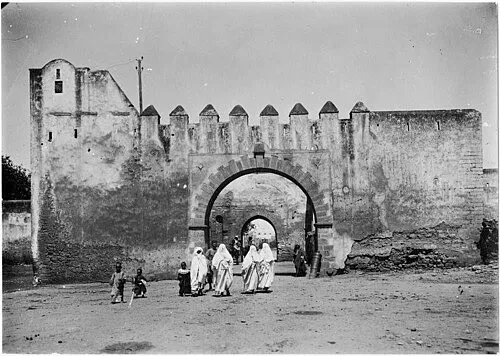
The Historical Significance of Bab Khamis
The ancient city walls and gates of Salé tell a rich story of a prominent historical presence in Morocco. This city, which served as a strategic point for naval jihad, evolved into a center of learning and intellectual pursuit that attracted scholars and knowledge seekers, ultimately becoming a beacon of enlightenment in the Islamic world. Following their settlement, the Muslims of Andalusia significantly contributed to Salé's cultural and scholarly character, leading to the establishment of a vibrant intellectual and economic nucleus within the city walls. Over time, maritime trade flourished, and various scientific institutions and Sufi lodges emerged, enhancing the city's reputation.
From Bab Fes to Bab Khamis
Among the many gates of the city, Bab Khamis, also known as Bab Fes, stands as a testament to the deep historical narratives of ancient Salé. This venerable gate, positioned on the eastern side of the city walls, is one of the oldest of Salé's seven gates and a notable historical landmark. Its construction dates back to the Almoravid period in 1356 AD when Salé was thriving as a city that blended architectural prowess with scientific and spiritual life. The significance of this site increased with the establishment of the well-known Sufi lodge by Sultan Abu Inan, which hosted numerous scholars and mystics, thus becoming a meeting point for urban life, knowledge, and spirituality, famously hosting recreational gatherings known as "halak".
Originally named Bab Fes, this gate served as the eastern exit of the city and the beginning of the road leading to Fes. Over time, a weekly livestock market developed outside the gate, held every Thursday, leading to the gate being popularly referred to as Bab Khamis, a name that has persisted even as the market eventually disappeared with the city's expansion and transformation. In the 19th century, the gate was rebuilt, retaining its distinctive architecture characterized by two square towers that lend it both defensive and aesthetic qualities.
For centuries, Bab Khamis remained a vital passage connecting the city to its rural surroundings, with residents from the plains and neighboring villages using it to enter Salé for their needs, while local farmers would pass through to access their agricultural lands in the outskirts or the salt ponds in the Oualidia region. Although the gate was permanently closed in 1991, a small door nearby remained open to facilitate the movement of residents. This historic landmark is also notable for the presence of two war cannons located beside it, evoking memories of a time when walls and gates served as fortifications for the city.
Today, the area around Bab Khamis has transformed into a cultural hub, hosting exhibitions, artistic endeavors, and literary activities, thus continuing its role in the life of Salé. However, it now serves as a bridge between historical memory and contemporary cultural creativity.
As reported by aljarida24.ma.