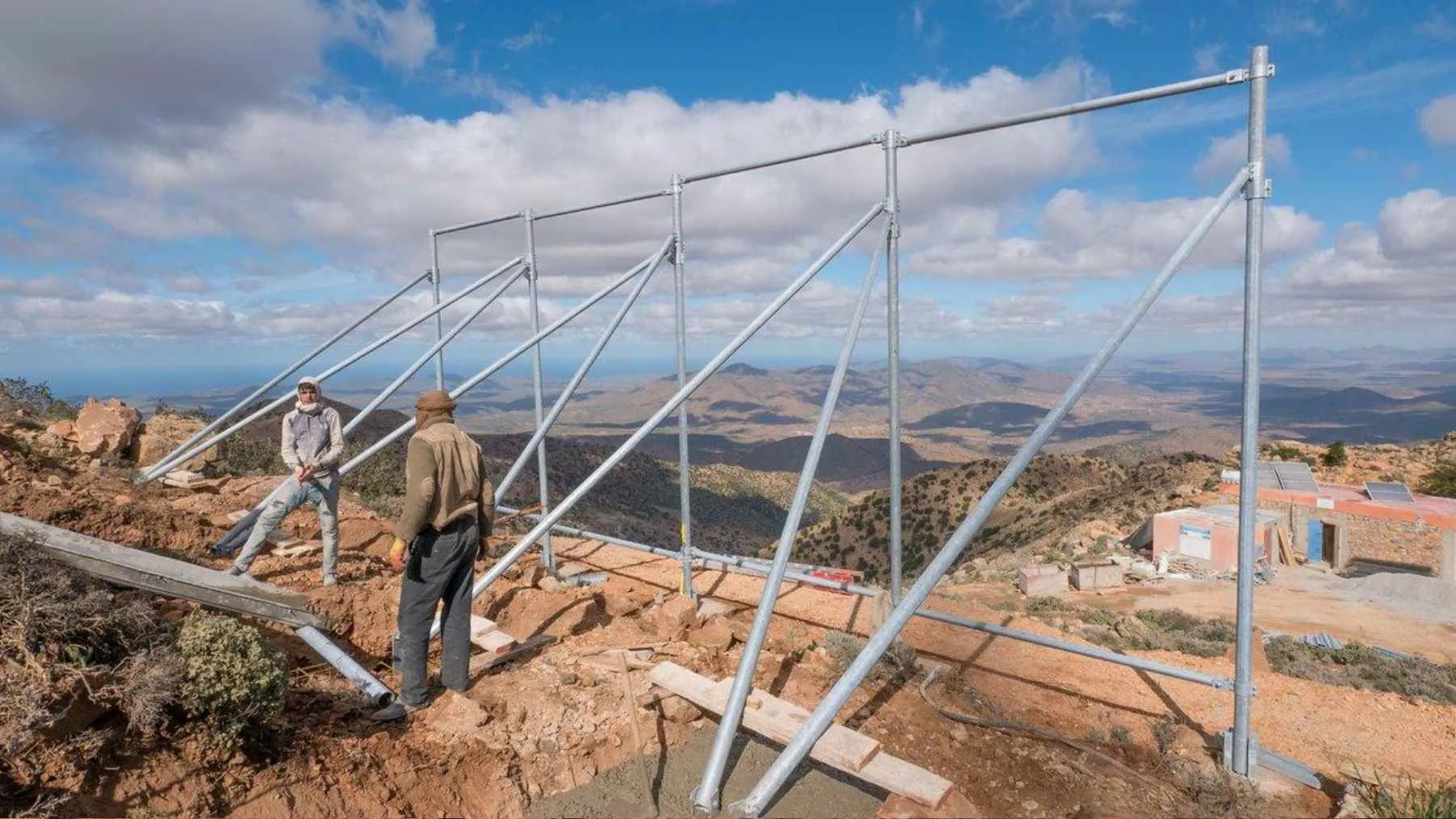

Innovative Water Solutions in Morocco's Anti-Atlas Mountains
Imagine witnessing fog enveloping a hillside and realizing that this natural phenomenon could be a source of drinking water. In the Anti-Atlas Mountains of southwest Morocco, this mist has become a vital resource for rural communities struggling against drought, dwindling wells, and the harsh realities of life near the Sahara Desert. For generations, women in Aït Baamrane have invested countless hours traversing difficult terrains in search of water, often carrying heavy 5-gallon containers weighing nearly 50 pounds when full. However, an innovative solution has emerged: fog-catching nets strategically positioned on Mount Boutmezguida are now harnessing moisture from the Atlantic air. This system has revolutionized water access, allowing clean water to flow directly to village taps, thereby transforming what was once a daunting daily chore into the simple act of turning on a faucet.
Empowering Communities Through Fog Harvesting
The project, pioneered by Dar Si Hmad, a women-led nonprofit organization in Morocco, was designed as a local response to the ongoing water crisis. The United Nations Framework Convention on Climate Change (UNFCCC) has recognized this initiative as a participatory climate adaptation project that utilizes an environmentally sustainable water source to combat desertification. Initially, the project encompassed approximately 6,460 square feet of fog nets, seven reservoirs capable of storing around 142,000 gallons of water, six solar panels, and over 6.2 miles of piping. This infrastructure was instrumental in connecting 52 households across five villages, benefiting more than 400 rural Berber residents, predominantly women. As the project progressed, it expanded its reach to 16 villages, innovatively delivering fog water directly to homes and alleviating the community's reliance on distant, drought-affected wells.
While fog harvesting may sound like a remarkable feat, the underlying mechanics are relatively straightforward. The system employs mesh panels suspended between robust supports; as wind carries fog through the mesh, tiny droplets adhere to the fibers, with gravity guiding the collected water into gutters and storage tanks. The geographical location of Mount Boutmezguida, which rises approximately 4,000 feet above sea level, is crucial to the success of the project, as seasonal fog and coastal humidity create ideal conditions for harvesting moisture—conditions that flat desert landscapes cannot provide.
Modern engineering advancements have significantly enhanced the efficiency of fog collection. Researchers at MIT discovered that modifications in mesh spacing, fiber size, and surface chemistry could potentially increase fog-collecting efficiency by up to 500%. This is a substantial benefit for communities that meticulously monitor every drop of water. Since the inception of the project in 2006, Dar Si Hmad has conducted extensive research on the region’s fog potential, progressing through testing, community consultations, and pilot programs before implementing full household delivery systems. This process was essential not only for demonstrating the functionality of the nets but also for building trust within the community, ensuring that villagers felt confident in utilizing this new water source.
A 2021-2022 case study by the Reach Alliance highlighted that Dar Si Hmad had successfully served 16 villages, installing around 18,300 square feet of honeycomb-style nets. The project has yielded numerous benefits beyond just providing drinking water; it has improved access to freshwater in homes and schools, decreased the time spent gathering water, and led to increased school attendance among girls. This is the core of the initiative's impact—it's not merely about building water infrastructure; it's about reclaiming time for families.
Initial skepticism towards fog-harvested water was common among villagers, with some expressing doubts about the reliability of this technology and the potential implications of relying on a source that had previously been viewed as a mere nuisance. However, this skepticism gradually dissipated as the system began delivering consistent results. Once water was made available inside homes, the concept shifted from an abstract idea to a tangible ally in daily life.
Moreover, the project has redefined traditional roles within households. Women, who have historically been the stewards of water, experienced changes in daily routines and family dynamics as water became more accessible indoors. In response, Dar Si Hmad implemented training programs, literacy initiatives, and water education, focusing on a women-centered management approach rather than treating the project as just a series of pipes and nets.
It's crucial to emphasize the human aspect of this endeavor. UNICEF estimates that individuals in Africa collectively spend about 40 billion hours annually fetching water, with the World Bank noting that women and girls are primarily responsible for water collection in nearly 80% of Sub-Saharan African households lacking direct water access. Thus, having a tap at home transcends mere convenience; it symbolizes the opportunity for education instead of enduring long treks, reducing the miles walked under the scorching sun, and alleviating the pressures on families already grappling with the challenges of drought and migration.
However, it is important to acknowledge that fog harvesting is not a panacea. It requires a specific combination of altitude, consistent fog, wind conditions, maintenance, and community trust. A net cannot capture mist that is not present.
Ultimately, Morocco's fog harvesting initiative exemplifies how climate adaptation can be effectively implemented by leveraging local geographical features rather than imposing a uniform solution. By utilizing moisture that is already present in the atmosphere and relying on gravity, filtration, storage, solar energy, and local management, this project has transformed the way water is accessed and utilized in these communities. While it does not replace the need for groundwater protection, desalination, or comprehensive water planning, in the right context, a simple mesh net on a mountain ridge can achieve what trucks, dry wells, and arduous walks could not. At its core, this initiative conveys a straightforward yet profound lesson: sometimes, innovative climate solutions resemble a simple net capturing fog before it vanishes into the morning air.
As reported by vozpopuli.com.