The Rise of Precision Manufacturing in Morocco's Industrial Landscape
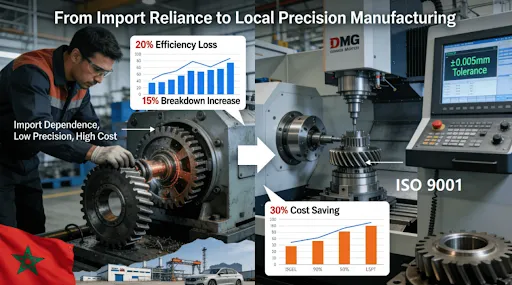
The industrial sector in Morocco is experiencing remarkable growth, primarily driven by the automotive and aerospace industries. Nonetheless, local manufacturers frequently grapple with a critical challenge: their reliance on inexpensive, low-quality precision gears. This dependency has led to significant equipment failures, contributing to a staggering 20% reduction in production efficiency. To counteract these issues, local sourcing of solutions is essential in a traditional manufacturing environment that continues to struggle with the absence of standardized quality controls. Customized solutions are imperative for achieving an optimal balance between cost and performance, particularly in a market that demands high precision and reliability.
Challenges and Opportunities in Gear Manufacturing
Despite Morocco's positive economic trajectory, the manufacturing sector still has several areas requiring improvement. A primary concern is the heavy reliance on imported gear components, leading to prolonged delays and inflated logistics costs. Furthermore, these imported parts often fall short of the precision standards required by modern machinery. For instance, an automotive plant located in Casablanca has reported a 15% increase in machinery breakdowns due to the degradation of components caused by the subpar quality of imported gears. These challenges highlight the pressing need for innovation within the sector.
Dependence on foreign suppliers for essential components, such as gears, exposes businesses to various risks, including inflated total ownership costs resulting from freight delays, import tariffs, and fluctuations in exchange rates. Moreover, local manufacturers may lack the bargaining power to negotiate for better quality or shorter lead times, making them vulnerable to market volatility.
The implications of using gears that are not manufactured to precise geometric specifications can lead to a cascade of operational failures. These inaccuracies can result in excessive vibrations and noise during equipment operation, as well as overheating due to the lack of precision in gear manufacturing. Such manufacturing deficiencies severely undermine the competitive edge of Moroccan industries.
Most local workshops do not adhere to a unified quality framework, and the absence of standardized processes, such as those outlined in the ISO 9001 international standard, often leads to inconsistent quality. This inconsistency poses significant challenges for manufacturers striving to produce repeatable quality that aligns with Original Equipment Manufacturers (OEMs) operating in Morocco.
Customization emerges as a vital strategy for meeting the unique operational requirements of Moroccan industries. Custom spur gears are not merely substitutes but tailored solutions designed for specific applications, conditions, and performance benchmarks. In the automotive sector, for example, this entails creating gears that can withstand high torque while remaining lightweight. Similarly, in the renewable energy arena, which includes solar tracking systems and wind turbines, the focus is on developing robust products capable of functioning efficiently amidst Morocco's diverse climatic conditions, which range from abundant sunshine to dusty environments and occasional humidity.
Adherence to international standards is crucial for establishing a robust quality assurance framework and achieving operational excellence. The ISO 9001 certification serves as a benchmark for manufacturers, demonstrating their ability to implement a Quality Management System (QMS) that spans the entire production process. Research indicates that companies incorporating this standard can reduce defects by as much as 40%. Furthermore, the ISO 9001 standard emphasizes a process-oriented approach, necessitating thorough documentation, control, and periodic audits of every step involved in spur gear production. This meticulous oversight ensures that each gear produced adheres to the same high standards.
Central to the ISO 9001 philosophy is the principle of continuous improvement based on empirical data. Manufacturers are encouraged to measure and monitor key performance indicators, such as scrap rates and delivery times, and take corrective action when these metrics fall short. This proactive approach fosters ongoing enhancements in quality and efficiency.
For Moroccan suppliers aiming to penetrate international markets, achieving certification at a globally recognized level is imperative. Such certification signals a commitment to quality, facilitating partnerships with multinational corporations that require stringent supplier qualifications.
The longevity and efficiency of gears are intrinsically linked to their materials. Selecting the appropriate alloy steel or engineering plastic and the heat treatment processes employed are critical factors in determining a gear's performance. Implementing precise heat treatment methods, such as carburizing or induction hardening, can significantly extend a gear's service life, potentially tripling it. Although this process requires an upfront investment, it ultimately reduces the total cost of ownership by minimizing the need for replacements. Therefore, the choice of materials and heat treatments should be viewed as strategic investments in operational efficiency rather than mere expenses.
When selecting materials, such as 4140 alloy steel, stainless steel, or PEEK plastic, it's essential to consider the specific requirements of each application concerning strength, weight, and environmental conditions. Given Morocco's challenging environments, using corrosion-resistant materials is vital to prevent pitting and fatigue, which are common causes of gear failure. Opting for lower-cost materials may result in premature failures, leading to higher long-term costs.
Processes like carburizing, which involves infusing carbon into the gear's surface, create a durable core and a hard exterior with exceptional wear resistance. This is crucial for ensuring that gear teeth can endure significant contact stresses. During production, controlled atmosphere furnaces are employed to achieve consistent case depths and hardness properties, complying with the geometric tolerancing specifications outlined in ASME Y14.5 to prevent distortion.
Moreover, a sophisticated perspective on costs is essential: the total cost of an item encompasses more than just its purchase price. For instance, a gear that costs 20% more but lasts 100% longer effectively lowers the cost per operating hour, making it a more economical choice in the long run.
Design for Manufacturability (DFM) is another critical aspect that focuses on creating parts that are easier and more cost-effective to produce. A notable case involves an industrial equipment manufacturer in Tangier that needed to design a complex drive gear for a new bottling machine. Initially, the design posed significant machining challenges due to sharp internal corners and unconventional hole patterns. However, by applying DFM principles, the design was optimized, facilitating more efficient production.
Looking ahead, Industry 4.0 technologies, such as automation, are pivotal for the future of Morocco's manufacturing sector. Integrating smart manufacturing technologies into production processes aligns with national development strategies, including the Industrial Acceleration Plan, aimed at enhancing Morocco's global competitiveness. For instance, machine vision systems can inspect gears at incredibly high speeds with superhuman accuracy, detecting even minute defects or dimensional inaccuracies in real time. Automated visual inspections not only enhance quality but also free skilled labor for more valuable tasks, addressing the technical skills gap in the industry.
Sensors that measure spindle vibration, temperature, and load can also be integrated into the production process. By utilizing these sensors, CNC programming algorithms can predict tool breakdowns or mechanical issues, enabling scheduled maintenance during programmed downtimes. This cohesive application of technology creates a digital thread linking design, production, and quality information, facilitating the development of digital twins for simulation and optimization of manufacturing processes. Leading companies in this sector have leveraged these innovations to enhance efficiency, thereby establishing smart manufacturing as a tangible component of the region's economic landscape.
Ultimately, the precision manufacturing approach, characterized by customized solutions, adherence to international standards, and the application of DFM principles, presents a viable path for the sustainable development of Moroccan industries. Transitioning from traditional manufacturing practices is essential for overcoming cost challenges and unlocking the potential for significant cost savings of up to 30%. As Morocco ascends the industrial value chain, implementing precision manufacturing practices will be crucial for achieving a competitive edge in the global marketplace.
As reported by programminginsider.com.