

The Evolution of Morocco-U.S. Security Relations
The security landscape in North Africa has undergone a significant transformation with the commencement of the African Lion 2026 military exercises. This large-scale deployment, which mobilizes over 5,000 troops at key strategic locations such as Agadir, Tan-Tan, and Dakhla, serves as a vivid demonstration of the strengthening security ties between Rabat and Washington. According to Ihsan Al-Hafizi, a noted expert on Maghreb security, the relationship between the United States and Morocco is currently at 'record levels'.
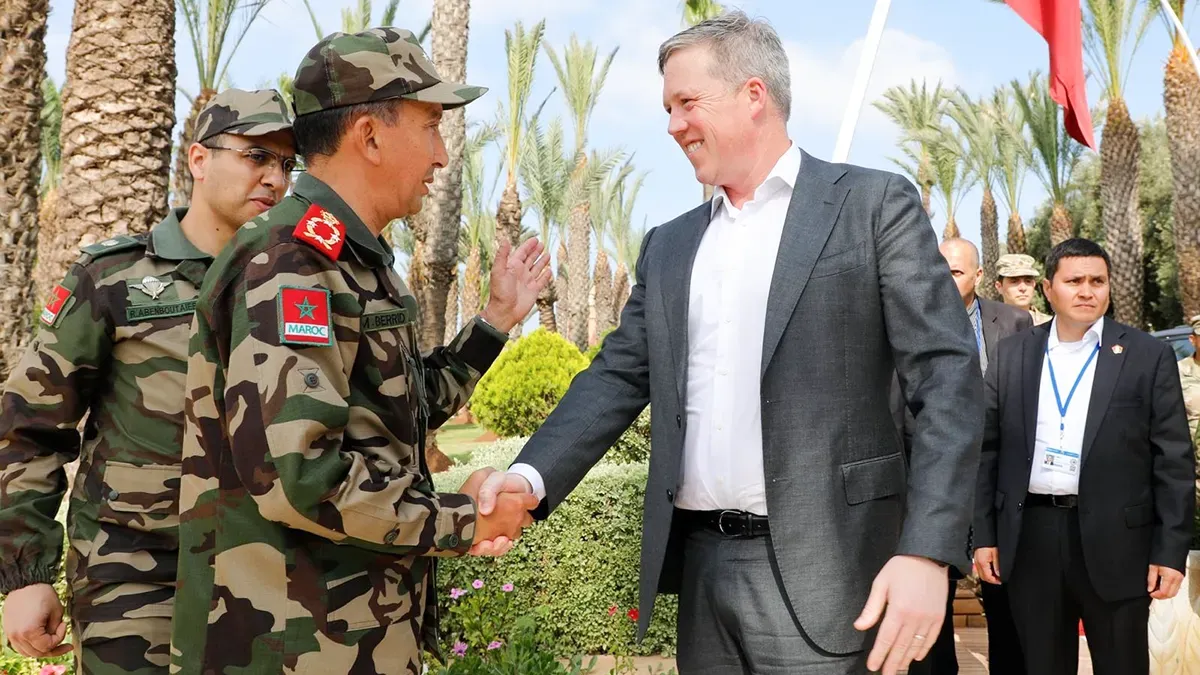
The visit of U.S. Army Secretary Daniel Driscoll to the Southern Command headquarters symbolizes a shift from a relationship based on assistance to one characterized by total operational integration. In this new dynamic, the intelligence of Morocco's Directorate of Territorial Surveillance and American intelligence services are working in complete synchrony, enhancing collaborative efforts in addressing security threats.
Modernizing Military Capabilities and Regional Stability
A cornerstone of this year's exercises is the adaptation to emerging warfare paradigms. Mohamed Al-Tayyar, director of the National Observatory for Strategic Studies, highlights that current coordination efforts focus on equipping the Royal Armed Forces with critical technologies, including artificial intelligence and drone systems, to bolster border security. This technical modernization is evidenced by the recent acquisition of AH-64E Apache Guardian attack helicopters. As noted in recent reports by Military Africa, this advanced system represents a significant leap in digital connectivity and command and control capabilities, allowing Morocco to lead joint operations that meet international standards.
In the Tan-Tan training field, the exercises have reached a milestone with the inaugural advanced support guide training course. This specialized program, which includes participation from U.S. Marines alongside representatives from Canada and Hungary, trains Moroccan officers in the complex task of coordinating air strikes, artillery, and naval fire from frontline positions. Such tactical precision is crucial in the modern operational environment, where troop security hinges on the ability to integrate joint firepower efficiently and safely, thereby reinforcing Morocco's role as a reliable technical hub on the continent.
The significance of this cooperation extends beyond Morocco's borders, particularly in addressing the instability in the Sahel region. Mohamed Essam Laaroussi, director of the Center for Geopolitical Perspectives, describes this area as a fragile region beset by cross-border terrorist alliances. In this context, Morocco's organizational robustness serves as a vital bulwark against these threats. Rabat's strategy is highly regarded in Washington for its comprehensive approach, which goes beyond military responses to combat extremism at its roots through religious and institutional reforms aimed at eliminating the intellectual foundations of radicalism.
Complementing the military dimension of Driscoll's visit is a strong political message from the U.S. capital. Deputy Secretary of State Christopher Landau, following discussions with Moroccan Foreign Minister Nasser Bourita, reiterated unwavering recognition of Morocco's sovereignty over Western Sahara. Landau emphasized that the conflict cannot afford to linger for decades, asserting that the Moroccan autonomy proposal is the only 'serious, credible, and realistic' basis for achieving lasting peace. This support also extends into the economic realm, where the U.S. government actively encourages American companies to invest in development projects within the southern provinces.
The coincidence of these exercises with the 250th anniversary of U.S. independence adds a symbolic weight to a relationship that Nabil Al-Andaloussi describes as 'institutional and regular'. For Washington, national security is reinforced by collaborating with partners that exhibit consistent operational stability. Morocco has transitioned from a peripheral ally to a central player in the new regional security architecture, capable of leading a Multinational Joint Task Force and projecting stability in a landscape marked by complex geopolitical challenges in the Western Mediterranean and Sub-Saharan Africa. For Mediterranean and Atlantic leaders, Morocco seeks to serve as a bridge for communication, information, and cultural understanding.
As reported by atalayar.com.

