
Spain's Financial Commitment to Water Infrastructure in Morocco
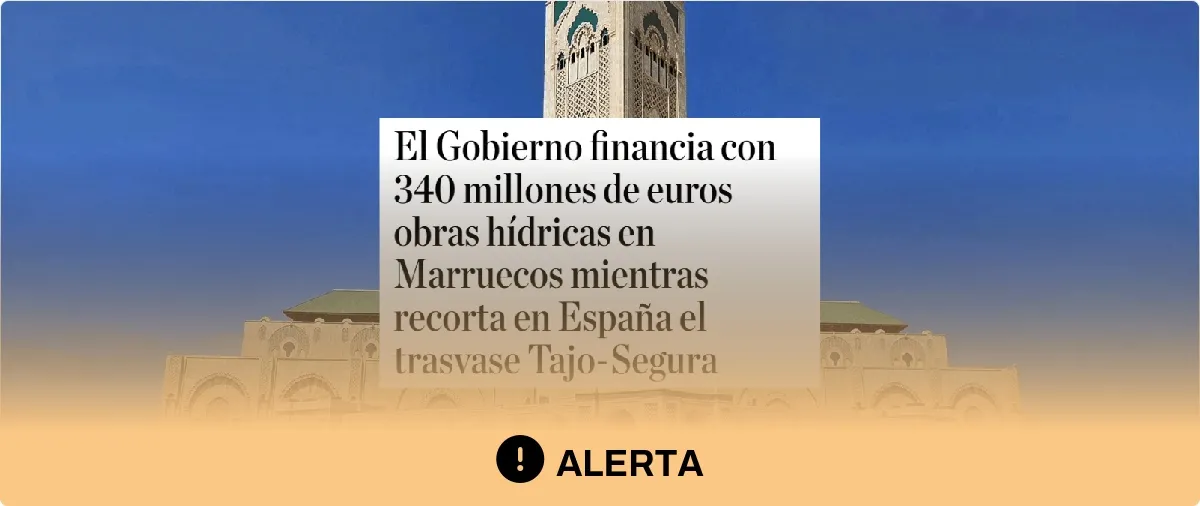
Since Pedro Sánchez took office in La Moncloa in 2018, the Spanish government has approved three loans aimed at constructing three desalination plants and two water treatment facilities in Morocco, which will need to be repaid, as previously reported by maldita.es. The most significant project among these is the Casablanca desalination plant, awarded to a consortium in which the Spanish company Acciona holds a 50% stake. The Spanish government has provided financing through three distinct loans totaling approximately €340 million, as announced in May 2025. The primary aim of this desalination plant is not to support agricultural irrigation but rather to supply potable water for human consumption across four Moroccan cities and their surrounding regions, although it also presents potential agricultural applications. Additional funding for this project comes from Attijariwafa Bank, Banque Centrale Populaire, and Bank of Africa.
Recent Developments in Spain's Water Transfer Policies
Between January 2018 and May 2026, the Spanish Agency for International Development Cooperation has subsidized at least three water-related projects in Morocco, totaling around €1.6 million, which do not require repayment. As discussions around water management intensify, claims have surfaced regarding the government "cutting back" on the Tajo-Segura water transfer system. This infrastructure channels water from the Tajo River, which has a higher flow, to the less voluminous Segura River for both irrigation and human consumption, particularly in southeastern Spain, including Murcia. Reports suggest that starting January 1, 2026, a new minimum ecological flow requirement for the Tajo River at Aranjuez in Madrid will come into effect, which ostensibly reduces the water available for transfer to the Segura.
However, this increase in the minimum flow of the Tajo River is not a government decision but rather the result of two court rulings. While the government possesses the authority to modify the operational rules of the transfer system by royal decree, no such changes had been implemented as of May 26, 2026. The last modification occurred in July 2021. Under the new regulations effective from January 1 to May 2026, the Tajo River must maintain a minimum flow of 10.4 m³/s at Aranjuez, compared to a fixed rate of 6 m³/s established by the Tajo Hydrographic Confederation's 2016 hydrological plan. This adjustment was prompted by Supreme Court decisions in 2019 and 2025 that invalidated parts of the 2016 plan for failing to comply with legal standards.
Furthermore, while the Supreme Court ruled that the new hydrological plan could not delay the goal of achieving good ecological status for protected water bodies until 2027, it mandated the immediate implementation of the minimum ecological flows designated for 2027. These new ecological flow rates were established following a methodology that considers the historical maximum and minimum water levels of the river and the ecological needs of its flora and fauna.
Importantly, the increase in the Tajo's minimum flow at Aranjuez does not automatically diminish the volumes of water transferable to the Segura, as the government has yet to approve new operational rules, a necessary procedural step. The amount of water transferred to the Segura is contingent upon the combined reserves of the Entrepeñas and Buendía reservoirs in Guadalajara. If these reservoirs release more water to the Tajo to meet the new ecological flow requirements while maintaining the same transfer volume, they will deplete more rapidly, potentially necessitating lower transfer volumes in the future. Thus, while the increase in Aranjuez's flow could indirectly affect transfer amounts, no modifications to the transfer rules have occurred to date, as confirmed by experts and the Tajo Hydrographic Confederation.
The Maldita.es Foundation has been compiling a database since 2018 to track misinformation trends in real-time, utilizing community alerts. We make our misinformation data available to researchers and organizations, collaborating on studies worldwide. Licensing this database is one of our revenue sources.