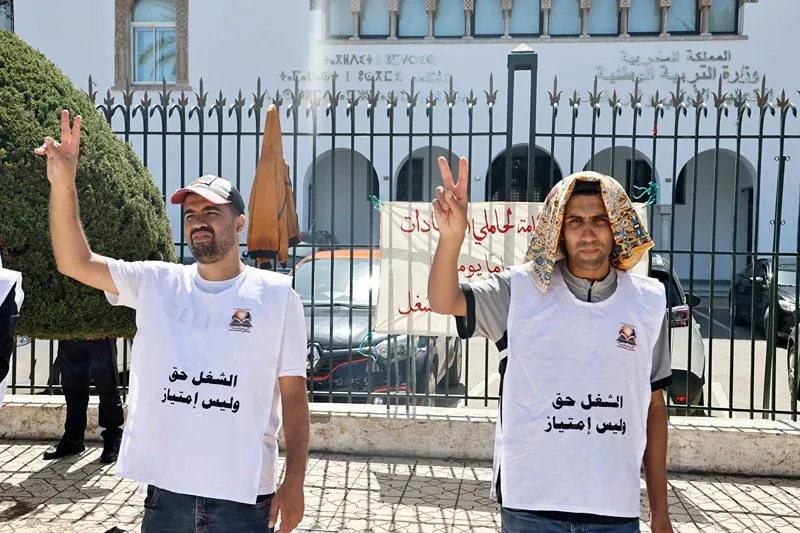

Resuming Protests Amidst Unemployment Crisis
After several weeks of inactivity, university graduates struggling with unemployment, united under the Coordination Al Karama, are set to reignite their protests. Starting Monday, July 13, they will resume their unlimited daily sit-in in front of the Ministry of National Education, Preschool, and Sports in Rabat. This decision follows a lack of tangible progress in discussions held with authorities, which the group deems as ineffective and unresponsive to their plight.
In an official statement, the coordination expressed their frustration, noting that "the relevant authorities have exhausted all pretexts for delay and evasion without offering any fair solutions or concrete measures." In what they consider a deadlock, they are committed to continuing their movement until their legitimate demand for the right to work is acknowledged and addressed.
The Impact of Prolonged Unemployment
Representatives within the collective assert that the prolonged unemployment has "consumed the prime of life" for many of their members, leading to a sense of despair and urgency. They emphasize that all avenues for dialogue have been exhausted, holding the authorities entirely accountable for the deteriorating situation. The group criticizes the government's ongoing policy of "negligence" and "procrastination" regarding their case.
Brahim Ben Aïssa, a member of the Coordination Al Karama, highlighted that this new phase of their movement continues a struggle that began nearly two years ago in the capital city. The last sit-in, organized in May, was suspended in anticipation of the Aïd Al-Adha holiday, yet no solutions were found during the interim. In his remarks to the press, he attributed the decision to resume the daily sit-in directly to what he describes as a "policy of procrastination and postponement" by the authorities, despite several dialogue sessions held in hopes of reaching a favorable resolution.
Ben Aïssa summarized the situation succinctly, stating, "This case has accumulated two years of mobilization and two years of waiting. So far, no solution has been found." The collective's sense of exclusion intensified following recent announcements by the ministry regarding recruitment measures, which they felt did not involve them, despite their representation of university graduates from diverse fields.
In light of these circumstances, the collective members have decided to reassert their presence on the ground, believing that the ministry has failed to uphold its commitments and promises. The sit-in will persist "until the full implementation of these commitments," as they demand accountability and action.
The coordination comprises graduates from various regions across the Kingdom, including Oujda, Fès, Meknès, Errachidia, and Zagora. They all share a common struggle: exclusion from public service recruitment competitions, including in the education sector, which hampers their professional integration and broader social and economic inclusion.
Over the months, their demand for employment access has coincided with a deterioration in living conditions for the coordination's members. Ben Aïssa recounted instances of graduates remaining unemployed for up to two years, with some forced to accept strenuous jobs in construction or domestic cleaning. Others work in the private sector for wages not exceeding 2,000 dirhams per month, despite their university qualifications.
He also pointed out that several members of the collective are married and support their families, yet continue to live with relatives in rented accommodations due to insufficient income. The coordination also includes individuals with disabilities who have been unable to access any job opportunities, despite their efforts with various institutions.
According to the representative, all institutional avenues have been explored. "We have knocked on the doors of different public institutions and ministries," he explained, noting that no administration has agreed to take charge of their case. He lamented that despite government announcements regarding the creation of one million jobs and support for youth, "we, the young people directly affected by this discourse, have received no support."
For Ibrahim Ben Aïssa, Coordination Al Karama has become a reflection of the plight faced by a segment of unemployed university graduates in Morocco. After two years of mobilization in Rabat, "no solution has been brought forth," he asserts, maintaining that the collective's members remain determined to continue their movement "until the right to a dignified and equitable job is achieved."
In conclusion, the previous episode of this mobilization occurred in May when authorities intervened to end the unlimited sit-in in front of the Ministry of National Education, Preschool, and Sports after several days of protesting for employment opportunities. The action was then suspended during the Aïd Al-Adha period. In their latest statement, Coordination Al Karama announced the resumption of their protest program starting Monday, July 13, in front of the ministry's headquarters.
As reported by fr.hespress.com.