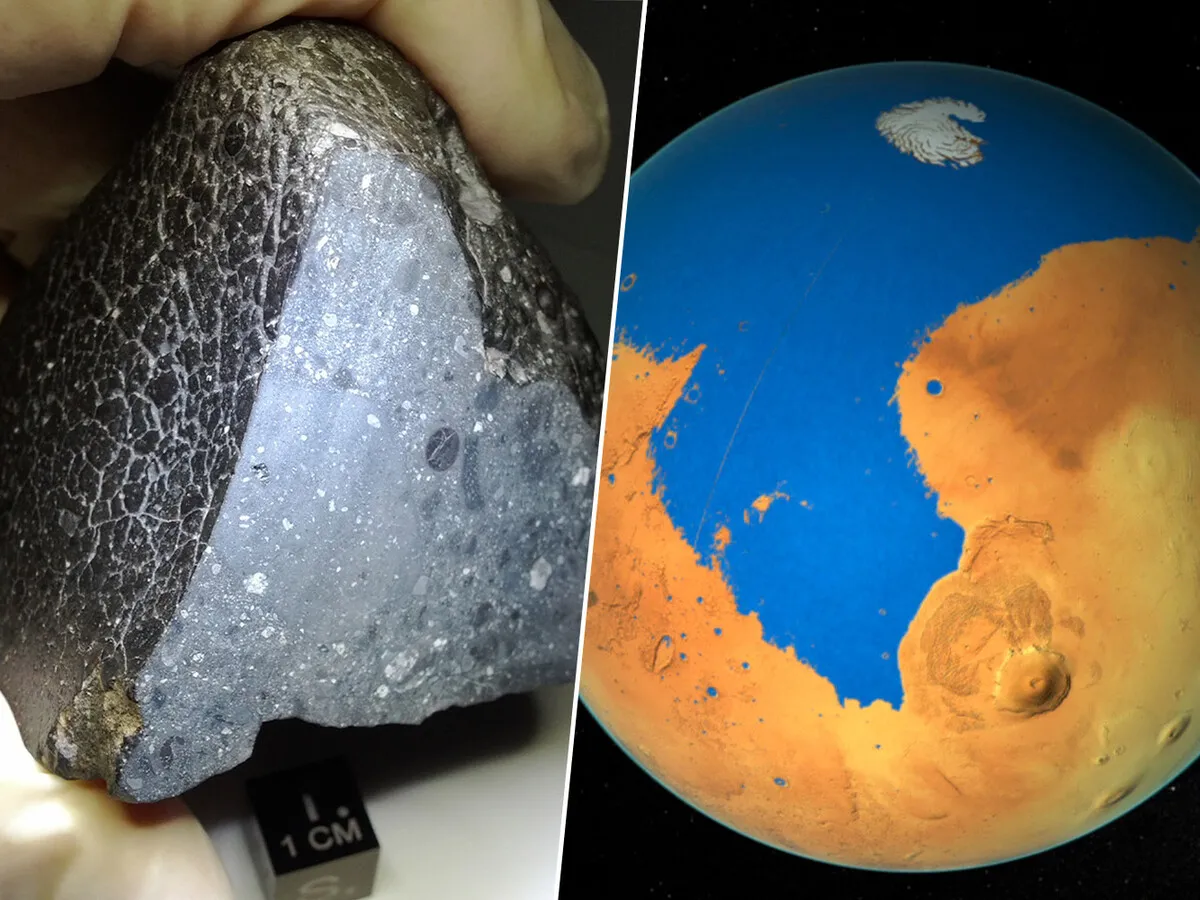

A Rare Find from the Red Planet
In a remarkable discovery, a black stone that fell from the sky was unearthed in the Sahara Desert by a group of Sahrawis. Initially sold to the highest bidder, this meteorite, known as 'Black Beauty' and officially designated as Northwest Africa 7034, has been confirmed to originate from the crust of Mars. Since its discovery in 2011, scientists have spent over a decade unraveling one of its best-kept secrets, and the revelations of 2026 are particularly exciting.
Weighing in at 320 grams, Black Beauty was discovered in the Western Sahara and later sold to a U.S. collector in Morocco. What sets this meteorite apart from other known Martian specimens is its unique composition. It contains a mixture of ancient and relatively young minerals, aligning with observations made by NASA's rovers on the Martian surface, indicating that it was part of the Martian crust when it detached from the Red Planet.
A Time Capsule of Martian History
Recent studies have revealed that Black Beauty serves as a veritable time capsule, providing insights into Mars' early history. In a groundbreaking study conducted in 2025, researchers focused on a zircon grain found within the meteorite, which is estimated to be around 4.45 billion years old, placing it in the earliest stages of Martian history. Most known Martian meteorites originate from later geological periods, making NWA 7034 an invaluable source of information about the planet's surface environment long before it evolved into its current state.
What further distinguishes Black Beauty is its water content, which is ten times greater than that of other Martian meteorites. A recent study has pinpointed the location and nature of this water, utilizing advanced techniques such as X-ray computed tomography and neutron tomography. The latter is particularly significant as neutrons can penetrate dense materials and detect hydrogen signatures without causing destruction.
This unprecedented mapping revealed that hydrogen was concentrated in clusters of 'hydrogen-rich iron oxyhydroxides.' Although these clasts constituted only 0.4% of the analyzed volume, they contained up to 11% of the total water within the sample. This finding indicates that Black Beauty not only interacted with water but also harbors a genuine reservoir of it within its structure.
Moreover, the fragment contains iron, aluminum, and sodium—elements that are unusual for a zircon of purely magmatic origin. Especially noteworthy is the presence of tiny magnetite inclusions, suggesting that it crystallized under hydrothermal conditions, meaning it formed in the presence of heated water within an oxidizing environment.
Perhaps the most intriguing aspect of the findings from 2026 is that the compounds formed by this water bear striking similarities to the samples being collected by NASA's Perseverance rover in the Jezero Crater. Despite originating from a completely different area of Mars, this resemblance indicates that over 4 billion years ago, there was likely a widespread water deposit near the surface across the planet. This reinforces the hypothesis that Mars possessed water during its formative stages, creating conditions favorable for widespread microbial life.
While the existence of life on Mars or the possibility that it reached Earth via meteorites remain unproven theories, the insights gained from a meteorite discovered in 2011 highlight the importance of Martian samples. As NASA and China plan to bring back Martian samples in the coming years, the discoveries surrounding Black Beauty provide a compelling reason to continue exploring the mysteries of the Red Planet.
As reported by xataka.com.