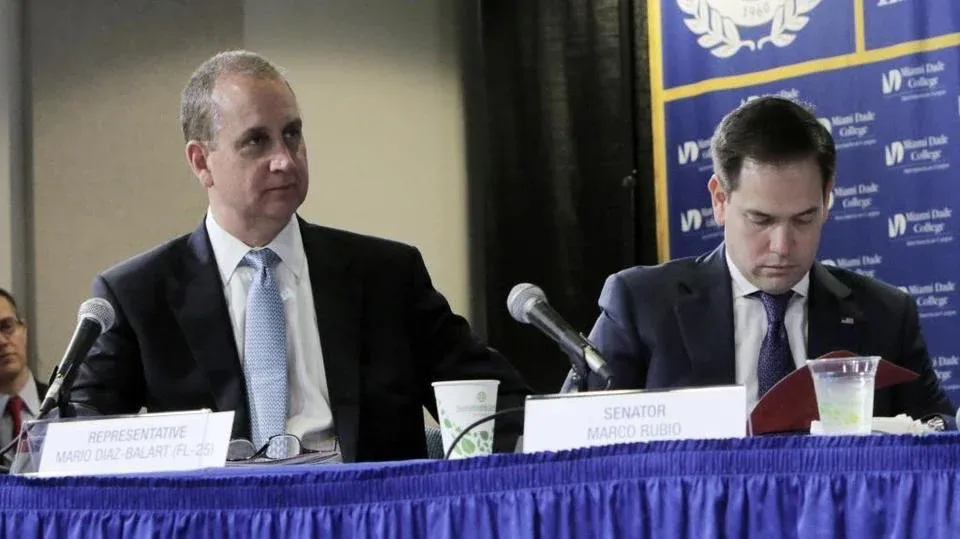

In a significant development that has stirred diplomatic tensions, U.S. officials are once again challenging Spain's claim to sovereignty over the territories of Ceuta and Melilla. This renewed scrutiny follows remarks made by Michael Rubin, a former Pentagon advisor, and is now echoed by Republican Congressman Mario Díaz-Balart, a notable ally of Marco Rubio. Díaz-Balart's statements have raised eyebrows within both the Spanish government and the right-wing opposition parties, signaling a potentially volatile shift in how American political figures perceive Spain's control over these territories.
During a recent interview with a media outlet known for its conservative affiliations in Spain, Congressman Díaz-Balart made a contentious assertion, stating, "Ceuta and Melilla are not situated on Spanish territory but rather on Moroccan soil." He underscored the historical and positive relations between Morocco and the United States, thereby framing the discussion about sovereignty within a broader context of international alliances and geopolitical strategy.
This assertion comes at a particularly fraught time, marked by increasing tensions between President Donald Trump and Spanish Prime Minister Pedro Sánchez, especially regarding the ongoing conflict in Iran. Notably, just a week prior, the Spanish government closed its airspace to American military aircraft engaged in operations against Iran, a move that has further complicated relations. Díaz-Balart did not hesitate to address these strained relations, suggesting potential American reprisals against Spain, stating, "It is not surprising that President Trump is exploring alternatives, as it is unfortunate that he risks the alliance between the United States and Spain." He pointed to American military installations in Rota and Morón, which continue to yield significant economic advantages for the Spanish regions involved.
In response to these developments, Spain's main opposition party, the People's Party, alongside the far-right Vox party, has expressed alarm over the implications of such statements and the potential for deteriorating diplomatic ties. Further escalating the situation, President Trump recently made comments suggesting a possible reevaluation of the U.S. commitment to NATO, stating, "I have never been convinced by NATO. I have always known it was a paper tiger," which could have far-reaching consequences for transatlantic relations.
Amidst this backdrop, Congressman Díaz-Balart criticized Prime Minister Sánchez for allegedly prioritizing relationships with nations such as Iran, Cuba, and Venezuela over those with the United States. A proponent of Moroccan interests, Díaz-Balart has previously supported legislation aimed at designating the Polisario Front as a foreign terrorist organization and is a member of the Congressional Morocco Caucus, which advocates for Moroccan concerns within U.S. legislative discussions.
As the chair of the State Department, Foreign Operations, and Related Programs Subcommittee, as well as an active member of the Defense Subcommittee, Díaz-Balart has played a significant role in shaping U.S. foreign policy towards Morocco. In April 2025, he engaged in talks with Morocco's Foreign Minister, Nasser Bourita, in Washington, further solidifying the U.S.-Morocco relationship. Meanwhile, former Pentagon advisor Michael Rubin has called on King Mohammed VI to consider a "new march to reclaim Ceuta and Melilla," arguing that these cities are not protected under NATO's umbrella, thereby intensifying the discourse surrounding the territorial claims.
As reported by en.yabiladi.com.