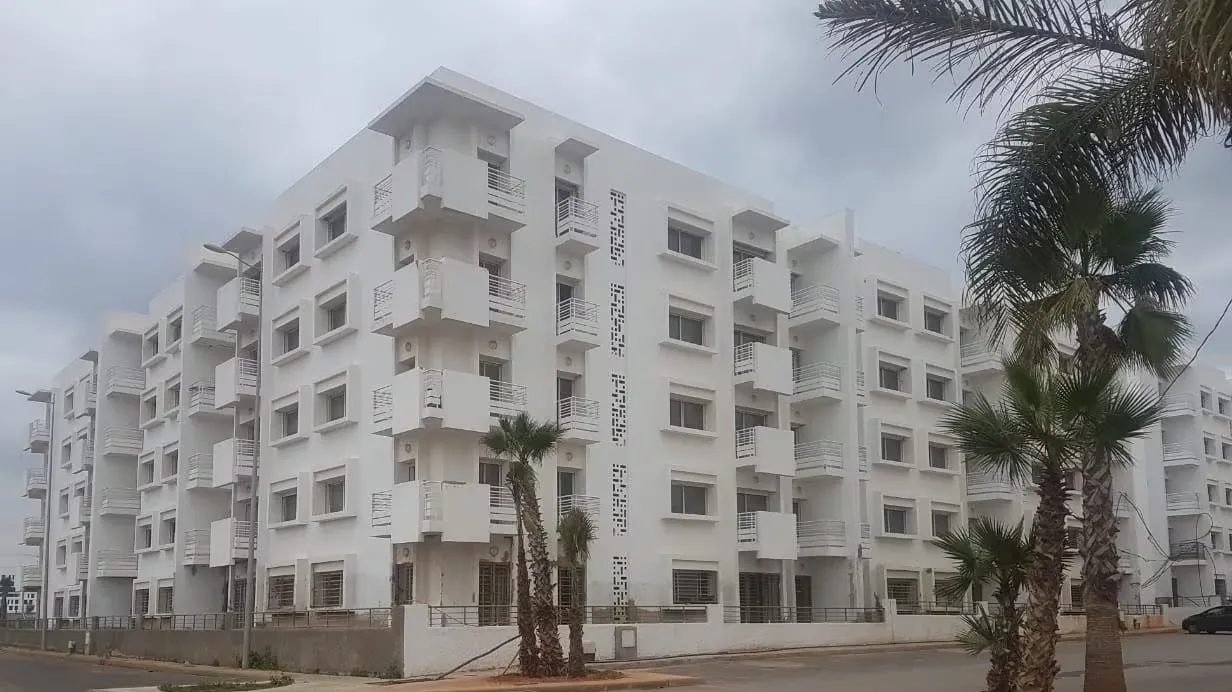

Aïn Sebaâ Court Delivers Verdict in Casa Parc Case
The Aïn Sebaâ correctional court delivered its verdict on Wednesday in the case involving real estate developers Sadreddine Benhima and Hassan Benabdelali, who are half-brothers and directors of the company Treize-Huit. They were sentenced to eight months in prison, with the sentence suspended, leading to their immediate release. The case revolves around the Casa Parc project, which aimed to create a large residential complex featuring nearly 1,200 apartments and land lots in the Sidi Maârouf neighborhood on the southeastern outskirts of Casablanca. Originally scheduled for delivery around 2016, the project faced significant and successive delays, prompting several buyers to form a collective to seek legal redress, either for the delivery of their properties or for the reimbursement of the amounts they had already paid.
The two developers faced charges of forgery and the use of false documents, as well as making misleading statements and the transfer of assets that were reportedly subject to a conservatory seizure. In terms of the forgery allegations, the defense successfully demonstrated that the prosecution's case lacked solid foundation. They were accused of failing to inform buyers about the existence of a mortgage on the property titles; however, the defense underscored that all pertinent information was publicly accessible, particularly through the platform of the national land conservation agency. Furthermore, the title numbers and construction permits were visibly posted at the construction site.
Additionally, the reservation contracts stipulated that clients were responsible for conducting all necessary verifications before committing. The sales process required that the buyer only signs after confirming the authenticity of the information provided. Given these circumstances, the charges of forgery and the use of false documents were dismissed. Regarding the misleading statements, the developers were accused of implying that the creditor bank, Attijariwafa bank, was associated with the project. The defense clarified that there was indeed a commercial relationship with the bank but no capital involvement. They also argued that the incriminating remarks had been misinterpreted during the inquiry.
Legal Proceedings and Financial Reimbursements
The accusation of transferring assets under conservatory seizure was also refuted. The developers claimed that the sales were concluded prior to any seizure measures. Certificates from the land conservation authority confirmed that no such seizure affected the properties at the time of the transactions. The defense also raised the issue of the statute of limitations, noting that the complaints were filed eight years after the events, exceeding the four-year legal limit for tort cases. They emphasized the purely commercial nature of the dispute, supported by various expert opinions indicating that the advances paid by clients were used to finance the construction site rather than for misappropriation or the acquisition of other properties.
Throughout the proceedings, the defense highlighted the good faith of the two defendants. The 57 complainants who initially opened this case have all been fully reimbursed. More broadly, the developers claim to have already refunded about 430 buyers, the majority of whom did not pursue legal action. These reimbursements were reportedly made in accordance with the terms of the reservation contracts in exchange for a waiver.
During the trial, seven new complainants joined the initial list. However, the two developers and their defense opposed their inclusion in the proceedings, arguing that "if reimbursements continue at this pace, the case will never be resolved." Nevertheless, the developers assured that these seven complainants would also be reimbursed, but outside the current judicial framework to avoid indefinite prolongation of the dispute. The priority now is to complete the construction project, which is expected to resolve several pending situations.
At the heart of the case is an agreement nearing finalization between the developers, the creditor bank, and a Moroccan investment bank. With Attijariwafa Bank, a settlement amount of approximately 370 million dirhams has been set to settle the debt. The proposed mechanism involves transferring the master title to an investment bank, which will finance the repayment to the creditor bank. A portion of the funds, estimated at 50 million dirhams, is expected to come from the sale of apartments still held by Treize-Huit. Once the debt is cleared, the lifting of guarantees will be obtained, thus removing legal blockages and fully resuming transactions.
In this new arrangement, the company Treize-Huit will retain management of pending matters with the buyers, while the investment bank will oversee the continuation of the real estate project through a newly dedicated structure. A first residential complex, currently 60% completed, is expected to be finished initially, before the launch of other blocks, all under the permits already granted to Treize-Huit. It is important to note that the main challenge in real estate promotion lies in land acquisition. For this project, Treize-Huit had to negotiate with more than 70 heirs to purchase the land, which was a particularly complex operation.
The Casa Parc project is distinguished by a finely tuned marketing strategy. The developers have targeted young couples in their thirties with dual incomes, capable of taking out long-term mortgages. The apartments, offered at prices below one million dirhams, cater to a wide market segment. The developers also assure that they have reserved a sufficient number of apartment lots to guarantee the rights of the buyers, offering several options between reimbursement and finalization of acquisition, depending on individual preferences.
As reported by fr.le360.ma.