
Ambassador Oubi Buchraya Bachir Addresses UN Human Rights Council
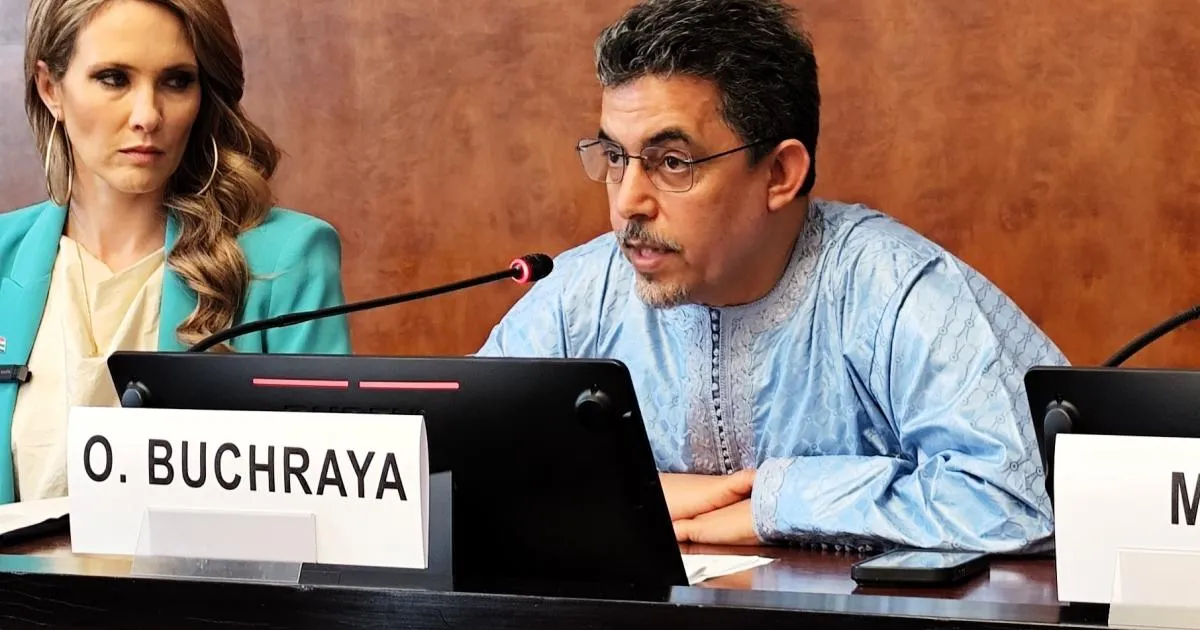
In a significant closing statement delivered at a high-level side event organized by the UN Human Rights Council in Geneva, Ambassador Oubi Buchraya Bachir, who serves as the Special Advisor to the Sahrawi President and leads the Committee on Natural Resources and Legal Affairs, raised urgent concerns about the implications of disregarding established international law in the context of Western Sahara. He cautioned that such actions pose a grave threat not only to global multilateralism but also to the stability of the North African region.
During this pivotal event, aptly titled "Western Sahara and the Right to Self-Determination: Challenges to International Legality," the Ambassador provided a comprehensive analysis of Morocco's unilateral political strategies and its diplomatic narratives. He began by articulating the Sahrawi struggle as intrinsically linked to the integrity of the contemporary international rules-based order, highlighting the unprecedented systemic challenges faced by global institutions today. "We are discussing today the credibility of international law, the effectiveness of multilateral institutions, and the universality of the right of peoples to self-determination at a time when respect for international law is facing unprecedented challenges," Oubi stated, underscoring the critical nature of these discussions.
Ambassador Oubi further emphasized the stagnation in the decolonization process, warning that this trend fosters a perilous environment for multilateralism and jeopardizes the futures of the remaining 17 Non-Self-Governing Territories still in pursuit of their own self-determination. He made a direct connection between resolving the Western Sahara conflict and ensuring broader security within the Maghreb region, characterizing Morocco as an expansionist entity with unresolved borders that could lead to regional destabilization. "Morocco is the only country in the world that doesn’t have any of its borders formalized with neighbours," he noted, citing ongoing tensions with Spain, Algeria, Mauritania, and Western Sahara as evidence of the potential for broader conflict.
Moreover, the Ambassador articulated that the Sahrawi resistance, underpinned by international legal frameworks, stands as a crucial barrier against Moroccan expansionism. He asserted that any weakening of self-determination in Western Sahara would embolden Morocco's territorial ambitions, stating, "the weakening of self-determination in Western Sahara would open the appetite of Morocco to new adventures. The narratives are already there. Therefore, the stability in this region depends largely on the proper decolonization of the territory in accordance with international law." In addressing the recent developments in diplomatic circles, Oubi skillfully dismantled the Moroccan media narratives regarding the UN Security Council's framework and the ongoing joint UN-US diplomatic initiatives.
He pointed out that the latest Security Council resolution reaffirms the primacy of the right to self-determination as a fundamental objective for any political resolution of the conflict, firmly grounding its legal basis in the UN Charter. Additionally, Resolution 2797 clearly identifies the Polisario Front and Morocco as the two principal parties involved in the conflict, emphasizing that a viable solution must be mutually acceptable while also extending the operational mandate of MINURSO for a full year without alterations.
While he acknowledged that joint UN-US diplomatic efforts successfully facilitated a direct dialogue between both parties for the first time in six years, allowing each to present their proposals, Oubi was quick to clarify the narrative surrounding responsible engagement. He criticized Moroccan propaganda that attempts to cast Rabat in a favorable light as a cooperative negotiator, asserting that it is actually the Polisario Front's commitment to constructive dialogue that has sustained UN efforts for decades, while Morocco has consistently acted as an obstructionist force.
In concluding his address, Ambassador Oubi reaffirmed the Polisario Front's commitment to negotiating in good faith to achieve a fair and enduring resolution that guarantees the Sahrawi people's right to self-determination. He stressed that "sovereignty over Western Sahara belongs exclusively to the Sahrawi people, and the final status of the territory can only be determined by them." He also provided a sobering assessment of the dire human rights and humanitarian conditions in the occupied territories, warning international stakeholders against endorsing proposals that do not adhere to international law. Highlighting systematic human rights abuses, media restrictions, the expulsion of international observers, and arbitrary detentions occurring daily, he cautioned that endorsing any notion of autonomy under such circumstances would effectively consign the Sahrawis to an abyss, perpetuating their plight within what he termed an open-air prison.
As reported by spsrasd.info.