
The prospect of French President Emmanuel Macron attending another match between Morocco and France raises intriguing questions about the potential for a repeat of the politically charged atmosphere witnessed during the 2022 World Cup in Qatar. As the possibility of Macron's presence at a future game unfolds, particularly on American soil, it invites speculation about the underlying political and geopolitical messages that may accompany such an event, transcending the realm of mere sports.
For many observers, merely contemplating Macron's attendance at a match featuring France and Morocco is enough to spark discussions laden with meaning and interpretation. While it is customary for heads of state to be present at significant sporting events, Macron's keen interest in being visible from the quarter-finals onward, especially against a team like Morocco, elevates the event from routine to a subject of inquiry: what message is he trying to convey, and to whom?
In principle, no one contests a president's right to support their national team; the iconic image of a leader waving their country's flag and celebrating goals has become a part of modern football culture. However, when such attendance becomes a focal point of discussion—“Will Macron come? When? Why?”—the inquiry transforms into a legitimate question: is this simply a display of sporting passion, or a conscious utilization of a match laden with symbolic significance?
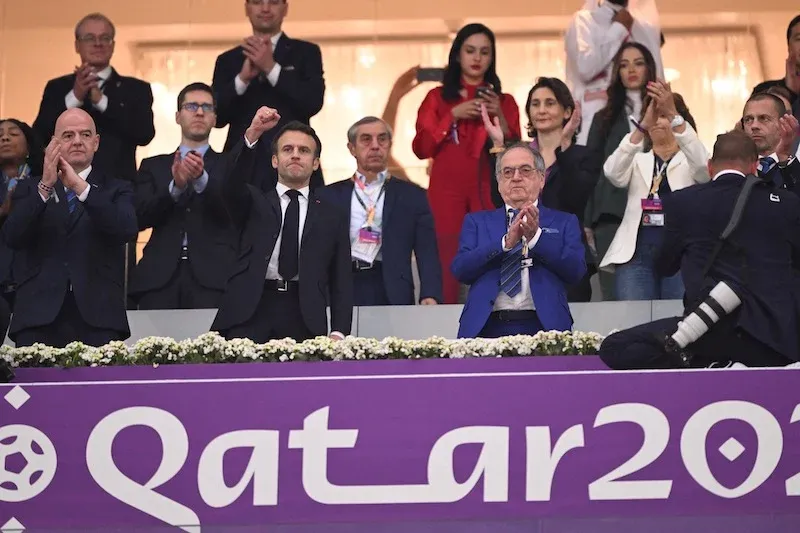
During the 2022 World Cup in Qatar, Macron transitioned from being a mere spectator to a pivotal player in the narrative. His presence in the stands, corridors, locker rooms, in front of cameras, and even on the plane made him an integral part of the unfolding story, as much as the French team itself. Today, as similar signals about his attendance at a new encounter between France and Morocco in an American World Cup emerge, we cannot help but ask whether we are on the verge of a deliberate replay of a scenario previously enacted, complete with its associated triumphs and tribulations.
The 2022 match was not merely a semi-final; it represented a convergence of various layers: intense discussions surrounding human rights and labor issues, European debates regarding finances, gas, and relations with Doha, as well as a specific sensitivity surrounding a matchup between France and an African Arab team, representing a country with a colonial history intertwined with France and a significant diaspora within its cities.
In this context, Macron raised the banner of “keeping sports apolitical,” yet his actions rendered the sporting event more politicized than ever. The images emerging from Qatar depicted not just a team striving for victory, but a president asserting France's presence in a tumultuous Gulf, navigating the threads of gas, alliances, and international reputation.
The stadium, in that moment, resembled a diplomatic stage: every movement, every appearance, every absence, and every statement carried multiple meanings. Thus, when we ask today, “What if Macron attends the Morocco vs France match in America again?” we are actually probing whether the same symbolic machinery will be reactivated, whether this encounter will once again serve as a platform for reiterating the narrative of “France present everywhere,” the “special relationship” with Morocco, and Paris’s ability to communicate with the world through the medium of football.
It is undeniable that any match between the French and Moroccan teams does not merely commence with the referee's whistle; there is always a historical context preceding it: the legacy of French colonialism, migration experiences, integration efforts, and generations of Moroccans in France holding French passports while retaining familial memories of Morocco, alongside an ongoing dialogue about identity, belonging, and the questions of “who are we” and “who do we support.”
Should Macron’s attendance at another match be contemplated, it directly engages with these pressing questions. His presence in the stands would not only resonate with traditional French fans but also with millions of French citizens of Moroccan descent, who sometimes cheer for both French and Moroccan goals simultaneously, and whose flags are observed in the streets and cafes as political indicators rather than mere spontaneous expressions of joy.
This leads us to a crucial inquiry: if Macron were to repeat his attendance at this match, would his stated and implicit objectives be to reaffirm the discourse of “shared living” and “friendship between peoples,” or would there also be an underlying desire to preemptively shape the narrative of the game to prevent it from falling into the hands of extremist discourses that might attempt to turn it into an identity clash?
At this level, football transcends mere athletic competition; it becomes a global platform for messaging, with the American context adding a new layer: the presence of a Moroccan, Arab, and Muslim community in the U.S., albeit smaller than that in Europe, alongside France's image in the United States as an old Western partner seeking a role in a changing world, competing with other powers (Europe, China, regional states) for influence in North Africa and the Sahel.
If Macron were to attend the Morocco-France match in America, he would simultaneously address multiple audiences: a divided and tense domestic French populace, Moroccans both within the country and in the diaspora, who see their team as a symbol of their nation’s ascent, and partners, allies, and competitors monitoring Paris's relationship with Rabat and France’s position in the southern Mediterranean and Africa.
Thus, the formulation of the question “What if Macron attends again?” evolves beyond mere curiosity; it becomes an invitation to interpret the event as a new chapter in France’s repositioning strategy, utilizing football as a soft power medium filled with emotion and seemingly devoid of overt politics, yet laden with significant political implications beneath the surface.
There is also an internal dimension that cannot be ignored; each time Macron appears at a major sporting event, discussions arise regarding the limits of exploiting collective joy for political purposes. In 2018, images of the president joyfully celebrating in Moscow were met with relative acceptance, as he appeared to genuinely share in the happiness of his people.
However, in 2022, the recurrence of such images, coupled with the clamor of statements, led some French citizens to feel that the president was overly leveraging football to compensate for the fragility of his image in other areas.
Today, the question remains: if Macron were to attend the Morocco-France match again, and it is not yet a final stage, would his presence be read as a signal of closeness to “the people” or as an insistence on placing his image at the forefront of every major emotional moment? Would he be perceived as a fan among fans, or as a director seeking to inscribe his name prominently in both the opening and closing credits?
Thus, the inquiry, “What if Macron attends the Morocco vs. France match again?” transcends the notion of merely occupying a seat in the stands; it delves into the nature of the current phase, with football serving as a mirror reflecting how a nation like France grapples with its colonial past and its relationship with Morocco, its complex domestic realities concerning identity, migration, and belonging, and its evolving position in the international influence map as it seeks to convey that it remains “present” through sport, culture, and symbols, even as its traditional tools wane.
Macron may choose to attend, or he may opt for absence. He might reiterate the language of “keeping sports apolitical” or engage in lengthy comments about “the friendship between peoples.” However, what is nearly certain is that any match between Morocco and France will not be interpreted—in Paris, Rabat, or Washington—as merely ninety minutes of chasing a ball, but rather as a condensed scene of a world striving to reorganize itself, with a president who understands that his presence in the frame is part of this reordering game.
Whether the upcoming attendance will replicate the 2022 scenario, serve as a corrective, or break away from it entirely is a question whose answer will not be determined by the score on the scoreboard, but rather by how Macron chooses to position himself—whether in the modest background or prominently in the forefront, as he has done on previous occasions.
As reported by hespress.com.