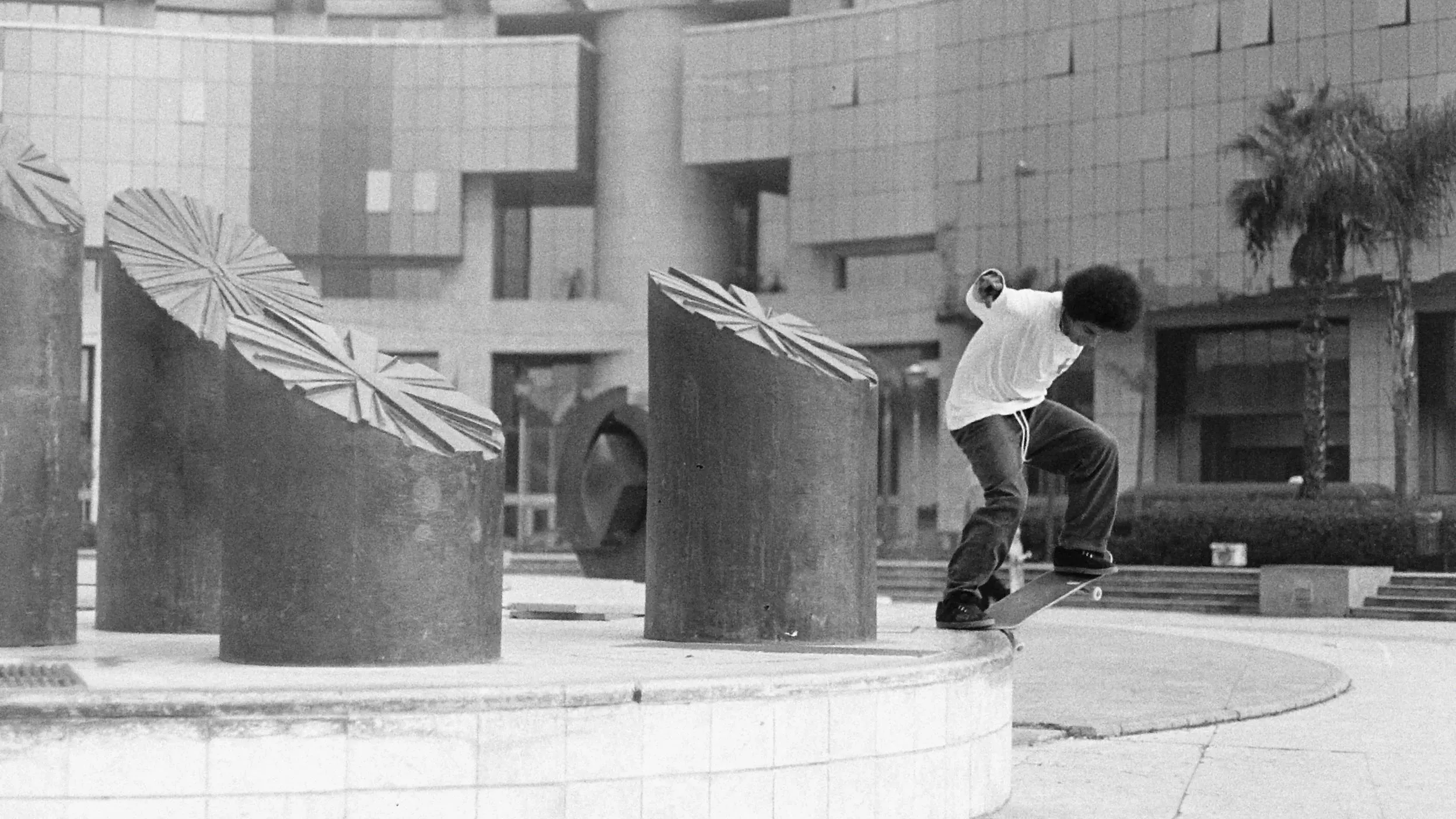

When you delve into Yassine Sellame’s Instagram, you are greeted by a vibrant portrayal of Morocco viewed through the lens of skateboarding. His feed is a tapestry of portraits and dynamic night shots, filled with scratched film negatives, cracked concrete plazas, worn-out shoes, and fleeting tricks that capture the essence of skate culture in cities like Casablanca, Marrakech, and Tangier. As you immerse yourself in these images, a deeper narrative unfolds—one that highlights community, movement, and the transformative power of skateboarding in shaping urban experiences.
Born in Marrakech, Sellame’s journey into the world of skateboarding predates his venture into photography. Like many skaters of his generation, he discovered this culture online, spending countless hours watching skate videos and hunting for local representations of the sport within Morocco. This curiosity eventually led him to Gueliz, Marrakech's modernist quarter, where he uncovered not only local skate spots but also a burgeoning community of fellow skaters. The interplay between skateboarding and urban environments has significantly influenced Sellame’s artistic trajectory, as he later pursued studies in Fes and spent more time in Casablanca, where he encountered a more interconnected and active skate scene that would become a pivotal reference point in his work.
Initially limited by financial constraints, Yassine Sellame turned to second-hand film cameras purchased at flea markets, teaching himself to develop and scan negatives independently. This self-taught journey laid the foundation for a practice centered around analog photography, eventually leading him to invest in a Mamiya RB67, a camera that has since become synonymous with his artistic identity. “The first time I saw my developed photos, I was immediately drawn to the process. Analog photography became essential to me because of its rawness, its texture, and the way it naturally aligned with skateboarding,” Sellame reflects.
As photography became an inseparable part of his skateboarding experience, Sellame embarked on extensive travels across Morocco from 2016 to 2021, documenting skaters and skateparks in cities including Casablanca, Tangier, Rabat, Agadir, Fes, and El Jadida. In 2019, he made the move to Casablanca to focus his lens on the newly reconstructed Nevada Skatepark, recognized as the largest skatepark in Africa and a key hub for local skaters. Here, he forged connections with David and Rayan, two Ivorian students, who reintroduced him to a broader West African creative network. His visit to Abidjan in 2023 further enriched his perspective, as he spent a month documenting the daily lives of skate collectives, musicians, and artists.
“As I traveled across Morocco, discovering new spots, I realized how the city itself was shaping me,” Sellame explains, emphasizing how his understanding of urban spaces evolved into a playground of possibilities. His photography captures not only the act of skateboarding but also the architecture, gestures, clothing, and atmosphere that surround it. The plazas, financial districts, medinas, and oceanfront promenades of Casablanca have increasingly become integral to the visual language of Moroccan skateboarding.
“I focus on capturing the aesthetics that shape the skate community—clothes, shoes, portraits, and everyday details,” Sellame shares. His photographs often come with personal captions that narrate the context of each image, transforming his archive into a living document of the skating scene. This attention to detail holds particular significance in Morocco, where skateboarding has historically lingered on the fringes of mainstream culture. “For a long time, skateboarding here wasn’t really captured beyond quick social media clips,” he notes. “Yet, I truly value slow documentation, allowing each moment to breathe because it preserves something more authentic in today’s fast-paced digital life.”
In 2017, as film development became less accessible, Sellame took the initiative to develop negatives himself, guided by friends until the process became second nature. His focus on medium format 120 film further slowed down his approach to photography, mirroring his perspective on skateboarding as a means of navigating cities and fostering relationships. He emphasizes that the moments between tricks—skaters waiting, worn trainers on pavement, late-night conversations, and empty parks at sunset—are just as significant as the tricks themselves.
Simultaneously, skateboarding in Morocco has gained visibility, with new skateparks emerging alongside traditional sports facilities, signaling a broader recognition of the sport. “Today, the skate scene across Morocco is really changing,” Sellame observes. “More people are aware of skateboarding, but the culture—its origins and evolution—remains somewhat misunderstood.” This gap in understanding became particularly pronounced when skater Aya Asaqas made history as the first Moroccan and Arab woman to compete in the sport at the Paris 2024 Olympics, drawing national attention while spotlighting the disconnect between public perception and the core of the skate subculture.
Sellame acknowledges the growing recognition of skateboarding as a sport, especially following Asaqas’s achievements. However, he stresses that skateboarding cannot be divorced from the communities and creative networks that surround it, as it naturally intersects with music, fashion, graffiti, photography, and filmmaking. “Skating and photography are deeply intertwined. When you’re a skateboarder at the spot, you naturally meet other creatives,” he explains, highlighting the collaborative spirit that defines the scene.
This synergy is increasingly evident among Moroccan youth, as streetwear, music, and skateboarding converge in ways that were rare when Sellame first embraced skating in Marrakech. Skate collectives have evolved into expansive creative communities that encompass merchandise, film, music, and exhibitions. This artistic intersection culminated in the 'Wheels in Motion' exhibition, a collaboration with photographer Salaheddine Elbouaaichi, presented through the Riad Alena artist residency in Marrakech and showcased at the 1-54 Contemporary African Art Fair. The exhibition explored the wheel as a recurring visual motif in the city, connecting skateboards, bikes, scooters, and everyday movement across urban Marrakech.
Momentum within the skate scene has also been fueled by Nassim Lachhab, the first African professional skateboarder, whose partnerships with prominent skate brands have brought international attention to Morocco. The visibility of skateboarding has been further amplified through social media, uniting skaters across cities that once felt isolated. However, Sellame expresses concerns regarding the design of newly constructed skateparks, which often lack an understanding of how skaters utilize space. “These parks are frequently built by individuals who don’t grasp the essence of skateboarding, resulting in awkward designs that frustrate skaters,” he remarks, reflecting a broader tension seen in emerging skate scenes globally.
Despite these challenges, Sellame remains optimistic about the future of Morocco’s skate scene, envisioning a more interconnected community. “My dream is to spend a month in each city, working with local skaters to strengthen their sense of community,” he shares. The burgeoning skate community is more diverse and skilled than ever, with streetwear evolving in tandem with skate culture. In Casablanca, Sellame has become actively involved with Beurdies, a skate collective that engages in events, merchandise, photography, and music, further intertwining the skate community with artists from various creative backgrounds.
In 2022, after years of focusing on a marketing master’s degree and working in Casablanca’s communications sector, Sellame reconnected with skate culture through a project with the Concrete Jungle Foundation, which sought to build a skatepark for an orphanage in Tamesloht, near Marrakech. This project reignited his passion for skating and deepened relationships with local skaters, including Mohamed El Mhaour, known as 'Hanota The Pirate.' “We helped him with visa applications for skate competitions, supported his projects, and watched him learn English. He feels like a brother to me,” Sellame shares, illustrating the emotional bonds that underpin the skate community.
Beyond the aesthetics and visibility of skateboarding, Yassine Sellame’s narrative emphasizes the importance of mutual support within skate scenes, especially in regions where creative industries face instability. He candidly expresses the pressures that accompany this passion, noting that despite increased visibility, Morocco’s skate scene still lacks the sponsorship and infrastructure found in larger markets. “One moment you’re dreaming about filming, and the next you’re struggling to make ends meet,” he reflects. “But I remain committed to the community. We keep skating, enjoying ourselves, and I continue to create, even when the freelance life gets tough.”
As reported by admiddleeast.com.