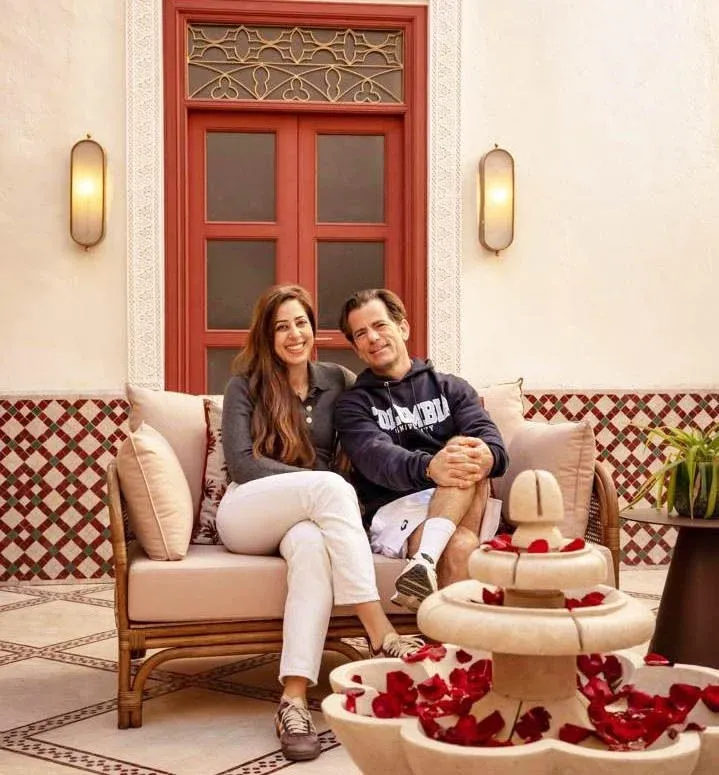
With vibrant green eyes and a dimpled smile that emerges at the hint of a fond memory, Nicolas Delsuc recalls phrases, proverbs, stories, and anecdotes from his father, which spring forth with an unmistakable sense of eagerness. In contrast, his wife Joëlle Dagher exudes a calm demeanor, characterized by a Cartesian approach and unwavering rigor. Although her smile is cautious and contemplative, it complements the vivacity of Nicolas. Together, they have formed a remarkable duo for the past six years, both in their personal lives and professional endeavors. "We can spend 24 hours a day together... Our friends envy us!" they exclaim, with Nicolas taking charge of the cooking while Joëlle handles the dishes, showcasing their harmonious partnership.
Despite their differing backgrounds and distinct personalities, they have come together to create a shared vision: an exclusive hotel in Marrakech, set in an 18th-century house transformed into a quaint establishment featuring twelve rooms, three patios, and two terraces in the serene neighborhood of Zaouia el-Abassia. Marrakech, a city far removed from their roots, serves as an unexpected chapter in their journey, which was not initially planned to lead them to this vibrant locale.
Nicolas hails from Ivory Coast, born into a family of entrepreneurs, where his grandfather was a polytechnician and his father, a self-made businessman who never attended school. His mother, Marysa Saad Delsuc, was born in Dakar to Lebanese parents. "I never knew my grandfather, who passed away from cancer when my mother was just 15," he explains. The family relocated to Ivory Coast following his grandfather's death, where his maternal uncle, Naguib Saad, had established a distribution company. It was in Ivory Coast that his mother met his father, and it is also where Nicolas grew up, immersed in three cultures: a distinctly French influence from his father's side, a Lebanese heritage from his mother's family, particularly from his grandmother Hélène Saad, and the everyday life in Ivory Coast with friends and familiar routines.
Nicolas, who possesses a gift for storytelling, could elaborate for hours about his childhood, the father figure who taught him about life while sharing laughter, his status as a top student, and his undergraduate studies in political science at Columbia University—"I didn't even know what Columbia was!"—before moving to New York for eight years, where vivid memories flood his mind. "Lebanon was ultimately the only one of these worlds I knew without having yet visited the country. My grandmother conveyed it through food, her accent, her stories, her hospitality, and that uniquely warm affection. I first physically discovered Lebanon at the age of 19 during a summer with friends, and I immediately felt at home there. And then, I met Joëlle."
Joëlle, born in Marjaba, Lebanon, has lived her entire life there, growing up and pursuing her education. An avid traveler with a keen curiosity, she has chronicled visits to about 44 destinations in her travel journals. Her professional life was dedicated to finance, where she spent many years working alongside the Obeji family. Meanwhile, Nicolas has been actively engaged in developing and coordinating large infrastructure projects in Ivory Coast. He notes that their respective journeys did not initially indicate a path to creating Beit al-Noor, but they realized that their experiences had indeed prepared them well for this venture.
"I have always dreamed of working in the hospitality industry," Joëlle shares. However, after the passing of her father when she was just seven, the responsibilities placed upon her mother forced her ambition to take a back seat. The couple met in 2019 and married in 2021. A few months before their wedding, Joëlle made a significant decision to leave Lebanon for Ivory Coast, where they would live for three years. "I was injured on August 4, 2020," she confides. "The double explosion at the port changed my life. It took me years to recover from the trauma. Initially, we had planned to return to Lebanon and create something there, but as events unfolded, the situation gradually deteriorated."
"We didn't set out to open a hotel in Marrakech as part of a predefined professional project," Nicolas explains. "We encountered a location, discovered extraordinary artisans, and felt that it was something we had to pursue. When we began the renovations in Marrakech, our complementary skills truly came to life, enabling us to complete the project in just 21 months." To realize their dreams and restore three historic buildings, including an 18th-century madrasa, they had to adapt to the culture, city, mindset, artisans, and various trades while preserving the heritage. "We were in buildings that had their own history, and it was essential to respect that and allow Morocco to express itself. Above all, we did not want to create a hotel in the conventional sense of the term."
For nearly two years, the couple meticulously observed the work being done on-site, paying close attention to every detail. "We met master artisans who introduced us to their crafts: zellige, sculpted _gebs_, _tadelakt_, metalwork, stone, wood, and painted ceilings... The project was built with them." Beit al-Noor, named for the light that envelops the entire space, is not a traditional riad structured around a single patio. The palace spans approximately 1,700 square meters and comprises three buildings: an 18th-century madrasa, a Berber house, and a _douheria_. Each of these components communicates with the others yet retains its unique identity. "The madrasa is particularly special to us. Historically, it served as a place of learning and transmission, and in a way, it has become the heart of the palace. Transitioning from the madrasa to the Berber house and then to the _douheria_ reveals various expressions of Moroccan architecture while remaining within a single home. It’s this disproportion that I love. A very spacious place with ultimately very few rooms. This allows us to maintain the impression of being in a house rather than a hotel," Nicolas emphasizes.
Lebanon has found its place here almost naturally. "I love to speak of a Lebanese breath," he remarks. This essence is found in certain room doors inspired by Lebanese homes, various metalwork elements, and some wall coverings. The furniture has also been designed with references to Lebanese design from the 1920s and 1930s. "We collaborated with Mia Derbas, a Lebanese interior architect, precisely because she understood this balance. She knew that we didn't want to impose Lebanon onto Morocco, but rather allow traces of our history to emerge amidst a fundamentally Moroccan home." Each room is named after a figure from Lebanese culture: Feyrouz, Khalil Gibran, Saïd Akl, Majida el-Roumi, Sabah, Zaki Nassif, the Rahbani brothers, Salwa al-Katrib, Nasri Shamseddine, Wadih el-Safi, Melhem Barakat… "For us, it was another way of conveying our heritage." Today, the couple may return to Lebanon despite their traumas. "But a part of us will always remain in Marrakech," they confess. "Perhaps that is ultimately what Beit al-Noor represents: a Moroccan home imbued with a Lebanese spirit, born from a dark period and constructed around a very simple idea, that of light."
As reported by lorientlejour.com.