European Parliament Initiates Inquiry into Google Maps' Representation of Ceuta and Melilla
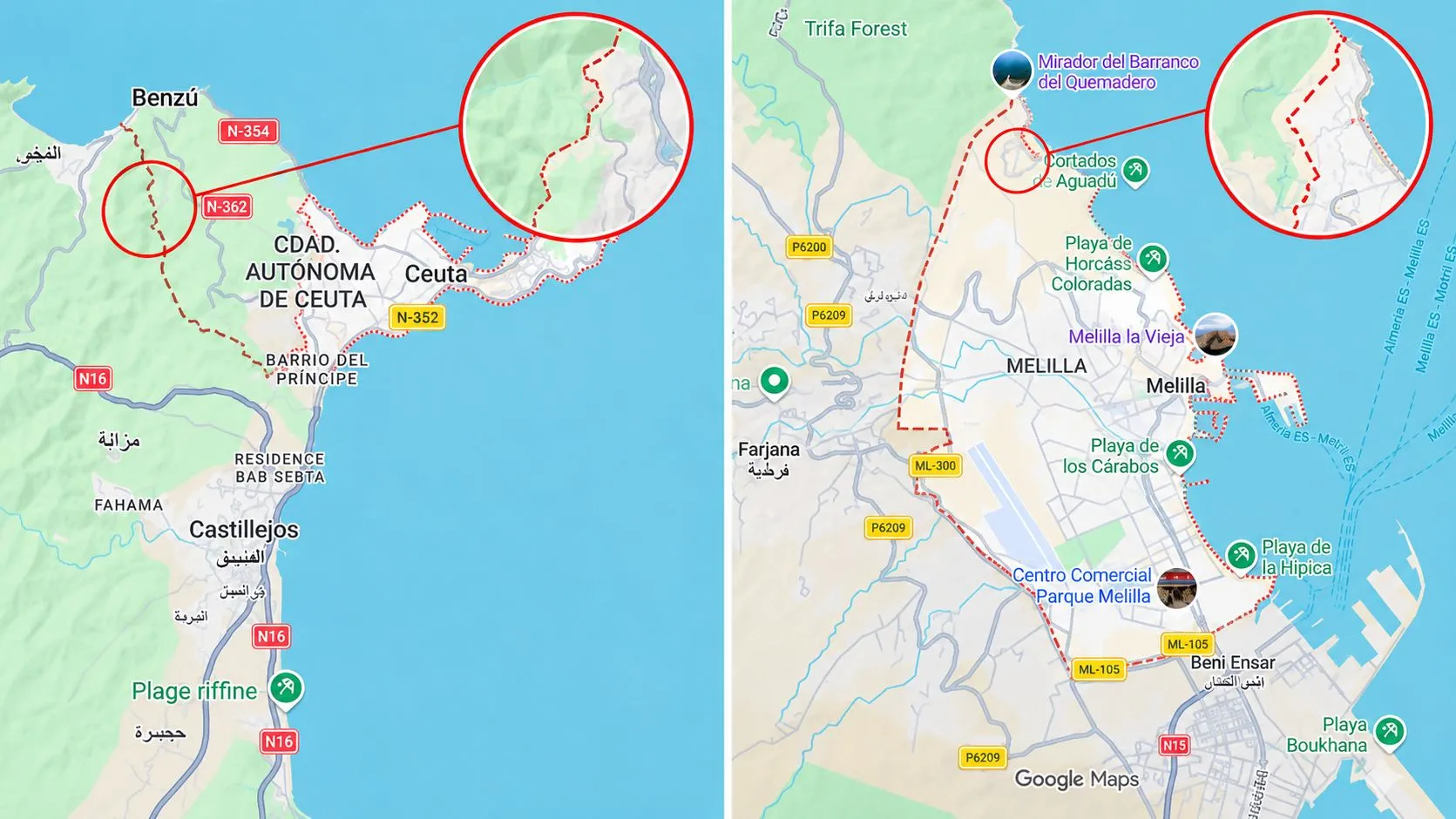
The Petitions Committee of the European Parliament has opened a pathway for the European Union to investigate whether Google Maps can be penalized for the manner in which it delineates the borders of Ceuta and Melilla in relation to Morocco. This decision comes after the coordinators of the committee agreed last week to continue processing a petition that accuses the platform of marking these borders as "disputed territories" using a dashed line. This classification has raised significant political and institutional concerns, placing Google Maps under scrutiny.
According to Google Maps' official nomenclature, as outlined in their guidelines, "dashed lines represent disputed boundaries, indicating that the parties involved do not agree concerning the border." However, it is important to note that Ceuta and Melilla have never been listed among the non-self-governing territories pending decolonization by the United Nations, nor has there been any resolution from the General Assembly or the Security Council questioning Spain's sovereignty over these territories.
Members of the European Parliament are urging Brussels to assess whether a map that implicitly questions Spain's borders in Africa aligns with the obligations imposed on major digital platforms under the Digital Services Act (DSA). This move follows what has been described as the most significant security crisis in Ceuta since the Transition, marked by the massive assault that occurred on July 30 and 31. Official data indicates that approximately 100,000 individuals were used to storm the border from Morocco, posing a direct challenge to Spanish sovereignty.
The petition, registered under the file number _2284/2026_, argues that Google Maps employs the same symbols for Ceuta and Melilla that it uses for territories that are "disputed, not internationally recognized, or subject to territorial litigation." It warns that this representation is misleading and does not correspond to the legal status of the two autonomous cities, potentially misinforming millions of users regarding the external borders of the European Union.
Spain asserts that its sovereignty over Ceuta dates back to 1640 and over Melilla to 1497, based on valid legal titles of international law that predate any entity that might be considered the Moroccan state. This sovereignty has been consistently reaffirmed by the Moroccan authority prior to statehood through treaties signed with the sultans since the 18th century, which recognized Spanish presence and sovereignty in both cities, as detailed in a study by professor Alejandro del Valle Gálvez for the Royal Elcano Institute.
Potential Consequences and Future Actions
Consequently, the petition requests European institutions to evaluate whether Google’s mapping constitutes a violation of the DSA. Specifically, it calls for the European Commission to study the potential risks of misinformation regarding the sovereignty of a member state and the external borders of the Union. The DSA mandates that "very large" platforms like Google assess and mitigate systemic risks related to misinformation, civic discourse, and public safety, allowing for fines up to 6% of the global annual turnover in cases of severe and intentional violations, which for Alphabet could amount to around $24 billion.
The petition further demands that Brussels instruct Google to clearly and continuously delineate the borders of Ceuta and Melilla as recognized international boundaries, thus eliminating their visual classification as disputed territories between Spain and Morocco. In the same committee meeting, the coordinators also supported the continuation of a separate petition, _1448/2025_, advocating for a special status within the EU for Ceuta and Melilla, akin to that granted to the Outermost Regions.
This request emphasizes the unique structural challenges faced by Ceuta and Melilla, including their extrapeninsular location on the African continent, isolation from European transport and energy networks, their status as the only land borders of the EU with Africa, and their limited area coupled with high population density. The petition argues that these factors contribute to a compounded disadvantage that conventional cohesion mechanisms fail to address.
Overall, the ongoing discussions surrounding Google Maps and European aid are occurring more than 80 days after the significant migrant assault last summer. Ceuta is currently home to nearly 3,100 unaccompanied foreign minors, and the local government has described the pressure on public services as "unsustainable." Furthermore, police and military sources have confirmed the presence of infiltrated Moroccan military personnel among the migrants, raising additional concerns about border security and sovereignty.
As reported by elespanol.com.