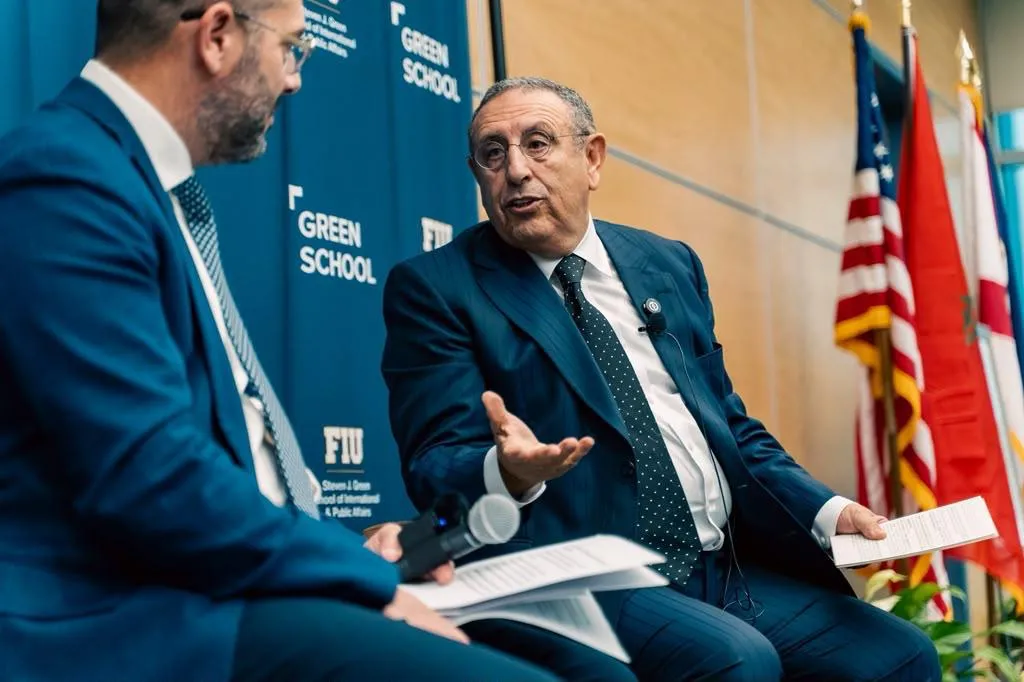
During a recent conference-debate held at Florida International University (FIU) in Miami, Morocco's ambassador to the United States, Youssef Amrani, emphasized that the Kingdom of Morocco is striving to be much more than just a meeting point between continents. He articulated a vision where Morocco aims to contribute to global solutions, seize opportunities, and firmly establish its role in the significant transformations currently shaping the world. Addressing a diverse audience of American students, scholars, and faculty members, Amrani underscored the importance of Morocco’s geographical position as a historical asset that fuels its ambitions rather than limits them.
In his presentation, which was part of the inaugural "Morocco Days in Miami" event organized by the Consulate General of the Kingdom of Morocco, Amrani highlighted Morocco's strategic direction, its role on the international stage, and the promising prospects for Moroccan-American partnership. Under the leadership of His Majesty King Mohammed VI, Morocco is undergoing a profound economic transformation characterized by the development of modern infrastructure and significant investments in key sectors such as industry, energy, and education.
A Forward-Looking Morocco Committed to Its Identity
When asked about what sets Morocco apart in a rapidly changing world, Amrani pointed out that the Kingdom has effectively leveraged its unique position at the crossroads of Africa, Europe, the Arab world, and the Atlantic to foster dialogue, openness, and cooperation. He noted that Morocco does not have to choose between tradition and modernity; rather, it successfully integrates both, which he believes fortifies the nation’s identity and prepares it for future challenges. The ambassador also highlighted the pivotal role of women in this evolution, citing their increasing presence in universities, businesses, research, and public institutions as a reflection of the societal changes underway in Morocco. For instance, he noted the rise in women's representation in the Moroccan Parliament from just two in 1993 to 107 today, a significant milestone that underscores the necessity of women's participation in the country's development.
Furthermore, Amrani remarked on the historic appointment of Fatima Ezzahra El Mansouri as the head of the Moroccan government, which he sees as a landmark moment in Morocco's institutional evolution. He conveyed that understanding contemporary Morocco requires recognizing the vital role women play within it.
An Economy Geared Towards Global Markets
The ambassador continued to outline Morocco's clear economic ambition: transforming the country into a production, investment, and value-creation platform capable of connecting markets and engaging in global production chains. In a context where businesses are seeking reliable partners and efficient infrastructures, he accentuated Morocco's significant advantages that pave the way for new avenues of cooperation with the United States. The goal, he asserted, is to move beyond mere trade exchanges and to develop joint projects focusing on production, innovation, and access to new markets. Notably, Morocco stands out as the only African nation with a free trade agreement with Washington, which further solidifies its strategic position.
As Amrani addressed the pressing international challenges, he reiterated the guiding principles of Moroccan diplomacy, emphasizing clear positions, fulfilled commitments, and enduring partnerships. He articulated Morocco’s belief that stability cannot be achieved without economic development, regional cooperation, and creating prospects for its population. This commitment is especially evident in Morocco's initiatives aimed at enhancing access for Sahel countries to the Atlantic Ocean, transforming geographical isolation into economic opportunity.
Highlighting Miami's role as a bridge between Morocco and the United States, Amrani underscored the shared ambition to turn their excellent political and strategic relations into a powerful driver of mutual economic prosperity. He pointed out that southern Florida serves as an access point to Latin America and the Caribbean, while Morocco provides privileged connections to Africa, Europe, and the Atlantic space. This complementary relationship opens up concrete opportunities for economic cooperation, facilitated by direct air links between Casablanca and Miami, as well as the 2025 partnership agreement between Miami-Dade and the Casablanca-Settat region.
Amrani concluded by emphasizing that for American companies looking toward Africa, Morocco offers not just an entryway but a reliable partner for building, producing, and achieving success together. He encouraged students to consider the evolving nature of diplomacy, which now extends beyond government relations into the realms of businesses, universities, and research sectors that shape the global economy.
In his closing remarks, the ambassador stressed the importance of fostering academic exchanges and collaborative research, particularly in areas such as water management, energy, climate resilience, and female entrepreneurship. He expressed Morocco's desire to deepen its privileged relationship with the United States, nearly 250 years after recognizing its independence, aiming to transform an exceptional historical legacy into new opportunities for cooperation and growth that benefit both nations.
As reported by marruecom.com.