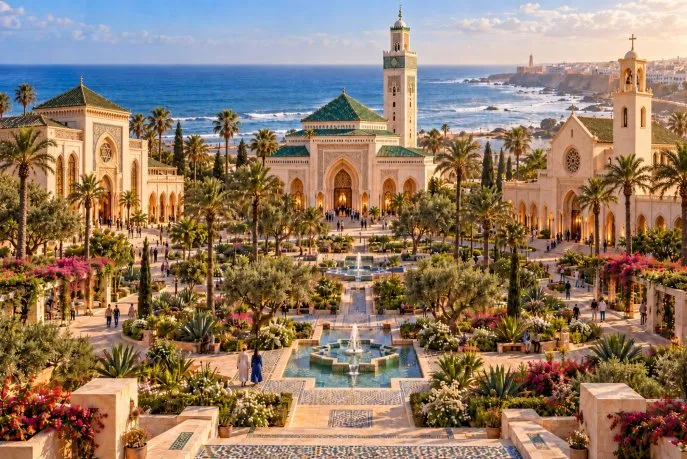
In the vibrant city of Rabat, Morocco, Aziz Daouda, a prominent athlete and technical director of the African Athletics Confederation, reflects on his childhood memories in the Ocean neighborhood. He envisions a remarkable garden facing the Atlantic Ocean, where the temples of the three monotheistic religions—Islam, Christianity, and Judaism—would stand side by side. This vision is deeply rooted in his recollections of a diverse Morocco, where Muslims, Jews, and Christians coexisted harmoniously, sharing neighborhoods, schools, and sports fields. With a mixture of nostalgia and a humanistic aspiration, Daouda sketches a project that seeks to give architectural and symbolic expression to Morocco's rich tradition of coexistence.
The Heart of a Multicultural Morocco
As Daouda drives along the coast of Rabat, he is transported back to a time when people of various nationalities, including Moroccans, Portuguese, Italians, Spaniards, and even Greeks and Russians, lived together in the same buildings. However, this area is undergoing significant changes, with many structures being torn down while a charming little mosque remains standing, isolated yet hopeful, gazing out toward the ocean. This mosque embodies the aspirations of a place that symbolizes unity rather than division.
The envisioned park, named after His Majesty King Mohammed VI, would not be about institutional equality among religions, as Morocco is constitutionally a Muslim state. Article 3 of the 2011 Constitution states that "Islam is the religion of the State, which guarantees to all the free exercise of worship.” This principle is not a concession but a profound expression of national identity, where the King serves as the protector of the rights of all believers. This reflects Morocco's long history of interfaith dialogue, characterized by a rich tapestry of Jewish and Muslim coexistence.
A Garden of Hope and Unity
Daouda’s dream is not merely a fantasy; it draws from concrete memories, such as his experiences at the College of Orangers in Rabat, where Jewish, Christian, and Muslim students shared classrooms, laughter, and dreams. His friend Lazare Benaccoun, a Moroccan Jewish athlete, competed alongside his Muslim peers, illustrating that religion was never a barrier but rather a part of their shared identity. This closeness and mutual respect are perhaps the most compelling evidence that Morocco does not need to reinvent its legacy as a land of coexistence; it simply needs to remember and manifest it.
Today, churches in Rabat thrive thanks to the growing presence of Christian Africans, while synagogues awaken with visits from nostalgic Moroccan Jews reconnecting with their roots. Daouda envisions a space dedicated to the history of these three monotheistic traditions—a center for interfaith dialogue, with facilities for exhibitions, conferences, and youth encounters, all designed architecturally to foster unity. The mosque, church, and synagogue would stand together, symbolizing not confrontation but a shared quest for understanding.
Rabat, as a city of light open to the Atlantic and the world, is the ideal backdrop for such a project. It would attract religious leaders and teach Moroccan children that knowing others does not mean losing one's own identity. This vision aligns with the royal discourse, where His Majesty King Mohammed VI emphasizes the significance of coexistence among Muslims and Jews as part of Morocco's cultural heritage. The continuity of this tradition—from historical protection of Jewish communities to contemporary actions preserving their memory—grants the project its deep legitimacy.
Thus, why not realize this vision with a monumental garden facing the ocean? A place dedicated to hope and humanity, a garden named after His Majesty King Mohammed VI, embodying the Moroccan concept of Islam that embraces the protection of others and interfaith dialogue as a sovereign responsibility. This would send one of the most beautiful messages that Rabat could convey to the world: not that we are all the same, but rather, we recognize our differences and have chosen to live together.
As reported by quid.ma.