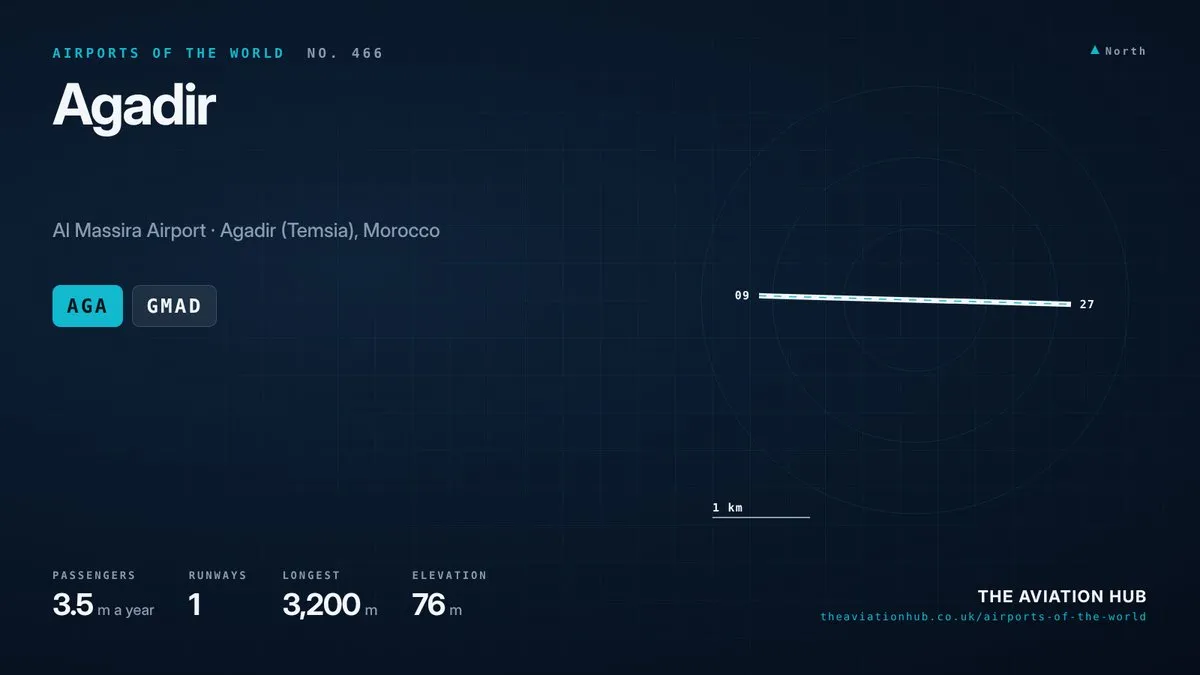
Agadir Airport, officially known as Al Massira, is an essential transport hub located in Agadir, Morocco, serving approximately 3.5 million passengers annually. This airport plays a pivotal role in connecting visitors to Morocco's stunning Atlantic beach resort and the picturesque Souss Massa region, situated in the southwestern part of the country. Although the airport is located inland amidst lush argan groves and fertile farmland rather than directly on the coast, it has become a primary gateway for winter sun seekers from the UK, France, and Northern Europe. Furthermore, it serves as the perfect launch point for surf enthusiasts heading to Taghazout and adventurers embarking on journeys into the breathtaking Anti Atlas mountains.
Agadir Airport Overview
With its IATA code AGA and ICAO code GMAD, Agadir Airport is positioned in the commune of Temsia, approximately 20 kilometers southeast of the city center. The airport is situated at an elevation of 76 meters and features a single runway that stretches 3,200 meters in length. The passenger terminal, spanning 26,550 square meters, was designed to accommodate around three million passengers per year. Notably, air traffic has surged from 2.3 million passengers in 2023 to an estimated 3.1 million in 2024, primarily due to the expansion of low-cost airlines. Key airlines operating from Agadir include Royal Air Maroc, which connects the city to Casablanca, and budget carriers like Ryanair, easyJet, Transavia, Jet2, and TUI that cater to a diverse range of international travelers. The airport is managed by the Moroccan state airports authority, ONDA, and additional information can be found on the airport’s official website.
The Evolution of Agadir Airport
Agadir's journey to establishing a modern airport began decades ago when the city relied on the older Inezgane airfield, which was much closer to the urban center. However, as the demand for air travel surged due to the growing resort industry, it became clear that a larger facility was necessary. Consequently, Al Massira was constructed further inland in Temsia, equipped with a long runway and ample space for aircraft operations, leading to the military repurposing of Inezgane. The name Al Massira translates to "the March" in Arabic, commemorating the historic Green March of 1975 when around 350,000 Moroccans marched into Western Sahara, a defining moment in the nation's history.
The evolution of Agadir Airport has been closely tied to the growth of tourism in the region. With package holidays from countries like France, Germany, and Scandinavia filling the local hotels, the airport has seen a substantial increase in international visitors. Tragically, a dark chapter in the airport's history occurred on August 21, 1994, when Royal Air Maroc Flight 630 crashed shortly after takeoff, resulting in the loss of all 44 individuals on board. Investigations revealed that the incident was caused by deliberate actions taken by the captain.
As Agadir Airport continues to develop, it is poised to play a significant role in Morocco's upcoming hosting of the 2030 FIFA World Cup alongside Spain and Portugal. Plans are already underway to expand the terminal facilities to accommodate the increasing passenger flow, while the introduction of high-speed rail connectivity from Marrakech to Agadir is also on the horizon, promising to revolutionize regional travel.
As reported by theaviationhub.co.uk.