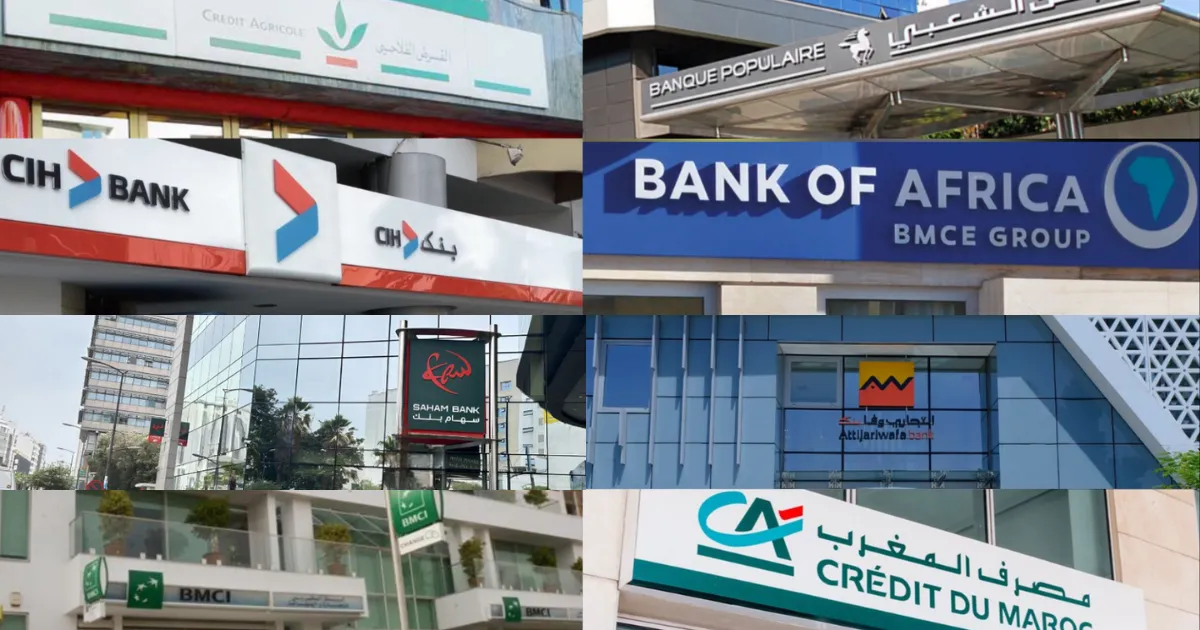

The 2025 Annual Financial Stability Report, jointly published by Bank Al-Maghrib (BAM), the Moroccan Capital Market Authority (AMMC), and the Insurance and Social Security Control Authority (ACAPS), reveals a significant concentration within the Moroccan banking landscape, predominantly centered around three private banking groups largely owned by Moroccan capital.
According to the report, "the Moroccan banking landscape remains structured around three systemically important banks predominantly backed by Moroccan private capital, which collectively account for **59.9% of total banking sector assets**, **63.2% of net customer loans**, and **62.1% of collected deposits**." Furthermore, these institutions rely on a vast network of 2,955 branches within Morocco, complemented by an international presence through 51 subsidiaries and 22 branches.
In 2025, the aggregate total of banking assets reached 2.323 trillion dirhams, representing 136% of the GDP, an increase from 134% in 2024. This growth of 8.2%, mirroring the previous year's performance, is primarily driven by a boost in lending activities. Loans to customers increased by 6.9% to reach 1.153 trillion dirhams, representing 55.2% of banking employment.
Participatory Banking Sector Shows Significant Growth
The report also emphasizes the ongoing expansion of participatory banking, with assets surging by 24.7% in 2025 compared to 19.2% the previous year, totaling 48.5 billion dirhams. The customer loans in this segment rose by 27.4%, amounting to 43 billion dirhams.
In addition, loans to credit institutions and similar entities increased by 10.8% to reach 283 billion dirhams, constituting 13.6% of banking employment. Market activity continued its upward trajectory, albeit at a slower pace than in 2024 (8.2% compared to 16%), bringing banks' securities portfolios to 550 billion dirhams, or 26.3% of banking assets. Conversely, other assets declined by 10.8% to 63 billion dirhams.
Household Credit Share Continues to Decline
From a sectoral perspective, the report highlights a gradual reshaping of banking exposures. The share of households in the credit portfolio has consistently decreased, falling from 33.2% in 2021 to 26.7% in 2025, translating to an outstanding amount of 331 billion dirhams.
In contrast, financial activities are capturing an increasing share of the credits, rising from 16.1% to 18.1% in just one year, totaling 224 billion dirhams, ahead of other services (16.3%, 202 billion dirhams). The manufacturing and construction industries each account for approximately 8.4% of the portfolio, with outstanding amounts nearing 104 billion dirhams for each sector.
Following these are the commerce (6.4%) and energy-water (5.9%) sectors, while extractive industries represent a mere 2.3% of the credits. Lastly, the transport and communications sector continues its decline, with its share dropping from 4.2% in 2021 to only 2.4% in 2025.
As reported by h24info.ma.