
The highly anticipated quarter-final match of the World Cup featuring France and Morocco has yet to begin, yet the atmosphere is already charged with excitement and unexpected drama. Outside a local Carrefour, two individuals engage in a comical scuffle on the ground, while a restless dog strains against its leash, adding a touch of humor to the scene. Although this altercation may seem unrelated to football, it perfectly encapsulates the vibrant energy that surrounds this momentous event.
While Donald Trump may have his own views, a defining theme of this year’s World Cup can be summed up in one word: diaspora. The tournament has expanded its reach, making room for former colonies like Cape Verde and Haiti, and the influence of France is undeniably palpable. A staggering 99 players participating in the World Cup hail from France, with six of them representing Morocco, creating a fascinating intersection of cultures and histories.
This match symbolizes a post-colonial narrative marked by improving relations, particularly following Emmanuel Macron's acknowledgment of Morocco's sovereignty over Western Sahara. Historically, Morocco was a French protectorate from 1912 until its independence in 1956, and today, around 1.7 million individuals of Moroccan descent live in France. Among them are hundreds of thousands in Paris, where I have come to witness a showdown between the former colonial power and its erstwhile colony, a nation that continues to embrace French as its _lingua franca_. This encounter goes beyond mere national pride; Morocco stands as Africa's last representative in the tournament, a continent that boasts 1.4 billion people yet has never produced a World Cup champion, adding to the weight of expectation.
The Heartbeat of a Diverse Community
As I navigate the bustling metro in Barbès, a neighborhood that has long been a refuge for African migrants, the atmosphere is thick with anticipation. The streets are a mosaic of PSG and France jerseys, juxtaposed with the vibrant red and green of Moroccan colors. The eclectic mix signifies not just a clash of teams but a blending of identities. Fans proudly don their jerseys in various styles; women transform shirts into crop tops to combat the heat, while men drape themselves in flags or opt for an untucked look. Some fans, caught in indecision, paint the French tricolor on their faces while sporting Moroccan kits, illustrating the complex loyalties at play.
In this lively setting, viewing options abound, with matches broadcasted in barbershops, butcheries, and even outside sex shops in Pigalle. The fight I witnessed earlier seems insignificant as I eventually find my way to a unique venue, the Union de la Jeunesse Internationale. This cultural center, previously the beloved Tati discount store, serves as a gathering spot for the African migrant community. The vibrant atmosphere is enhanced by the presence of an elderly gentleman dancing to Afrobeat, a testament to the joy and camaraderie that football brings.
As I settle in among a diverse crowd, I realize I’m possibly the only white person there, sitting next to three enthusiastic Moroccan fans. The tension in the room escalates when Kylian Mbappé earns a penalty for France, causing one fan's heart rate to spike dramatically. When Mbappé's shot is saved, the room erupts into a cacophony of cheers and groans, reflecting the divided loyalties present. Yet, amidst this rivalry, a shared moment of joy arises when the famous Colombian pop star Shakira appears on screen, uniting everyone in a chorus of nostalgia.
A Night of Friendly Rivalry
Despite my hopes for a Moroccan victory, the match unfolds with France taking the lead. Sitting beside a French supporter, her expressions of excitement contrast sharply with the Moroccan fan near the door, who fervently chants in support of his team. As France doubles their score, some Moroccan fans can no longer bear to watch, while others continue to cheer on their players with fervor. The atmosphere remains friendly, as evidenced when a Moroccan fan proudly declares "Je suis Maroc" and a French supporter responds with "Je suis Français," both reveling in the camaraderie that football fosters.
The narrative could have been a triumphant tale of Moroccan victory, but even in defeat, the night remains a celebration of African pride. Notably, many players on both sides have African heritage; for instance, Mbappé’s father is Cameroonian and his mother Algerian. As the final whistle blows, the celebration continues within the Union de la Jeunesse Internationale, where dancing persists, showcasing a spirit of unity despite the competitive atmosphere.
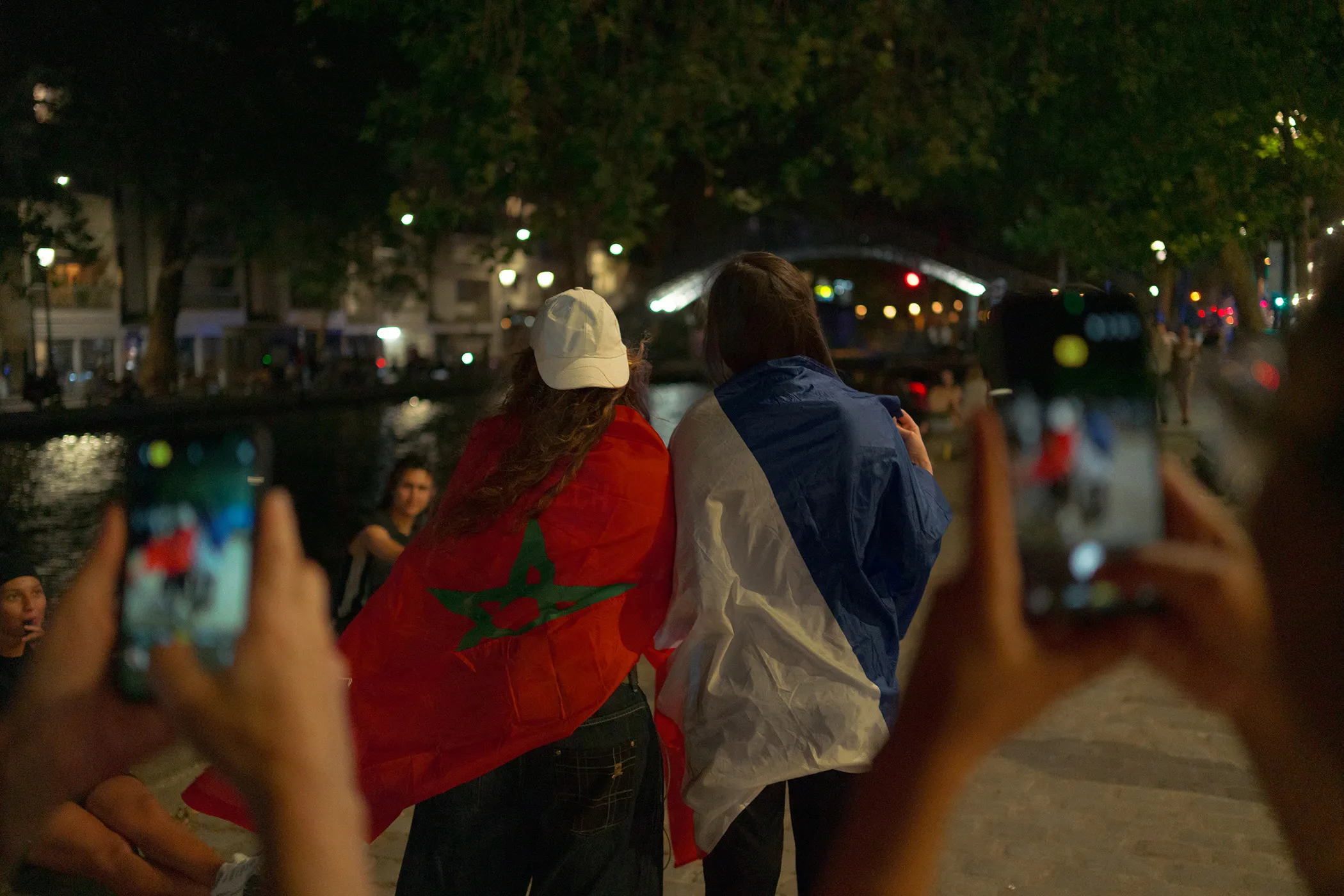
Outside, the Parisian streets reflect the city’s vibrant character, with car horns blaring and fans celebrating in unison. At the traffic island on the edge of Barbès, a Moroccan and a French woman joyfully wave their flags, embodying the shared happiness of the day. This delightful juxtaposition serves as a reminder that, in the end, football transcends national boundaries, weaving a tapestry of cultures and histories that unite rather than divide.
As reported by observer.co.uk.