
Morocco's Humanitarian Vision and Global Commitment
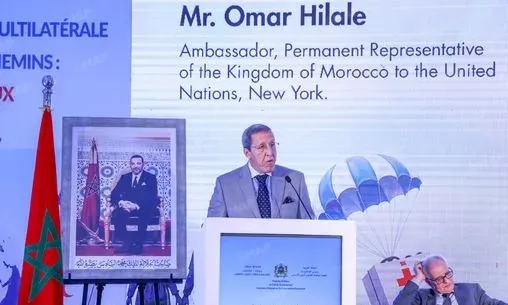
In a reaffirmation of its dedication to advancing global humanitarian efforts, Morocco has articulated a strong commitment that is deeply anchored in the humanistic vision of King Mohammed VI. Ambassador Omar Hilale, Morocco's permanent representative to the United Nations, emphasized that the nation’s humanitarian approach is guided by core principles of solidarity, shared responsibility, and adherence to international humanitarian law. Speaking at the international colloquium entitled “Multilateral Humanitarian Action at the Crossroads: Challenges and Issues,” Ambassador Hilale elaborated on the foundational principles that steer Morocco's humanitarian initiatives, highlighting the Royal Vision which is built upon three interconnected pillars: active solidarity as a fundamental value, shared responsibility as an operational principle, and an unwavering respect for international humanitarian law as an essential necessity.
During his address, Hilale participated in a panel discussion focusing on “Multilateral Humanitarian Action and the Challenges of Peace and Sustainable Development,” where he underscored Morocco's perspective that the protection of civilians, vital infrastructure, and essential services constitutes a fundamental obligation that must be upheld by all parties involved in conflicts. He pointed out that Morocco's commitment to global peace is exemplified by its significant contributions to UN peacekeeping operations, with thousands of Moroccan peacekeepers deployed under the United Nations flag across various conflict zones globally.
Challenges and the Path Forward in Humanitarian Action
In addition to peacekeeping efforts, Ambassador Hilale highlighted Morocco's proactive response to major natural disasters and humanitarian crises, a testament to its long-standing commitment to international solidarity. He asserted that despite the inherent limitations and challenges faced by multilateral humanitarian action, it remains a critical pillar of the international system. Hilale called for necessary reforms and adaptations, advocating for increased investment in preventive measures, enhanced coordination between humanitarian efforts and peace and development initiatives, and a renewed sense of global solidarity.
He identified several pressing challenges that the humanitarian system currently faces, including funding shortages, restricted access to those in need, the politicization of humanitarian aid, and the existence of prolonged crises that have been forgotten by the international community. Moreover, he emphasized the importance of linking emergency responses more effectively with sustainable development strategies. Drawing from Morocco's experience in mediation, South-South cooperation, human development, and humanitarian assistance, Hilale believes that the Kingdom possesses valuable insights that could contribute significantly to the reform and strengthening of the global humanitarian framework. He concluded with a call for swifter responses to emerging crises, innovative financing solutions, enhanced international cooperation, improved governance of humanitarian organizations, and stronger partnerships between humanitarian actors and development institutions, as well as a reinforced coordination between humanitarian mechanisms and the UN 2030 Agenda for Sustainable Development.
As reported by moroccoworldnews.com.