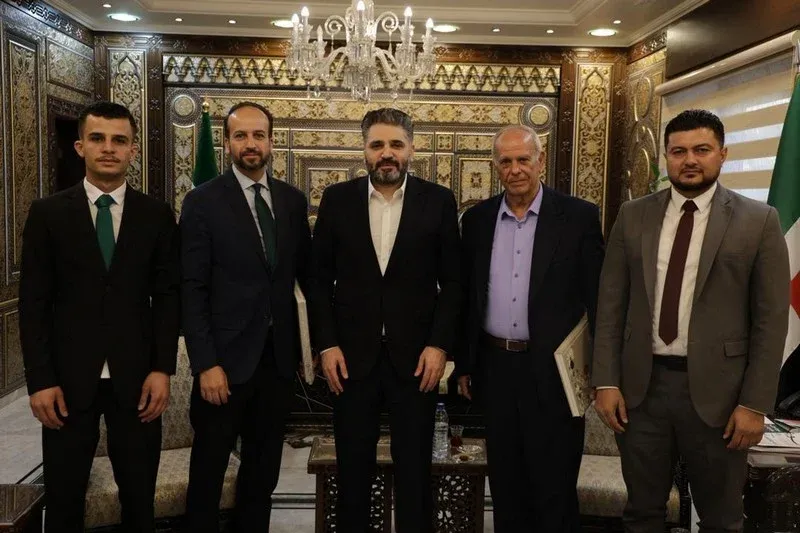

After nearly five decades of forced exile, Syrian national Ali Al-Ahmad has finally returned to his homeland, Syria. His journey encapsulates the life of a man who left his country as a young man, only to have years of absence stretch into decades. During this time, he resided in Morocco, a nation that welcomed him with open arms, where he built a family and forged deep human connections that transcended mere friendships formed during his time abroad.
Al-Ahmad, a poet and writer, has returned to Syria after a long wait, discovering that many things have changed in his native land. He revisits a homeland that has remained etched in his memory, but which has also seen the loss of many family and friends during the years he was unable to share in their joys or sorrows, nor even bid farewell to those who departed. In this moment of return, he is not only reclaiming a country that he has been away from but also rediscovering a part of his life that has been suspended in time throughout his years of exile.
What makes Al-Ahmad’s journey particularly significant is his status as one of the longest-standing opponents of the former Syrian regime. Political circumstances in the 1970s forced him to leave his homeland, and he arrived in Morocco on September 6, 1977, to work as an Arabic language teacher. From the city of Kenitra, a new chapter in his life began, extending over many years, during which Morocco transformed into a second homeland and became an integral part of his and his family's narrative.
Embracing Memories of Exile
For Ali Al-Ahmad, exile was not just a physical relocation from one country to another; it was a profound experience that spanned from youth to old age, filled with countless moments that he would have preferred to experience in his homeland. As his life unfolded in Morocco, Syria remained a constant presence in his mind, intertwined with a bittersweet nostalgia for the loved ones he could not say goodbye to.
In a conversation with Hespress, Al-Ahmad revisited some of the tragedies of his absence, recounting the losses of family members who passed away during the years he was away, unable to stand by their sides in their final moments. This reflects one of the harshest realities of exile, where separation from one’s homeland often results in a painful distance from family as well, leaving a person as a distant witness to the departure of those they love.
Thus, his current return signifies not just a physical arrival in Syria, but also the culmination of years of longing, waiting, and memories. Many of those he left behind are no longer there, and the places he remembers have changed, while he carries with him a complete chapter of his life lived far from his first homeland.
Morocco: From Host Country to Second Homeland
In contrast to the homeland he left behind, Al-Ahmad found in Morocco a place where he could rebuild his life. Upon arriving in Kenitra as an Arabic language teacher, he had no inkling that the years spent there would turn into decades, and that the country he entered as an expatriate would become an essential part of his personal and familial story.
Reflecting on this experience, Al-Ahmad states, "Morocco represented for me and all expatriates a dignified place, a safe home, and a warm embrace—a spiritual dwelling, honorable work, and noble companionship that evolved over time into a brotherhood I cherish, and that all Syrians in Morocco cherish as well."
These words reveal another facet of his return; Al-Ahmad is not leaving Morocco as a mere stopover that has completed its duty, but rather he carries with him a deep gratitude towards the country where he spent a significant portion of his life and among people who helped ease the harshness of exile, offering him opportunities for work, family, and lasting connections that endured through the years.
In his testimony to Hespress, he shared insights about his early years in Morocco, explaining the typical challenges faced by newcomers, which were soon alleviated by the generosity and kindness of the Moroccan people, leading to relationships that transcended professional boundaries into genuine friendships and brotherhoods.
Ali Al-Ahmad’s return is not just a personal journey; it is also intertwined with the memories of his children, who grew up in Morocco and experienced the life their father chose—or was compelled to embrace due to circumstances of exile. For them, Morocco is where their family was formed, where their initial dreams took shape, and where the details of their lives unfolded over decades.
His son, Abdullah Al-Ahmad, describes the moment of return, saying, “We see our father, who has been absent for decades from his land and family, regaining his first breaths, as if a new spirit has awakened in him after a long exile.” However, Abdullah notes that the joy of returning does not overshadow the presence of Morocco in this moment; rather, it powerfully evokes memories of a land that has never made them feel like strangers. He adds, “This joy brings us back to the land that never made us feel out of place; Morocco has been our support and refuge, the homeland that opened its arms to us with dignity and warmth, where we built our dreams and reclaimed our dignity.”
For Abdullah, the family’s relationship with Morocco has been a complete human experience that has left a profound impact on their hearts. Thus, he affirms that “the beauty of the Kingdom of Morocco will remain alive in our hearts,” pointing out that since arriving in Syria, their father has not missed an opportunity to speak of Morocco and its people.
Abdullah notes that his father, in every meeting and gathering on Syrian soil, takes every chance to highlight Morocco’s virtues, its noble people, and its enduring significance in their lives.
After nearly five decades, Ali Al-Ahmad has returned to the land he left as a young man, changed, and facing a country transformed, marked by the absence of faces he longed to meet. Yet, he returns carrying with him another human story forged in Morocco, where he spent the majority of his life, demonstrating that some homelands are where a person is born, while others offer the opportunity to live, grow, and leave a part of their soul behind.
As reported by hespress.com.