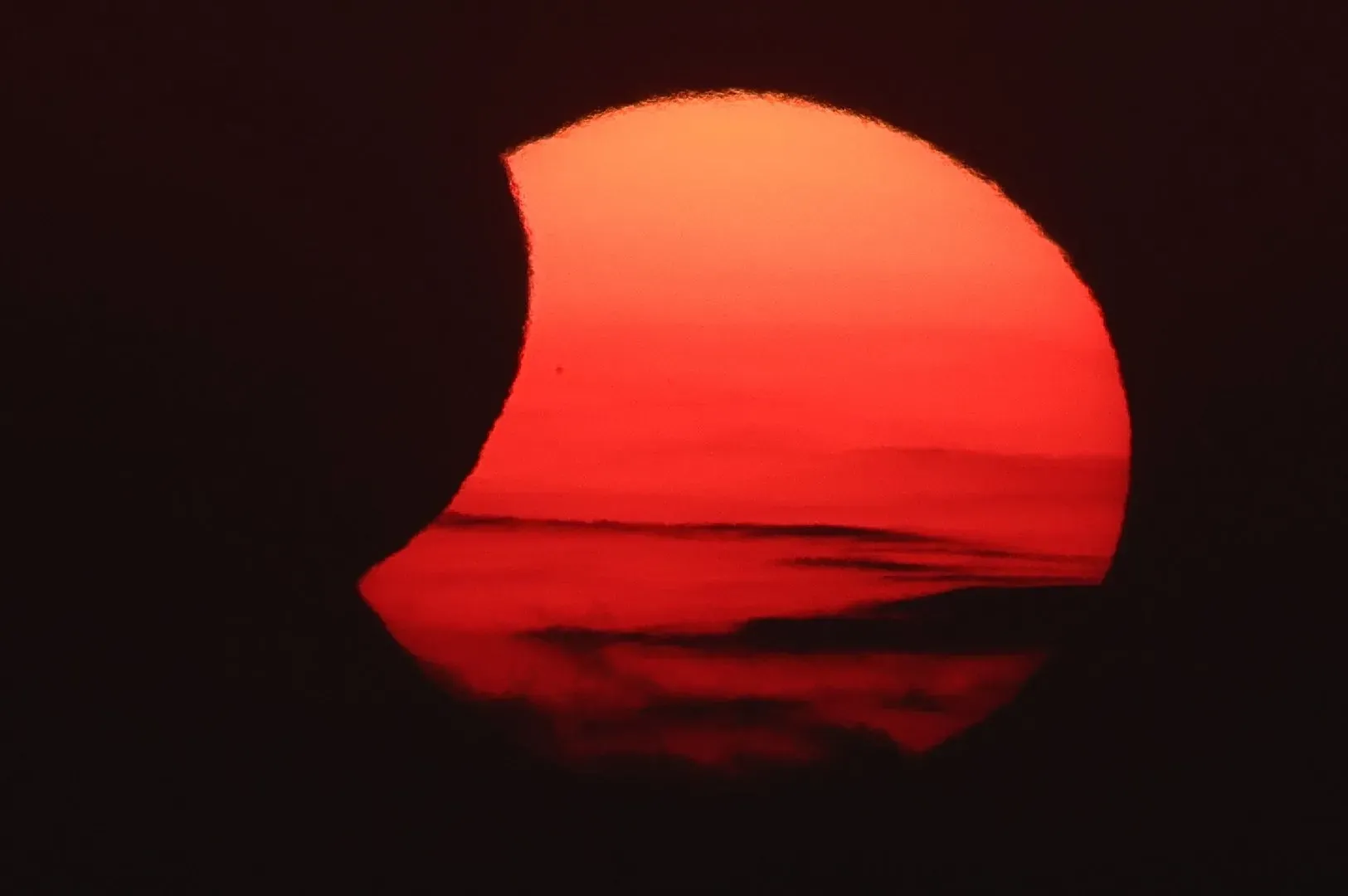

On Wednesday, a rare solar eclipse captivated vast regions of the northern hemisphere, an extraordinary astronomical event whose totality path traversed areas including the North Pole, Greenland, Iceland, and parts of the North Atlantic, extending into southwestern Europe. Meanwhile, a partial eclipse was visible across broader areas of Europe, North America, and western Africa, drawing the attention of countless observers eager to witness this celestial phenomenon.
This event holds particular significance for Europe, marking the first total solar eclipse the continent has experienced in 27 years. Such a remarkable occurrence is not expected to repeat in the same region for several decades, making this eclipse a once-in-a-lifetime experience for many.
In Brussels, Al Jazeera correspondent Salam Kayali reported that the eclipse reached its peak at 8:15 AM local time, gradually receding and concluding around 9:05 AM. However, the spectacle in Brussels did not plunge the city into complete darkness, as it fell outside the totality path. Instead, residents witnessed a partial eclipse that obscured approximately 89% of the sun's disk, leaving a portion still brilliantly illuminated.
Adding to the rarity of this event, the eclipse occurred with the sun low on the horizon, at about an 8-degree elevation, creating a striking sight as daylight approached its end. Kayali noted that a similar phenomenon was last seen in the region in 1999 and will not occur in the same manner for another 55 years, rendering the viewing of this eclipse a significant event for current generations.
Morocco Observes the Partial Eclipse
Across the Mediterranean in Morocco, the eclipse was also visible, albeit partially. Al Jazeera correspondent Mokhtar Alablawi reported from the capital, Rabat, where locals and foreign tourists gathered along the waterfront to observe the phenomenon and capture it on their phones and cameras. The partial eclipse reached about 88% coverage in Rabat, with the percentage increasing as one moved north toward cities closer to Europe, reaching around 93% in Nador, Tetouan, and Tangier. Along the waterfront stretching from Rabat to Harhoura, citizens and visitors flocked to witness this moment, with children particularly excited to document the event as a lasting memory of a rare astronomical occurrence.
The phenomenon also garnered extensive attention on social media and Moroccan media outlets, where users shared images and videos, alongside comments encouraging reflection on the celestial event and its cosmic implications.
Warnings Against Direct Sunlight Exposure
In conjunction with the eclipse, Morocco's Ministry of Health issued warnings to citizens wishing to observe the event, urging them to avoid looking directly at the sun with the naked eye and to use specialized, safe glasses for solar viewing. Meanwhile, the Moroccan Ministry of Awqaf and Islamic Affairs announced that there would be no eclipse prayer held on this occasion due to the timing of the event coinciding with the afternoon and evening prayer times. The ministry encouraged people to increase their prayers and seek forgiveness during this unique event.
Notably, the solar eclipse was not the only celestial event capturing attention, as meteor showers are expected to grace the night sky, coinciding with Earth passing through the orbit of Comet Swift-Tuttle. These meteors occur when dust particles left by the comet enter Earth's atmosphere at high speeds, igniting and appearing as fleeting, bright streaks in the night sky. Thus, the northern hemisphere's sky showcased two captivating astronomical phenomena: a moon obscuring the sun during daylight and cosmic dust particles burning up at night, much to the delight of stargazers.
Between Brussels and Rabat, this extraordinary event transformed into a rare public occasion, with people gathering in squares and along waterfronts to witness and document this exceptional astronomical moment before the sun resumed its usual path, disappearing from view for many years to come.
As reported by aljazeera.net.