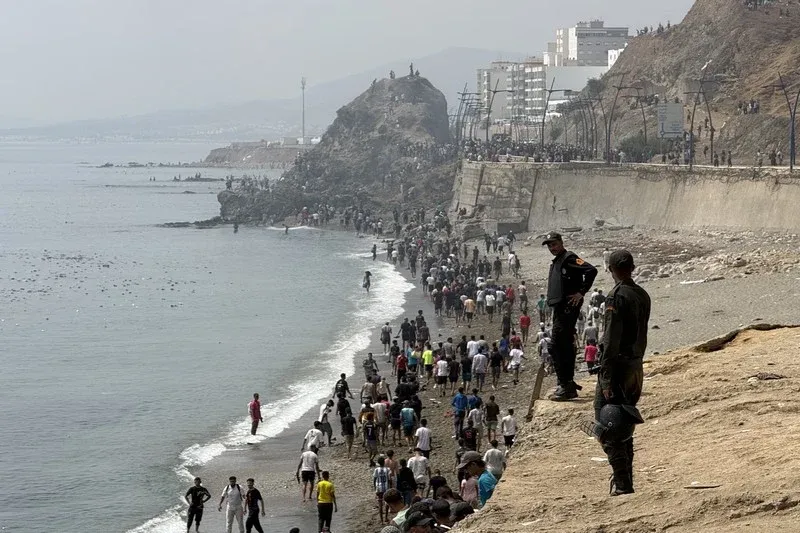

The recent events at the border between Fnideq and Ceuta have transformed what was once merely a crossing point into a dramatic stage for an unprecedented scene in the history of irregular migration in Morocco. Thousands of individuals, representing a diverse spectrum of ages and hailing from various cities, have surged towards the occupied city in a collective attempt to cross the border. This massive influx has reignited long-standing questions about the underlying causes of migration, the limitations of security approaches, the role of human trafficking networks, and the bleak future facing countless youth who no longer perceive their homeland as a viable avenue for achieving their dreams.
In a matter of hours, the situation shifted dramatically. What began as a typical day quickly turned into a surge of hundreds, even thousands, of people heading towards Ceuta. They did not come solely from northern cities; rather, they arrived from all corners of the kingdom, including young adults, minors, women, and the elderly, united by a single goal: to reach the other side.
Amid this collective march, the stories varied, yet the motivation remained consistent. One young man who attempted the crossing shared that this endeavor was not premeditated. He recounted, "I went with some girls, and we had no prior plan. We saw people entering and decided to join them. There was nothing organized; everyone was going in, men and women alike." Another young man from Settat, after a long journey costing around 2000 dirhams, explained, "We took a taxi to Tangier, then moved to Tetouan and from there to Fnideq. We came with hope for crossing, as this country no longer provides what we need. We suffer, and we urge His Majesty King Mohammed VI to find a solution for us.”
Others described harrowing experiences. One individual detailed his strenuous journey from Fes to the border area, saying that what he witnessed was shocking. He noted, “We found burnt buses and cars, confrontations between security forces and citizens, and then we entered through one of the border points,” adding, “I work, but my salary is not sufficient. How can one live on a salary of 3000 dirhams, paying rent and covering other necessities? There’s nothing that can be done with that income.”
Conflicting Figures and a Humanitarian Crisis
According to initial data released by the local government of Ceuta, approximately 1500 people arrived in the city on July 29, a number that gradually increased, with local authorities later reporting around 60,000 individuals—equating to about 70% of the city's population—prompting the declaration of a full humanitarian and social emergency. However, the Moroccan Interior Ministry later provided differing figures, stating that around 40,000 people attempted to cross into Ceuta and 1135 towards Melilla, with 11 reported fatalities, while Spanish authorities cited even higher numbers.
Beyond the statistics, the accounts of survivors were harrowing. One individual recounted the grim reality upon entering: “As we crossed, we encountered a significant number of corpses. I personally saw three bodies, while others spoke of over forty.” Another added, “People were swimming in the sea and would suddenly find a body in front of them, colliding with it directly. It’s an unbearable sight.” A young man recounted a particularly painful detail, stating, “We found a dead man with a swollen stomach, who lay there for hours before an ambulance arrived. He is a human being, not an animal.”
Meanwhile, a mother searched through the crowds for her son, struggling against tears, saying, “I’m looking for my son. The youth of this country are lost. We can’t find anything to eat. He spoke to me yesterday, then left this morning saying, ‘Mom, I’ll be back.’”
The Return: Dreams Diminished
For many, the dream of reaching Europe remained unfulfilled, as many were returned to Morocco under a Moroccan-Spanish agreement. One returnee described the experience in Ceuta, saying, “We entered yesterday but were sent back today. We found no bread, no water, nothing at all. We were left hungry and afraid, and we had to return. We experienced hours of hunger and fear, and we were subjected to tear gas.” Another migrant from Sudan residing in Morocco detailed his attempt to cross, asserting he faced violence at the border while seeking a dignified life in Europe.
The Moroccan Interior Ministry deemed the events non-accidental, attributing them to a confluence of factors, notably the exploitation of digital spaces to disseminate misleading information, in addition to the activities of human trafficking networks and misinterpretations of legal data that misled those wishing to migrate into believing they could enter Europe without legal repercussions. Lawyer Abdel Aziz Khalil explained that the cooperation agreement between Morocco and Spain allows for the return of individuals who entered Spanish territory irregularly, asserting that such returns occur within a legally regulated framework, respecting certain guarantees enshrined in international law, especially concerning minors who require special procedures in certain cases.
Professor Mustapha Merizig, a researcher in the sociology of international migration, refrains from characterizing the events as a mere collective migration attempt, preferring to label it as a “mass spatial outburst,” considering it a sudden and unprecedented event, contrasting it with traditional migration that typically involves long psychological and material preparations. He views what transpired as a serious warning sign, revealing a deep social resentment that demands serious attention.
Despite the magnitude of the crisis, Abdel Hamid Bjouki, an expert on Moroccan-Spanish relations, argues that the incident will not impact the strategic choices between Rabat and Madrid, particularly regarding the Moroccan Sahara issue or security and economic cooperation, though it may lead to delays in some joint projects or slow their progress.
As the events in Ceuta conclude and the border returns to a relative calm, the questions raised remain unanswered: Was this merely a transient wave of irregular migration or an indicator of a deeper social crisis? Are security measures alone sufficient to prevent a recurrence of such scenes, or do they require developmental policies that restore young people's confidence in their future within their homeland?
As reported by hespress.com.