
A Celebration of Quranic Recitation Across Africa
In a remarkable display of talent and devotion, readers from twelve African nations, including Niger, Nigeria, Mali, Somalia, Mauritania, Tanzania, Mauritius, Côte d'Ivoire, Liberia, Gambia, Guinea-Bissau, and Rwanda, showcased their skills in the seventh annual competition organized by the Mohammed VI Foundation for African Scholars, which took place in the historic city of Fes. This prestigious event, dedicated to the memorization, recitation, and proper articulation of the Quran, has garnered significant attention and participation from across the continent.
According to Professor Mohamed Maghrawi, the general coordinator of the competition, the first category, which focused on the complete memorization of the Quran with recitation following the Warsh narration from Nafi, saw 26 contestants who exhibited exceptional proficiency in their memorization and recitation skills. Their performances reflected the meticulous training and dedication they received from their teachers, emphasizing the importance placed on accuracy and the rules of recitation.
In the second category, which allowed for the memorization of the Quran with various other readings and narrations, 42 participants demonstrated commendable abilities. All but one contestant read according to the Hafs narration from Asim, with one participant opting for the Qalun narration from Nafi. This diversity in participation highlighted the contestants' capacity to recall their memorized verses and their competence in delivering them with excellence.
In the third category, which required participants to master the art of Tajweed while memorizing at least five sections of the Quran, 46 competitors stood out, particularly among children and youth. The high level of participation in this category underscores its significance in encouraging young people to engage with the Quran and discover their hidden talents in recitation.
Winners and Special Awards
Three winners were announced from each category, representing various countries. In the first category, the top three were Ubaidullah Abubakar Angu from Niger, Bashir Younes from Nigeria, and Muhammad Jalo from Mali. The second category saw Abdul Qadir Yusuf Muhammad from Somalia take first place, followed by Hamoud Lahbib Taleb Boubakar from Mauritania and Ismail Yusuf Hamad from Tanzania. In the third category, Ahmed Ahmedou Sidi Muhammad Abu Ubaidah from Mauritania claimed the first prize, with Abdullah Bah from Mali and Yahya bin Ali Malam Hassan from Mauritius following closely behind.
Additionally, the youngest participant award went to Hasna Bajou from Gambia, who is just 10 years old, while the youngest male participant award was given to Abdul Rahman Jalo from Guinea-Bissau, aged 7. Furthermore, the competition introduced encouraging prizes, with Salima Diara from Côte d'Ivoire, Abdul Aziz Muhammad Diallo from Liberia, and Nirarakondo Muzdarifa from Rwanda each receiving recognition for their outstanding performances in their respective categories.
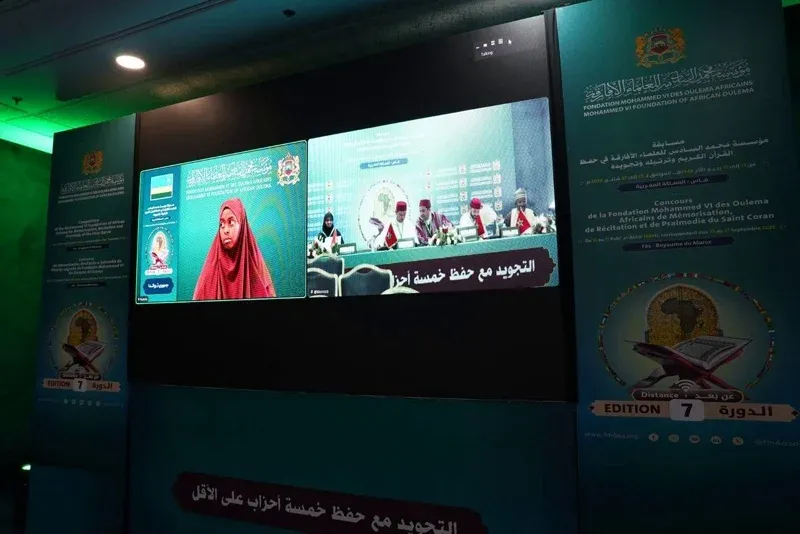
A panel of judges, comprised of scholars and specialized readers from Morocco, Senegal, Tanzania, Mauritania, Nigeria, Cameroon, Côte d'Ivoire, the Central African Republic, Burkina Faso, and Sudan, evaluated the competitors' performances in person from Fes. Additionally, a central technical team coordinated remote connections, allowing participants from all 48 participating countries to engage in the competition via video conferencing technology.
The Mohammed VI Foundation for African Scholars aims to strengthen the bond between the African Muslim youth and the Holy Quran through this annual competition, encouraging them to memorize, recite, and perfect their reading of the Quran. This initiative aligns with the noble care that His Majesty King Mohammed VI, the Commander of the Faithful, extends to the Quran and its adherents, reinforcing the importance of the Quranic values and guidance among the youth of Africa.
Previously, from March 29 to April 26, 2026, the foundation conducted local eliminations across its 48 branches, attracting more than 1,300 contestants. This effort resulted in the selection of 114 finalists, including 16 females, to represent the foundation's branches in the final round. The local eliminations also saw extensive involvement from African scholars, Quranic memorization centers, religious institutions, and families, all aimed at encouraging youth to engage with and cherish the Quran.
As reported by hespress.com.