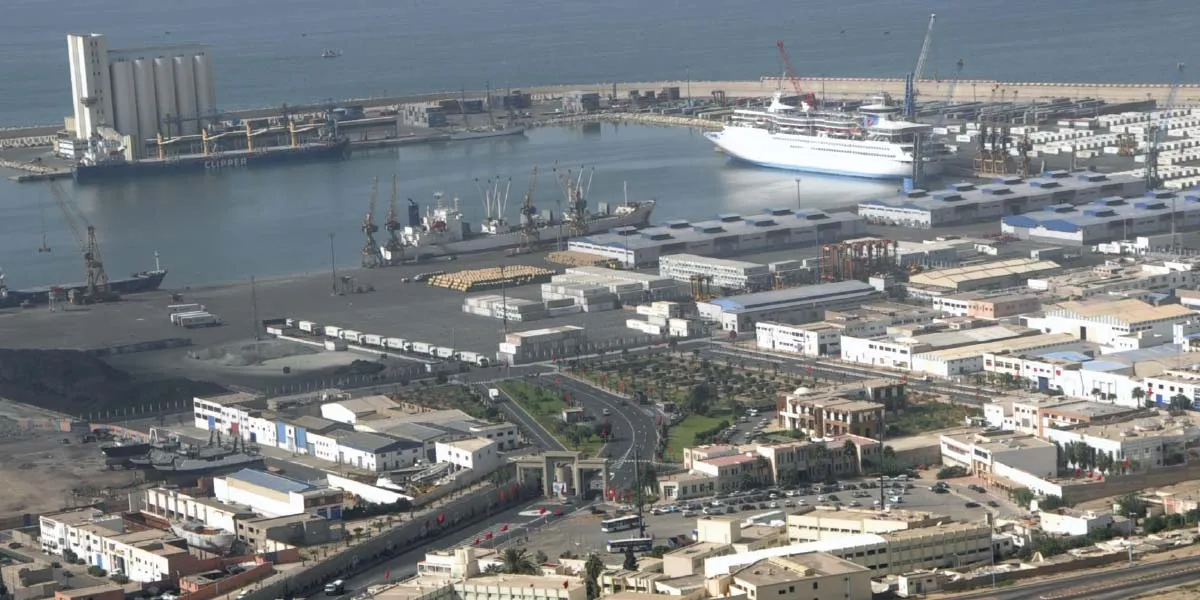

Significant Investment for Infrastructure Development
The construction of the access road to the Port of Agadir from the North-East bypass is set to mobilize an impressive budget of 232 million dirhams (MDH). This extensive project will involve massive earthworks and is highlighted by the construction of an open girder bridge. Agadir is advancing rapidly with several key infrastructural projects, particularly aimed at enhancing road connectivity to its port. Currently, teams are actively working on a road that will link gate number 3 to the North-East bypass, as planned by the Ministry of Equipment, which has allocated the aforementioned budget for this first segment of the connection.
The overall execution timeline for this project is projected at 24 months. Beyond the road access improvements, several enhancements have either been completed or initiated at gate number 3 in recent weeks, including the installation of a fence budgeted at 16.22 MDH. Concurrently, an architectural study is underway to assess the necessary superstructures that will facilitate the expected increase in heavy truck traffic through this access point. Additionally, a circulation study within the port area has been launched to optimize traffic management.
Complex Engineering and Geotechnical Studies
The new road connection will require the clearance of approximately 27.2 hectares of land. The complexity of the path necessitates significant earth-moving operations, estimated at nearly 2.3 million cubic meters of excavated material. This comprehensive geometric redesign also incorporates hydraulic recalibration of the Tildi River bed over 49,100 cubic meters, aimed at preventing the flooding that has historically threatened the structural integrity of access routes to the port complex.
Technically, the infrastructure is designed with a cross-section profile of two lanes each measuring 7.50 meters wide, engineered to support exceptional heavy traffic generated by regional logistics activities. A key feature of this segment will be the construction of a reinforced concrete open girder bridge, which will have a span of 15 meters and a straight length of 20.5 meters. It will be supported by robust retaining walls reaching heights of up to 9 meters, engineered for durability that could last a century, alongside the Abarraz underpass, which is yet to commence construction.
In addition to this, the provincial equipment department has finalized the bidding process for a geotechnical study concerning the continuation of the North-East bypass towards Taghazout. The winning bid was awarded to the Public Laboratory for Testing and Studies (LPEE). This project has a total budget of 4.56 MDH, marking the beginning of geological and geotechnical reconnaissance operations along the route, which is crucial for ensuring the stability of future earthworks and structures that will secure the express link to Taghazout. This infrastructure aims not only to alleviate congestion but also to enhance accessibility to four major tourist hubs along the northern coast of the region, namely Taghazout, Imi Ouaddar, the future Aghroud resort, and Imsouane.
Specifically, the project is structured into four main tasks: the first involves comprehensive topographical surveys (including aerial photogrammetry, ground surveys, and parcel plans for expropriations); the second focuses on the design of the pathways and intersections, encompassing geometry, drainage, environmental impact assessments, and traffic forecasts over the next 20 years. The third task is dedicated to the engineering of the structures, particularly the crossings over the Asserssif and Tamraght rivers. Finally, the fourth task involves geotechnical expertise to validate soil stability and foundation sizing.
As reported by leseco.ma.