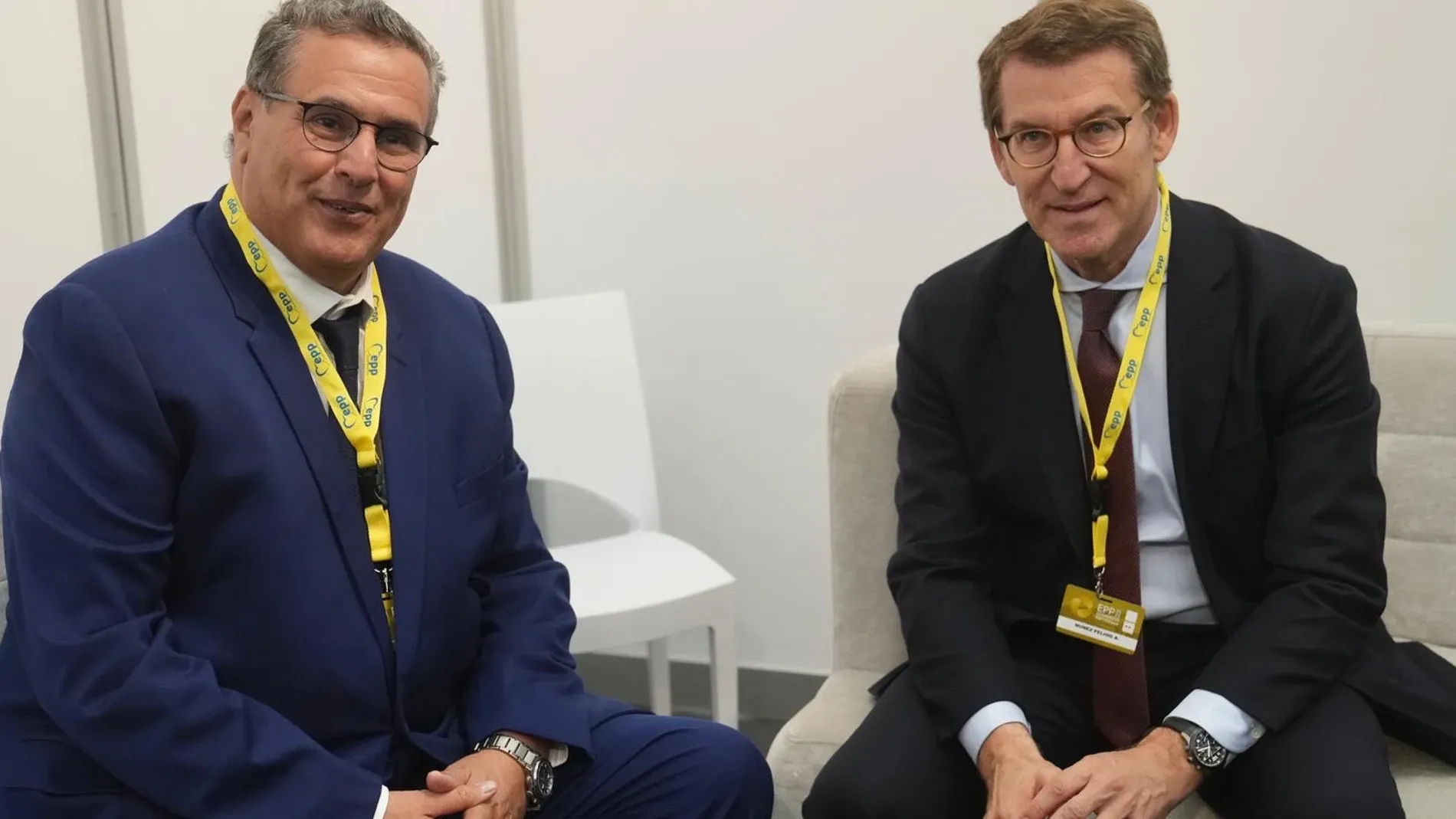

Shortly after being elected as the national leader of the Popular Party, **Alberto Núñez Feijóo** received an invitation to visit Morocco. This invitation took place in Rotterdam, Netherlands, during May 2022, coinciding with a European PP congress. During this event, Feijóo had the opportunity for a bilateral meeting with Moroccan Prime Minister **Aziz Ajanuch**, who proposed organizing a visit to Rabat to deepen bilateral relations. Feijóo accepted the proposal with enthusiasm; however, time passed, and he never made the journey to the neighboring country. The reasons for this remain known only to him. Nevertheless, he utilized his conversation with Ajanuch to commit, in the event of reaching the Moncloa, to uphold a relationship of “neighborhood and loyalty with Morocco and to implement a reliable foreign policy where any agreement would be executed transparently, be sustainable, and seek parliamentary consensus.”
Years later, in the summer of 2025, Feijóo shared a pivotal aspect of his first and only face-to-face conversation with the Moroccan leader. When Ajanuch asked him about his potential stance from Moncloa regarding Western Sahara, Feijóo offered a lengthy evasion. He stated, “You see, there is a basic principle in my political conduct, which is not to lie. If you want me not to deceive you, I can only respond one way: I do not know what I must do, what commitments I have to maintain, as those commitments are not known in Spain. Therefore, Prime Minister, do not ask me to commit to fulfilling a commitment of which I am unaware of its content and scope. Unless you wish to explain it to me, and I understand that you are not obliged to explain anything to me, nor do I ask for any explanation.”
The Delicate Balance of Relations with Morocco
Feijóo recounted that this was how “the meeting” concluded with Ajanuch—leaving an ambiguity that remains untouched to this day. The Popular Party (PP) is keen to avoid antagonizing their neighbor in North Africa. Even now, following accusations regarding Morocco's culpability in the “invasion” that occurred on July 30, they maintain a desire to nurture ties. Recently, the message from the Popular Party regarding Morocco has shifted significantly. Initially, their approach revolved around confrontation and criticism, but they have now begun to directly address the regime, issuing stern warnings.
This week, during the absence of **Margarita Robles** in the Senate, the popular defense spokesperson, **Fernando Gutiérrez Díaz de Otazu**, who previously served as the Commander General in Melilla, painted a clear picture of the situation in Ceuta, placing blame squarely on the neighboring country: “We are not facing a sporadic situation; we are witnessing the culmination of a series of concessions and unfriendliness promoted, tolerated, or deliberately ignored by Moroccan authorities in their harassment of normal life in the autonomous cities of Ceuta and Melilla.” Days later, Feijóo, during his second visit to Ceuta, aimed to express an unprecedented firmness towards Morocco, clarifying the principles that would guide a future relationship under his government. He stated, “My wish is to maintain the best possible relationship with Morocco—one of friendship and neighborhood.” However, he added, “This relationship of neighborhood must be based on two conditions that require no nuance: one is respect, and the other is reciprocity. The territorial integrity of Spain is not to be questioned, neither in Ceuta, nor Melilla, nor in Spanish waters. This is respect and reciprocity.”
Feijóo expressed his belief that the events at the Ceuta border on July 30 were an “instrumentalization” by Moroccan authorities, asserting, “Whether by action or omission, the movement of tens of thousands of people was facilitated.” He criticized the government for conducting years of secret diplomacy with Rabat, claiming that “today, Ceuta is the visible result of its foreign policy.” For Feijóo, the most alarming aspect is that Sánchez “has subcontracted the key to Europe’s southern border to the goodwill of Morocco,” a situation he deemed “unacceptable,” emphasizing that “the security of Europe cannot rely on a foreign nation,” especially one that manipulates its citizens for political gains.
During a press conference held on Wednesday from Ceuta, the Popular leader reiterated his longstanding desire to forge alliances with Morocco but underscored that “reciprocity is founded on mutual respect, loyalty, and trust. These are the principles.” He even articulated some of the harshest words directed at the Alawite regime, stating, “Spain does not seek enemies, does not seek conflicts, does not threaten anyone. **But Spain will not accept threats or blackmail.**” Feijóo clarified that he has “no interest in fostering any animosity” but acknowledged—referring to the Moroccan justice minister, who questioned the Spanish sovereignty over Ceuta and Melilla—that “there are statements that do not contribute positively to the relationship of loyalty, friendship, and trust.”
Despite the recent crisis at the border, Feijóo maintains that if elected president of Spain, his first institutional visit will be to Morocco. This practice, traditionally followed by all Spanish presidents since the advent of democracy, was altered when **Pedro Sánchez** took office, opting instead for a visit to France. A separate issue remains whether a government led by Feijóo would rectify the historical pivot Sánchez took regarding the sovereignty of Western Sahara. This uncertainty lingers over the PP, which has never definitively resolved the issue. However, it is evident that the party has consistently criticized that decision and has supported numerous resolutions in favor of **“international law”** in Parliament, positioning themselves to potentially revert to their original stance.
At the last national congress of the PP, held just over a year ago, Feijóo invited the representative of the Polisario Front in Spain, Abdullah Al-Arabi. This gesture significantly discomforted Morocco, prompting them to express their displeasure with the PP through sympathetic media outlets, which accused the party of maintaining a “hostile attitude” towards the regime, being “hypocritical,” and even “anti-Moroccan.” The Moroccan newspaper Goud even published an editorial stating, **“The PP is playing with fire.”** In the past, during the tenure of **José María Aznar**, Spain experienced its most significant diplomatic incident with Morocco involving the land invasion of the Perejil islet, resolved through military intervention. Since then, the Alawite regime has viewed the conservative party with suspicion. Despite Mariano Rajoy's time in Moncloa being devoid of significant tensions, the PP leadership today asserts that their obligation is to “get along with Morocco” for the simple reason that **“no one wants to have a bad relationship with their neighbor.”**
As reported by larazon.es.