
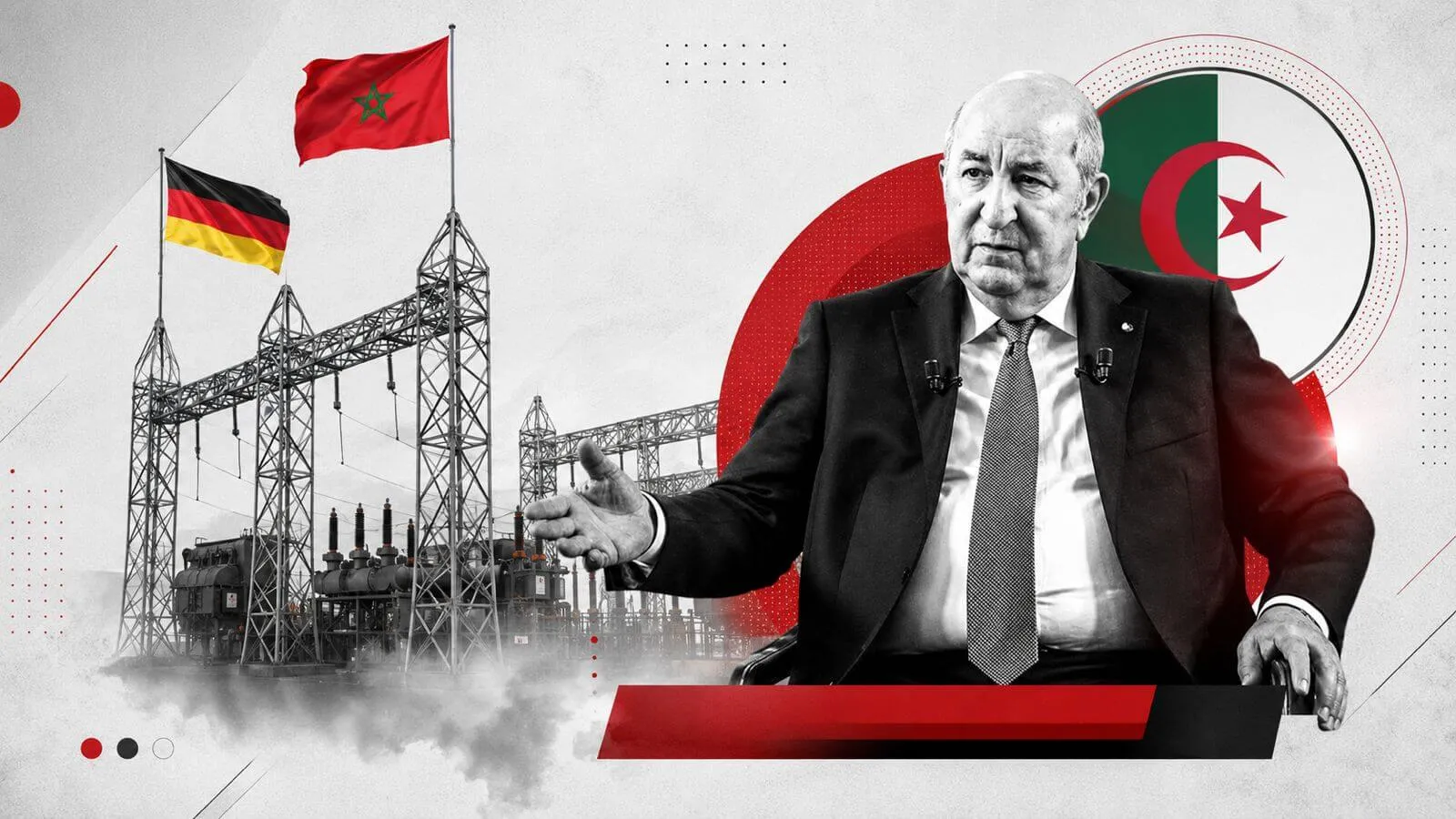

Recent data obtained by assahifa.com revealed that Algerian President Abdelmadjid Tebboune proposed a significant shift in a recent discussion with German officials in Berlin. He suggested that Algeria could serve as an alternative to Morocco in the ambitious "Sila Atlantic" project, which aims to transport renewable energy produced in North Africa to Germany via a transcontinental underwater cable.
According to well-informed German sources, Tebboune presented this proposal earnestly during his talks with German counterparts on July 16. He attempted to persuade them that Algeria possesses the necessary natural and technical conditions to generate electricity from both solar and wind sources, akin to the capabilities available in Morocco. The proposal included a suggestion to "ease the requirements" that Algeria might impose for the project's execution, contrasting with the stricter conditions set by Morocco. The Algerian president expressed his country's willingness to bear or finance a substantial portion of the project's costs.
The Algerian offer was portrayed as an opportunity for Germany to navigate current challenges, emphasizing the abundance of land, solar irradiance, and potential for renewable energy production in the Algerian desert. However, German officials primarily listened to the proposal without providing detailed feedback or committing politically or technically, leaving the door open for various possibilities.
Notably, the official statement following Tebboune's visit to Berlin did not mention the "Sila Atlantic" project or any potential substitution of Morocco with Algeria. It highlighted that energy, energy transition, and infrastructure were among the discussion topics, while reaffirming the significance of the German-Algerian partnership and the southern hydrogen corridor project.
This development comes on the heels of a report by Reuters detailing the challenges confronting the Morocco-Germany electrical interconnection project, which is estimated to cost around $30 billion. The report cited disagreements primarily focused on project structuring and long-term political and legal guarantees, rather than the project's technical feasibility. Morocco insists on signing an official government agreement with Berlin to ensure clear sovereign support for the project and its long-term sustainability. Additionally, Morocco seeks to allow the cable to enable bi-directional electricity flow, rather than solely exporting Moroccan energy to the German market.
According to Reuters, Moroccan authorities had pledged to allocate approximately 150,000 hectares in the Guelmim-Oued Noun region for the previous UK project but have yet to approve the same area for "Sila Atlantic." In contrast, the company involved in the project confirmed its progress in accordance with its technical, commercial, organizational, and financial roadmap, indicating ongoing negotiations and unresolved conditions rather than a final decision to cancel the project.
The "Sila Atlantic" initiative plans to establish two high-voltage submarine cables stretching nearly 4,800 kilometers, with a total capacity of 3.6 gigawatts, fed by solar and wind facilities in Morocco potentially generating up to 15 gigawatts, alongside electricity storage systems. Developers estimate that the project could supply about 26 terawatt-hours annually, equating to roughly 5% of Germany's electricity consumption, capable of providing clean energy for more than 20 hours a day through a combination of solar, wind, and storage.
Originally conceived as part of a UK project named "X Links," which aimed to transmit clean electricity from the Tan-Tan region to Britain via a 4,000-kilometer underwater cable, the UK government decided in June 2025 not to proceed with granting a long-term price guarantee for the project, thereby losing a guaranteed sales pathway in the British market. Subsequently, a new German company was established to develop the "Sila Atlantic" project, directly connecting Morocco to Germany, with "X Links" joining the group of supporting investors. Despite the current setbacks, there are no official indications that Berlin has abandoned the Moroccan option.
In February, German State Secretary for Economic Affairs Frank Witzel expressed in a letter to Moroccan Investment Minister Karim Zidan Germany's interest in the project and its readiness to continue discussions. The project was also included in exploratory phases within the planning of the long-term European electricity transmission network.
Available data indicates that the Algerian proposal comes at a critical juncture, coinciding with revealed disputes over arrangements and guarantees between Rabat and Berlin. Moreover, Algeria already possesses a framework for energy cooperation with Germany encompassing gas, green hydrogen, and the southern hydrogen corridor, providing a political backdrop for Tebboune's suggestion that Berlin may consider, even though no public stance has yet been made regarding replacing Morocco with Algeria.
However, substituting Morocco with Algeria would not merely involve relocating production sites. The current design is linked to Moroccan locations, a clearly defined maritime route, technical and regulatory studies, as well as land requirements and network connections, along with investor conditions. Thus, transferring the project to Algeria could necessitate a complete redesign, remapping, and re-financing from the outset, a conclusion drawn from the inherent nature of the announced project rather than an official position from the company or the German government.
Conversely, Morocco's conditions reflect a desire to ensure that the project does not transform into a unilateral channel for electricity export but rather serves as a strategic infrastructure that allows the kingdom to benefit from the interconnection when needed, framed by a government agreement that protects it from shifts in governments or European policies.
Amid the generous Algerian offer and Morocco's insistence on economic viability guarantees through mutual flow, Germany's decision remains open, as renewable energy has become a new arena for geopolitical competition between Rabat and Algiers in the race to become Europe's closest green partner.

