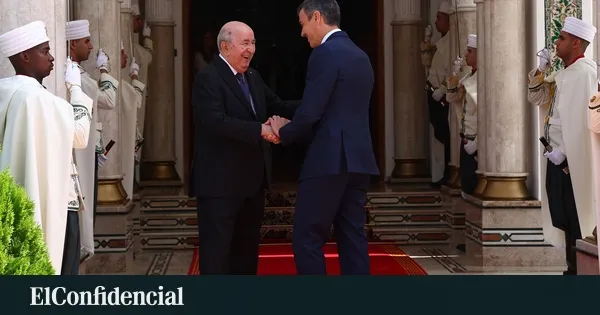

The Algerian head of state, Abdelmadjid Tebboune, is set to make his inaugural visit to Spain at the end of October, following an invitation from President Pedro Sánchez. This visit marks a significant diplomatic milestone, as it will be the first time in 16 years that an Algerian president travels to Spain. Sources from both Spain and Algeria, along with the French bulletin "Africa Intelligence," have confirmed this upcoming meeting.
Tebboune's visit is poised to intensify existing tensions with Morocco, a country with which Algeria's diplomatic relations have already soured following a significant influx of migrants into Ceuta. Despite Sánchez's attempts to absolve Moroccan authorities from responsibility for the migration crisis that overwhelmed the city, there remains an underlying apprehension towards Morocco, particularly within segments of the Spanish government, although this sentiment is rarely vocalized.
In addition to this visit, there are two other initiatives that could further strain relations between the two neighboring countries: the approval of legislation that will allow many Sahrawis to obtain Spanish nationality, and the anticipated visit of King Felipe VI to Ceuta, as announced by Sánchez for the "coming weeks." This context hints at a complex web of diplomatic interactions that could redefine the regional landscape.
During his upcoming trip, Tebboune will lead an Algerian ministerial delegation to Madrid for a High-Level Meeting, marking the first summit between the two governments since 2018. Traditionally, such meetings are spearheaded by the prime ministers; however, Sánchez has encouraged Tebboune to take the lead in Madrid, where he will also have an audience with King Felipe VI.
When questioned about Tebboune's visit, the Spanish Secretary of State for Communication responded that the information regarding the Algerian president's presence in Madrid was "not correct." The official emphasized that the summit would occur at the level of prime ministers, adhering to standard diplomatic protocol. Notably, Algerian President Abdelaziz Bouteflika attended similar meetings in Madrid in 2005 and 2010, as documented by the Government Presidency's official website.
Sánchez's brief visit to Algeria on July 20 resulted in a mutual agreement with Tebboune to revitalize government summits. From Spain's perspective, there is a strong interest in deepening energy relations, particularly concerning gas supplies, which have seen a staggering 125% price increase over the past year. In 2025, Algeria emerged as Spain's primary gas supplier, surpassing the United States.
On the Algerian side, the motivations for this diplomatic engagement are largely political. The ongoing crisis with France since the summer of 2024 has prompted Algeria to reassess its diplomatic strategies, particularly in light of Sánchez's 2022 support for Morocco's autonomy plan concerning the Western Sahara conflict. While Italy remains Algeria's closest ally in the Mediterranean, Spain is swiftly becoming the second.
The developments surrounding Ceuta have been closely monitored in Algeria, with local media expressing strong criticism of Morocco, its perennial adversary, while refraining from condemning the Spanish government's stance on the immigration issue. Amar Belani, a former Secretary-General of Algeria's Ministry of Foreign Affairs, is one of the few who has publicly criticized Spain's perceived evasive diplomacy. He argues that Spain's fear of Moroccan reprisals—whether at its borders, regarding security, or in terms of internal stability—leads it to prioritize appeasement over confrontation.
Additionally, the proposed law granting Spanish nationality to Sahrawis born under Spanish administration has gained significant attention in Moroccan media, eliciting unusual criticism directed at Sánchez. Hassan Alaoui, director of the pro-government "Maroc Diplomatique," described the move as an "act of covert hostility towards Morocco," suggesting it embodies a colonial perspective reminiscent of Spain's past, particularly during Franco's regime.
From Morocco's viewpoint, the legislative recognition of the legal ties binding the Sahrawi population to Spain could be interpreted as a revival of Spain's colonial dimension in the Sahara, especially at a time when Rabat perceives that Madrid has already established its political stance by supporting Morocco's autonomy proposal. This law, in the context of the Ceuta crisis, could serve as a new source of discord amid broader trust issues between the two nations.
Furthermore, the impending visit from the Spanish royals to Ceuta and Melilla, mentioned by King Felipe VI during a recent phone call with the president of Ceuta, has provoked significant backlash in Moroccan media. Samir Bennis of Media24 described a potential visit by the Spanish king as a "serious imprudence," while Yahya Yahya, a former president of the now-defunct committee for the liberation of Ceuta and Melilla, has labeled the royal visit as a provocation.
History shows that the last visit by Spanish royals to these autonomous cities occurred 19 years ago, when King Juan Carlos and Queen Sofía traveled there amid a cordial Spanish-Moroccan relationship. However, the then Moroccan Prime Minister Abbas el Fassi publicly requested the royal couple to cancel their visit. Despite this, the royals persisted, prompting a reaction from King Mohamed VI, who lamented the visit and recalled his ambassador from Spain, leading to a temporary diplomatic crisis.
Despite the potential for renewed tensions, the relationship between Spain and Morocco under King Felipe VI is not as strained as it could be, indicating that while challenges loom, avenues for dialogue and diplomacy remain open.
As reported by elconfidencial.com.