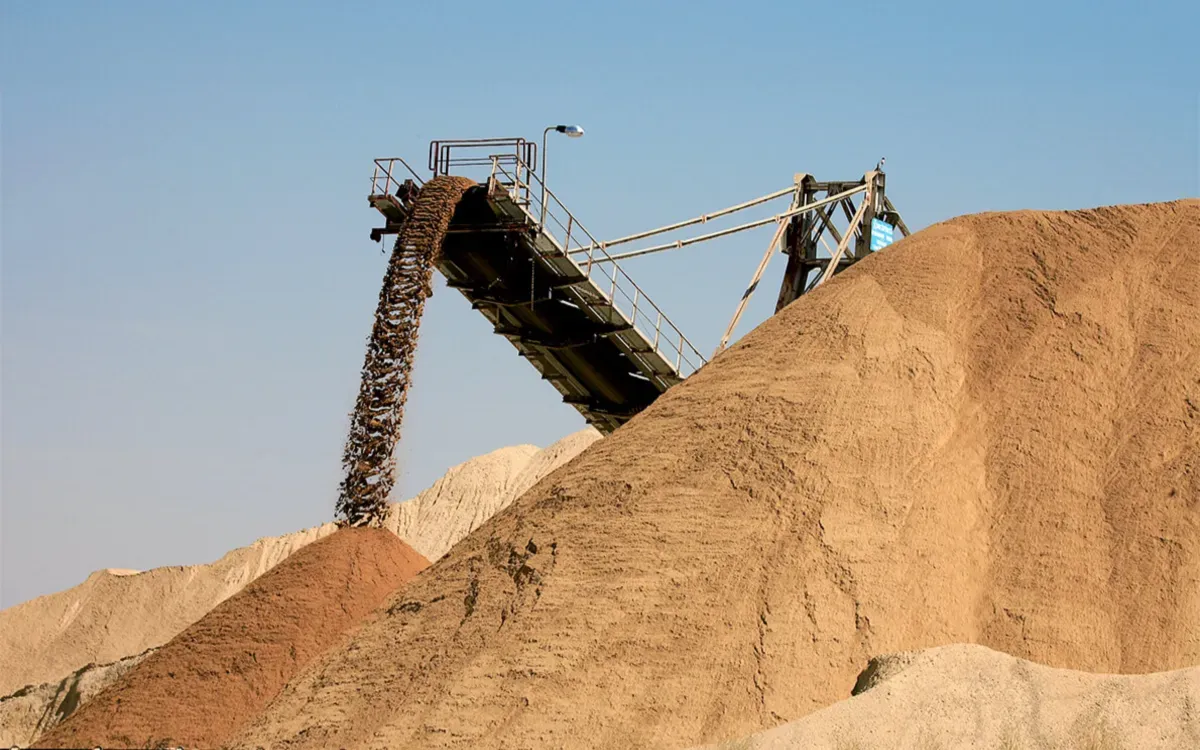

The Bled El Hadba project in Algeria is being presented as a potential threat to Morocco's phosphate industry, boasting an ambitious plan to produce 2.4 million tonnes of phosphate fertilizers annually. Currently, the Moroccan firm OCP (Office Chérifien des Phosphates) has a production capacity of 15 million tonnes and aims to expand that to 20 million tonnes by 2027.
TSA has characterized the integrated Algerian phosphate complex as a potential harm to Morocco's economy; however, this assertion comes not from the Algerian government but from an economist's analysis featured by the media outlet. The project is indeed real. According to data released by Sonatrach, the first phase of the project aims to extract 5.5 million tonnes of raw phosphate per year, produce 3.2 million tonnes in concentrated form, and manufacture 2.4 million tonnes of phosphate fertilizers. Additionally, a urea unit capable of producing 570,000 tonnes has also been planned.
To accurately assess the competitive landscape with Morocco, it is crucial to compare fertilizer production capacities rather than raw phosphate extraction volumes. Currently, OCP's production capacity stands at 15 million tonnes of plant nutrition solutions, with plans to increase this to 20 million tonnes by 2027 as part of a 130 billion dirham investment program. Therefore, even at maximum capacity, the first phase of the Algerian project will remain more than six times lower than OCP's current capacity and over eight times lower than the Moroccan group's target for 2027.
The emergence of Algeria in the phosphate market could enhance competition in certain regions, particularly in Africa and the Mediterranean. However, it does not pose an immediate threat to OCP's industrial standing, which is supported by several processing platforms, an extensive international commercial network, and ongoing production capacity expansions in Morocco.
Contractual Uncertainties Surrounding the Project
Another significant caveat arises from official documents regarding the project. Sonatrach describes the agreement with Saipem as an EPC contract for processing and production facilities. However, the Italian company clarified in a press release dated August 12 that it has only signed a limited notice to proceed, valued at approximately 500 million euros. This limited authorization includes detailed studies, equipment orders that require long lead times, and preliminary mobilization. Saipem explicitly states that the complete EPC contract is still under negotiation and finalization.
Moreover, the timeline for 2027 needs clarification. An official announcement from the APS agency indicates that phosphate exports from Bled El Hadba are expected to begin in March 2027, although it does not guarantee that the complex will produce 2.4 million tonnes of phosphate fertilizers by that date. Caution is warranted, especially since this project was initially announced in 2018, with an estimated investment of six billion dollars and a planned operational date of 2022, which has since been missed.
Additionally, TSA has raised concerns regarding the cadmium content in Moroccan phosphate. OCP claims that its fertilizers shipped to the European Union have been below the 20 milligrams per kilogram threshold since 2025, compared to a European limit of 60 milligrams. However, Brussels acknowledges that it lacks a systematic control mechanism to independently verify all relevant volumes.
With its reserves and plans for an integrated complex, Algeria has the potential to become a significant player in the fertilizer market. Yet, the current figures do not support the notion that it will be able to 'harm' Morocco by 2027. The announced capacity remains significantly lower than that of OCP, and both the definitive industrial contract and the operational timeline still need to be secured. As reported by bladi.net.