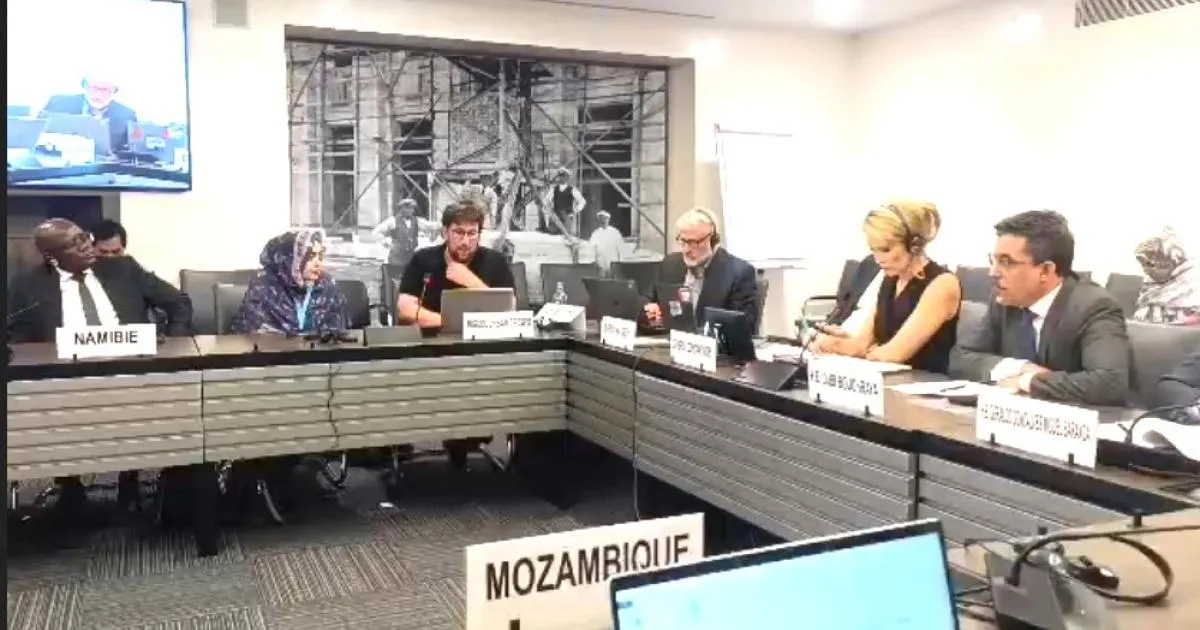

On September 6, 2026, at a pivotal Side-Event focusing on climate justice and human rights, Ambassador Ubbi Bouchraia Bachir, the Special Adviser to the President of the Sahrawi Republic and the Head of the Working Group on Natural Resources and Related Legal Matters, articulated the critical stance of the Sahrawi people regarding renewable energy projects in the occupied territories of Western Sahara. He emphasized that any development in these territories cannot ignore the legal and political intricacies surrounding their status. The Ambassador clarified that while the Sahrawi people are not opposed to renewable energy per se, they firmly reject its exploitation as a means of perpetuating occupation and denying their inalienable right to self-determination.
During his concluding remarks, Ambassador Bachir underscored that the mere installation of renewable energy infrastructure—like wind turbines or solar panels—does not legitimize the ongoing occupation nor does it create a sustainable path forward for the Sahrawi people. He pointed out that Western Sahara continues to be classified as a Non-Self-Governing Territory by the United Nations, and the process of decolonization remains incomplete with the final status of the territory yet to be resolved. Importantly, he stressed that the Sahrawi people have not yet exercised their right to self-determination, which should form the foundation for any discussion surrounding the territory's resources and economic development.
Ambassador Bachir referred to the 1975 Advisory Opinion from the International Court of Justice, which did not acknowledge Moroccan sovereignty over Western Sahara. Instead, it highlighted the absence of any territorial sovereignty that could override the principle of self-determination for the Sahrawi people. The Ambassador's remarks also included references to the UN Charter, particularly Article 73, which underscores the rights of colonial peoples to self-determination and independence. He reiterated that these foundational principles remain applicable, regardless of whether the resource in question is derived from wind or sunlight.
Furthermore, he addressed the long-standing exploitation of Western Sahara’s natural resources by Morocco, including phosphates and fisheries, and more recently, the intensified development of renewable resources. He made it clear that transitioning from phosphate extraction to renewable energy does not resolve the fundamental legal question of who rightfully controls the territory's resources. Unilaterally made decisions by Moroccan authorities, particularly in collaboration with foreign companies, are not acceptable, as they do not reflect the legitimate consent of the Sahrawi people.
Ambassador Bachir highlighted the legal opinion provided by the UN Legal Counsel in 2002, which asserted that any contracts with foreign companies regarding natural resource exploitation in Western Sahara would violate international law if conducted without considering the interests of the Sahrawi people. He firmly stated that economic development in the territory cannot be dissociated from the Sahrawi people's rights to determine their future. He advocated for the European Union's role in reinforcing this principle, citing landmark rulings from the Court of Justice of the European Union that have consistently rejected the automatic extension of EU-Morocco agreements to encompass the territory of Western Sahara.
In his remarks, he cautioned against the notion that renewable energy projects should be exempt from the principles of consent and decolonization. He challenged the rationale that climate objectives should be utilized to bypass these essential principles. The Ambassador criticized Morocco’s efforts to frame occupied Western Sahara as a model for green energy development, arguing that such initiatives serve to solidify Moroccan control rather than facilitate genuine sustainable development.
Concluding his intervention, Ambassador Bachir reiterated that climate justice must encompass human rights and the right to self-determination. He called on international companies and investors to refrain from becoming instruments of occupation, urging them to recognize that approval from Moroccan authorities does not equate to consent from the Sahrawi people. He emphasized that the pursuit of renewable energy should not come at the expense of the Sahrawi people's fundamental rights and that any development must respect their status and right to self-determination.
As reported by spsrasd.info.