

As Morocco prepares to unveil its inaugural official pavilion at the prestigious Venice Biennale, artist Amina Agueznay is set to immerse visitors in the rich tapestry of ancestral crafts through a monumental contemporary installation. For more than two decades, Agueznay, who transitioned from architect to artist, has dedicated her efforts to illuminating Morocco's diverse heritage crafts. She has collaborated with countless artisans across the country, from urban centers like Casablanca to the remote villages nestled within the Atlas Mountains, with the aim of preserving and evolving traditional handicraft techniques for modern contexts.
This May, Agueznay will showcase her work at the Venice Biennale of Art, highlighting Morocco's first official pavilion located at the Arsenale. The installation, named ‘Asǝṭṭa’—a term derived from the Amazigh language meaning ritual weaving—promises to transport attendees into the heart of Morocco's artisan community, offering both a visual and spiritual experience.
Under the curation of Meriem Berrada, the pavilion explores themes of craftsmanship transmission, collective memory, and the unique stories and symbols that define Moroccan artistry. This exhibition resonates deeply with the overarching theme of the Biennale, ‘In Minor Keys,’ curated posthumously by Koyo Kouoh, which aims to spotlight subtle narratives, quiet practices, and the enduring legacies passed down through generations.
Berrada reflects on the significance of ‘Asǝṭṭa,’ stating, “This installation honors the often-overlooked talents who are the guardians of time-honored skills. They are not merely peripheral figures but pivotal resources in a living transmission space where artisanal creation is viewed as a dynamic language and thought in action.” The installation represents an evolving archaeology of gestures that have been passed down, reshaped, and celebrated, continuing to influence new artistic expressions derived from ancestral heritage.
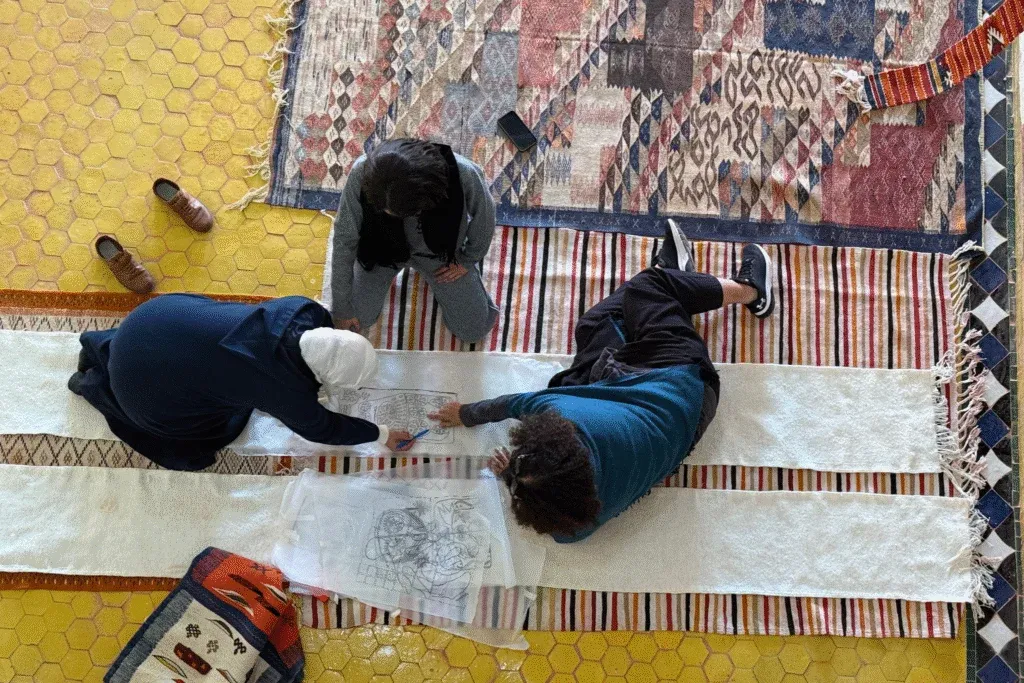
Agueznay's architectural background profoundly influences her artistic endeavors, allowing her to manipulate scale, engage with negative space, and approach materials as fundamental building blocks with limitless potential. Her work for the pavilion exemplifies this philosophy by layering various artisanal crafts, creating a comprehensive catalog of the innovative craft experiments she has undertaken. The installation, styled as an enormous loom, features nearly 200 woven textile banners or ‘bands’ that act as enlarged threads, a testament to the collaborative efforts of 160 artisans guided by Agueznay’s experimental vision.
Expressing the essence of her collaboration, Agueznay remarks, “I worked with artisans I have known for years, which holds great significance for me. At the Biennale, you will notice entire walls created by individual artisans.” She emphasizes the importance of exchange in the creative process, where knowledge flows both ways, allowing for deconstruction and exploration of new forms—such as transforming traditional basket weaving into larger scale pieces like bracelets and necklaces.
The banners were meticulously crafted one at a time, following the rigorous standards of master artisans who can weave bands measuring 30 cm in width and 7 meters in length. This dedication to craftsmanship will be prominently featured in the Biennale, where the expansive 300-square-meter room in the Arsenale will be adorned with these 30 cm wide banners, extending to 450 cm in length to suit the space. Each band will showcase a variety of interventions, including silver jewelry, raffia embroidery, crocheted elements, and intricate eye-symbols woven into 2D frames.
Agueznay also seeks to honor the ancient connections between Morocco and Venice, allowing the installation to echo the historical walls of the Arsenale. The earthy browns, ochers, and reds found within the installation are inspired by the brickwork of the venue, with assistance from color experts and master dyers from Morocco who meticulously stained the wool and textiles in specific shades.
During her research, Agueznay discovered that the name ‘Arsenale’ originates from the Arabic term ‘Dar Al Sinaa,’ meaning a house of craft or workshop. This revelation struck her as serendipitous, especially since Dar Al Sinaa is the name of a craft cooperative she has previously collaborated with, now participating in the Biennale project.
The installation aims to serve as a ‘second skin’ for the pavilion walls, creating negative spaces where viewers can encounter unexpected elements—a video installation, a soundscape, or a serene resting spot—interspersed among the bands.
Moreover, the installation engages with the concept of thresholds, or ‘aataba’ in Arabic, symbolizing transitions between the exterior and interior realms, the private and public spheres. These beautifully adorned thresholds, inspired by traditional Moroccan architecture, signify more than mere physical boundaries; they embody a deeper notion that Agueznay has woven into the fabric of her Venice showcase.
“As visitors navigate these thresholds, they may stumble upon beaded representations of lions, scorpions, or other creatures,” Agueznay explains. “Once the installation is set up in the Arsenale, we will distribute these beaded figures to the team and set designers, allowing them to place them throughout the installation, thereby adding their unique touches to the work.”
Agueznay envisions that even those who may not possess a strong interest in crafts will resonate with the palpable energy of the space, leaving them feeling intrigued and revitalized. The pavilion reimagines Moroccan heritage crafts not as static relics of the past but as a dynamic, evolving language that continues to narrate stories in innovative ways.
As reported by arabianbusiness.com.

