
Revolutionary Discoveries at Oued Beht, Morocco
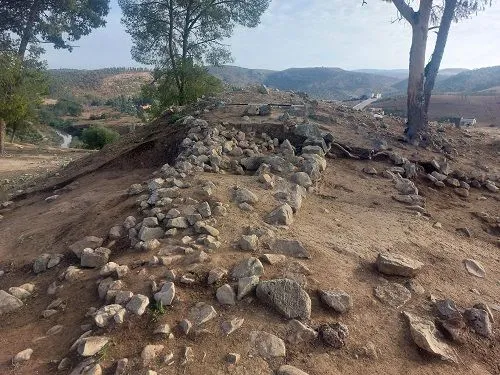
Recent archaeological excavations at Oued Beht in northwestern Morocco have unearthed an extraordinary ditch-and-rampart defensive system, believed to date back between 3,500 and 4,000 years. This significant finding was made during the third excavation season of the Oued Beht Archaeological Project (OBAP) and is intricately tied to an international collaboration involving the National Research Council of Italy (CNR) and several prestigious academic institutions. The results of this extensive research have been documented in the esteemed journal Libyan Studies.
The newly discovered structure represents the oldest known defensive mechanism in North Africa beyond the Nile Valley, illustrating the advanced capabilities of communities in the region during the second millennium BC. According to Giulio Lucarini, an archaeologist affiliated with CNR ISPC and ISMEO, Oued Beht has been a focal point for researchers since 2021, when an expansive settlement encompassing approximately ten hectares was identified. This settlement, situated on a ridge overlooking its namesake river, thrived during the mid-fourth to early third millennium BC, showcasing a community engaged in agriculture, livestock management, and trade networks extending to the Iberian Peninsula.
Unraveling Historical Mysteries
The recent excavation efforts have addressed a long-standing archaeological enigma concerning the dating and function of the defensive structures that encapsulate a large quadrangular area at the site. Beneath the visible stone masonry, archaeologists have identified a substantial ditch and rampart that dates back to the early to mid-second millennium BC. This remarkable structure, strategically designed to block access to the southern end of the settlement, utilized the natural topography of the ridge to enhance its defensive capabilities. The discovery of seventeen new radiocarbon dates has further allowed researchers to reconstruct the chronological development of the site, revealing that the communities in northwestern Maghreb were indeed proficient in executing extensive construction projects that had not been previously documented.
The scale of this complex defensive system indicates significant planning, organization, and collective effort, reflecting a socially intricate community capable of structuring its environment in accordance with specific needs and strategic imperatives. Over time, the settlement's core appears to have migrated from the more exposed northern area towards the more defensible rocky spur in the south.
Moreover, this new evidence enhances our understanding of Oued Beht's potential interactions with neighboring regions. Notably, during the same period, communities in southern Iberia, such as those at El Argar, were establishing fortified settlements and advancing in metallurgical practices, thereby developing increasingly complex social structures. The later construction of a formidable medieval stone wall atop the earlier rampart, along with the finding of a cemetery from the same era, further documents the site’s reoccupation and sheds light on the history of rural communities in medieval Maghreb.
This significant archaeological project is conducted in partnership with Morocco’s Ministry of Youth, Culture, and Communication, as well as the local Aït Siberne community in Khémisset. It is supported by various funding entities, including the CNR, the Italian Ministry of Foreign Affairs and International Cooperation (MAECI), and the University of Cambridge.
As reported by cnr.it.