
The Power of Diversity in Morocco and Greece
André Azoulay, advisor to King Mohammed VI, emphasized the rich cultural heritage of Morocco and Greece, stating that both nations have historically transformed their diversity into a source of strength and have created a shared memory that serves as a bridge to the future. This assertion was made during his speech at an international seminar titled "Dialogue of Civilizations" held in Athens, Greece on Wednesday, May 20, 2026. Azoulay noted the event's profound symbolism, as Athens is deeply associated with philosophy, democracy, and the human quest for meaning. He stressed that this gathering goes beyond mere diplomatic or academic dimensions; it represents a meeting of two ancient civilizations that have, in their unique ways, taught the Mediterranean region how diversity can be a powerful asset.
Shared Histories and Modern Challenges
During his address, Azoulay highlighted that Morocco and Greece have, over the centuries, fostered open spaces for dialogue and exchange across their seas. He pointed out that the Mediterranean Sea was not historically a dividing line between peoples but rather a vibrant space that connects cultures, religions, and human imaginations. In light of current global challenges, he articulated that today’s world is characterized by fragmentation, fear, and isolation, which calls for a collective responsibility to revive the idea of coexistence. He underscored that this vision is embodied by King Mohammed VI, who represents a Morocco faithful to its plural identity while remaining open to Africa, Europe, the Mediterranean region, and all cultural and spiritual traditions that have enriched its history.
Azoulay elucidated that Morocco’s uniqueness lies in viewing diversity as a "civilizational choice" rather than a challenge. He pointed out that Jewish, Islamic, Amazigh, Arab, African, Andalusian, and Mediterranean elements coexist within the Moroccan identity, contributing to a shared national narrative. Furthermore, he emphasized that preserving Jewish heritage in Morocco, restoring places of worship such as synagogues, churches, and mosques, and protecting spiritual diversity are not merely symbolic initiatives; they reflect a political, cultural, and humanitarian conviction that dignity and coexistence are inseparable values.
In discussing Greece, Azoulay noted that it too embodies a profound civilizational heritage that underscores the importance of dialogue, critical thought, and humanism as essential foundations for building peaceful societies. He mentioned that both nations share a "common Mediterranean message" that emphasizes the essence of civilizations not clashing when they know themselves well and respect one another. He warned that civilizations begin to retreat when they cease to listen, share knowledge, and imagine a common future.
Azoulay called for the Mediterranean Sea to once again become a "laboratory of hope," advocating for it to be a space of responsibility and closeness rather than division or fear. He noted the growing importance of cultural diplomacy and interfaith dialogue in this context, asserting that culture is not a luxury but a strategic choice, and memory is not merely nostalgia for the past but a powerful force capable of transformation. He concluded his speech by expressing gratitude to Greece, the Moroccan Embassy in Athens, and all partners and organizers who contributed to the success of the event. He hoped that Morocco and Athens would continue to remind the world that coexistence is not an abstract idea but a daily commitment that requires courage, intelligence, and generosity.
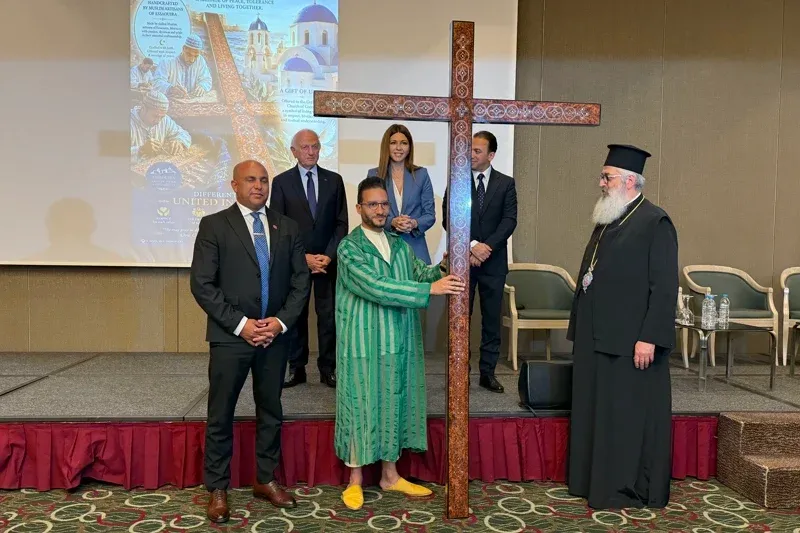
The event featured interventions from representatives of the three major religions, as well as the Greek Minister of Education and Sports. A wooden cross made from cedar, crafted by Moroccan artisans, was presented to the Orthodox Church during the gathering.
As reported by hespress.com.